

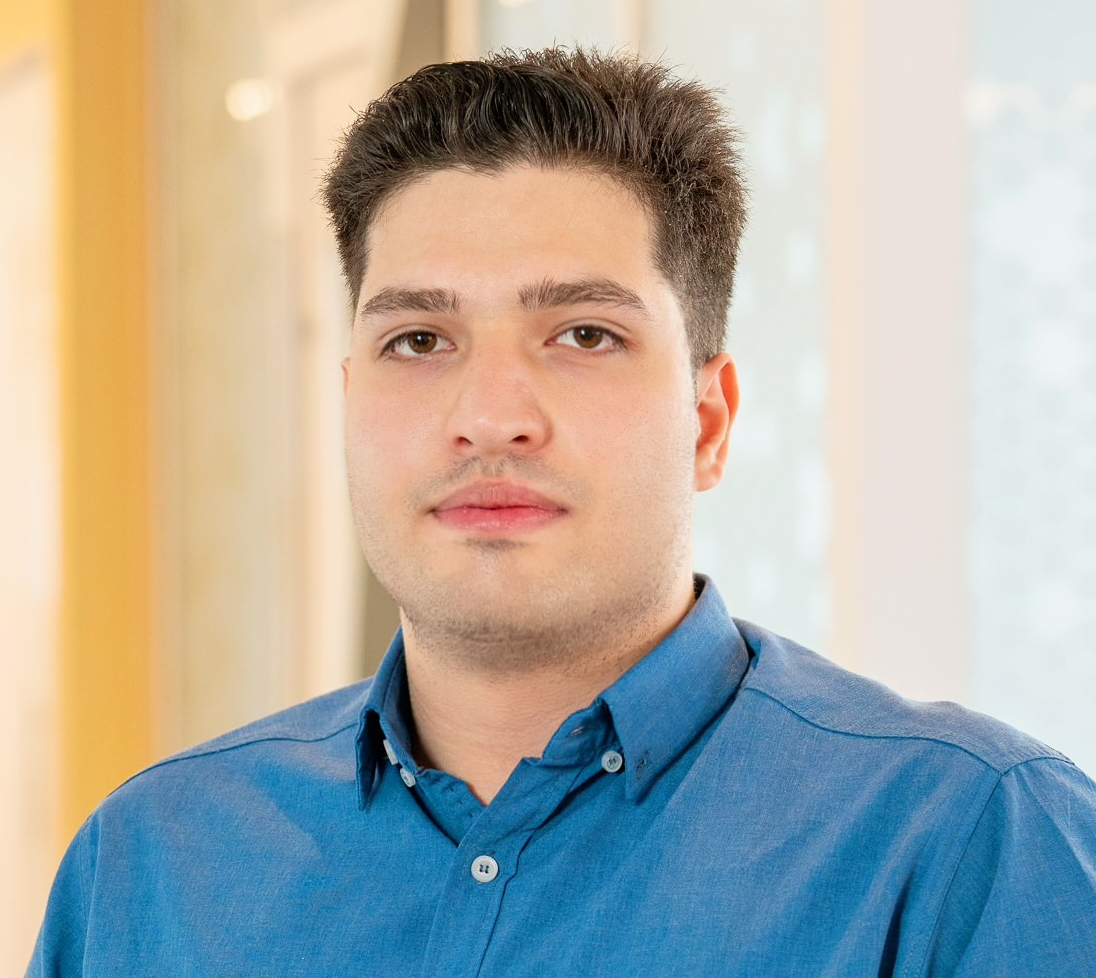
 Hafez Ghaemi
· 5 previous affiliations
- Researcher · 2023–2027
- Doctoral Researcher · Since 2023
- Université de MontréalSince 2023
- Doctor of Philosophy - PhD, Computer Science · 2023–2027
- Graduate Teaching Assistant · 2024
- Neuromatch2024
- Teaching Assistant · 2024
- University of Tehran2016–2023
- Graduate Research Assistant · 2022–2023
- MS student · 2020–2023
- Graduate Teaching Assistant · 2023
- Undergraduate Research Assistant · 2019–2020
- Undergrad student · 2016–2020
- Politecnico di Torino2020–2022
- MS student · 2020–2022
Research Overview
Hafez Ghaemi focuses on self-supervised learning, world modeling, and multi-agent reinforcement learning for perception and control. His trajectory spans early work in biologically plausible neural networks and brain-computer interfaces to recent advances in risk-sensitive decision making. Currently, he investigates invariant and equivariant representations to build robust, context-aware world models for task-agnostic control.
Research Trajectory
Ghaemi’s early research explored alternative neural architectures and the decoding of neural signals. In 2022, he investigated biologically plausible learning mechanisms with BioLCNet: Reward-modulated Locally Connected Spiking Neural Networks. This work proposed an architecture that avoids standard backpropagation and weight sharing, which do not correspond to mechanisms in the primate visual system. Instead, the network utilized a rate-coded input layer, spiking neurons, and reward-modulated spike-timing-dependent plasticity (R-STDP) to perform image classification.
Following this interest in neural processing, he contributed to the development of deep learning frameworks for brain-computer interfaces (BCIs). With Towards real-world BCI: CCSPNet, a compact subject-independent motor imagery framework, he helped introduce a system that dynamically learns spectral and spatial features for motor imagery. This compact framework provided an efficient solution for real-world applications, contributing to the broader research direction of Moving Beyond Binary Classification Frameworks. He subsequently synthesized the state of this field in Deep learning in motor imagery EEG signal decoding: A Systematic Review. By analyzing nearly 400 studies published between 2017 and 2023, this review mapped the dominant architectures, reliable datasets, and persistent challenges involved in translating brain waves into actionable commands.
Transitioning toward complex decision-making systems, Ghaemi’s focus expanded to multi-agent reinforcement learning (MARL) and the mathematical modeling of risk. In Risk-Sensitive Multi-Agent Reinforcement Learning in Network Aggregative Markov Games, he and his collaborators developed a distributed actor-critic algorithm that incorporates Cumulative Prospect Theory to model human-like risk preferences. This research demonstrated how agents with high loss aversion naturally adopt conservative strategies and tend toward "social isolation," providing a realistic framework for modeling economic and social systems. This work advanced the area of Time-Consistent Risk Measures for Sequential Decision Making. To further map this domain, he co-authored Risk Sensitivity in Markov Games and Multi-Agent Reinforcement Learning: A Systematic Review, which categorized how agents account for uncertainty and catastrophic losses rather than relying solely on risk-neutral expected returns. This comprehensive review bridged theoretical foundations with modern deep learning applications in finance and autonomous driving, touching upon research areas such as Non-Linear Probability Weighting for Risk-Aware Decision Models and Sample Efficiency in Zero-Sum Markov Games.
More recently, Ghaemi has concentrated on self-supervised learning and the construction of robust world models for artificial agents. In Seq-JEPA: Autoregressive Predictive Learning of Invariant-Equivariant World Models, he introduced a framework that processes sequences of actions and observations to naturally disentangle invariant and equivariant properties. Unlike previous methods that faced trade-offs between these representations, the seq-JEPA architecture proved highly effective for sequential reasoning tasks like path integration.
Building on the need for agents to adapt to complex, multi-task environments, he contributed to Context-Aware World Models for Task-Agnostic Control. This work argued for aligning an agent's inductive biases with environmental structures, enabling the separation of context-specific dynamics from shared global regularities to support better generalization. Continuing his investigation into representation learning, he explored the one-to-many mapping problem in Self-Supervised Learning from Structural Invariance. By introducing a variational distribution to model conditional uncertainty in the latent space and deriving a lower bound on pairwise mutual information, this research provided a more flexible approach to joint-embedding self-supervised learning for naturally occurring generative processes, such as successive video frames.
Current Directions
The most recent papers in the evidence indicate a strong focus on self-supervised learning and the development of advanced world models for perception and control. Ghaemi is currently investigating how to build representations that capture both the invariant and equivariant properties of environments without relying on explicit reconstruction. A major theme in his recent work is addressing the multi-task nature of realistic environments, specifically by designing context-aware architectures that can disentangle shared global dynamics from task-specific variations. Additionally, he is exploring probabilistic approaches to joint-embedding self-supervised learning, utilizing variational distributions to model the inherent uncertainty present in sequential data. Together, these efforts aim to create more adaptable, task-agnostic agents capable of robust sequential reasoning in complex environments.
Profile updated
Loading new papers…
Other researchers whose papers cluster into the same research directions — a proxy for overlapping technical interests and shared intellectual neighborhoods.
See something wrong? Report a mistake