

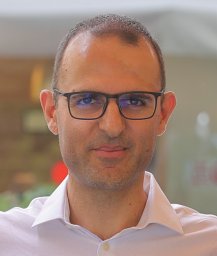
 Guy Lev
· 7 previous affiliations
- Intuit (United States)Since 2023
- Senior AI Scientist · Since 2023
- Piiano2022–2023
- Senior Machine Learning Researcher · 2022–2023
- IBM Research AI2015–2022
- Machine Learning Researcher · 2015–2022
- Researcher · 2015–2022
- Tel Aviv University2000–2015
- MS student · 2012–2015
- Undergrad student · 2000–2004
- Senior Software Engineer · 2012
- Broadlight2006–2012
- Software Engineer · 2006–2012
Research Overview
Guy Lev focuses on multimodal representation learning, natural language processing, and sequence modeling. His early work explored the integration of word embeddings with image representations using Fisher Vectors to bridge vision and language. More recently, his research has shifted toward sequence labeling and expressive text-to-speech synthesis using deep neural networks.
Research Trajectory
Lev’s early research centered on improving feature representations for computer vision and natural language processing, with a particular emphasis on Fisher Vectors and mixture models. In 2014, he co-authored Fisher Vectors Derived from Hybrid Gaussian-Laplacian Mixture Models for Image Annotation, which challenged the standard practice of relying solely on Gaussian Mixture Models (GMMs) for computing Fisher Vectors. By deriving Expectation-Maximization and Fisher Vector expressions for alternative distributions, including a Laplacian Mixture Model, the work demonstrated how tailored probabilistic models could improve image annotation pipelines.
The following year, Lev led research investigating the utility of unsupervised word embeddings for broader text representation. In In Defense of Word Embedding for Generic Text Representation, he demonstrated that standard word2vec representations—often considered insufficient for capturing the semantics of longer word sequences without complex architectures—could achieve highly competitive results when augmented with specific pooling techniques. This insight directly informed his subsequent collaborative work in vision-language modeling. In Associating neural word embeddings with deep image representations using Fisher Vectors, Lev and his colleagues successfully combined these two threads of research, pooling word2vec embeddings via Fisher Vectors to create robust sentence representations for image search and annotation tasks.
In 2016, Lev’s focus evolved to integrate these statistical representation techniques with deep learning architectures. As first author of RNN Fisher Vectors for Action Recognition and Image Annotation, he proposed using Recurrent Neural Networks (RNNs) as the generative probabilistic models for computing Fisher Vectors, utilizing backpropagation to extract partial derivatives. This methodology advanced the broader research direction of Feature Extraction through Model Parameter Gradients, shifting the focus from standard data attributes to representations based on how data affects a model's internal state. Furthermore, the paper demonstrated a surprising transfer learning capability from image annotation to video action recognition, touching upon challenges central to the area of Zero-Shot Video Intelligence from Static Image Pre-training.
By 2017, Lev’s trajectory moved increasingly toward sequence modeling for speech and language. As senior author on Joint Learning of Correlated Sequence Labeling Tasks Using Bidirectional Recurrent Neural Networks, he directed research into multi-task learning frameworks that leverage bidirectional RNNs to jointly optimize related sequence labeling problems. Continuing in the speech domain, he later participated as a co-author in Word Emphasis Prediction for Expressive Text to Speech (2018). This work utilized Deep Neural Networks to predict emphasized words, replacing hand-crafted features to generate more subjectively expressive prosody in modern Text-To-Speech (TTS) systems.
Current Directions
The most recent papers in the evidence, published between 2017 and 2018, indicate a shift in Lev’s focus toward advanced sequence modeling for speech and language applications. This recent work investigates the use of bidirectional recurrent neural networks for correlated sequence labeling and deep neural networks for expressive text-to-speech synthesis. These efforts align with subsequent broader themes in speech processing, such as the research direction of Overcoming the Specialized Vocabulary Gap in Speech Recognition and the area of Robust Natural Language Understanding for Noisy Speech Transcripts, reflecting an ongoing interest in making automated speech and language systems more resilient and expressive in complex domains.
Profile updated
Loading new papers…
Other researchers whose papers cluster into the same research directions — a proxy for overlapping technical interests and shared intellectual neighborhoods.
See something wrong? Report a mistake