

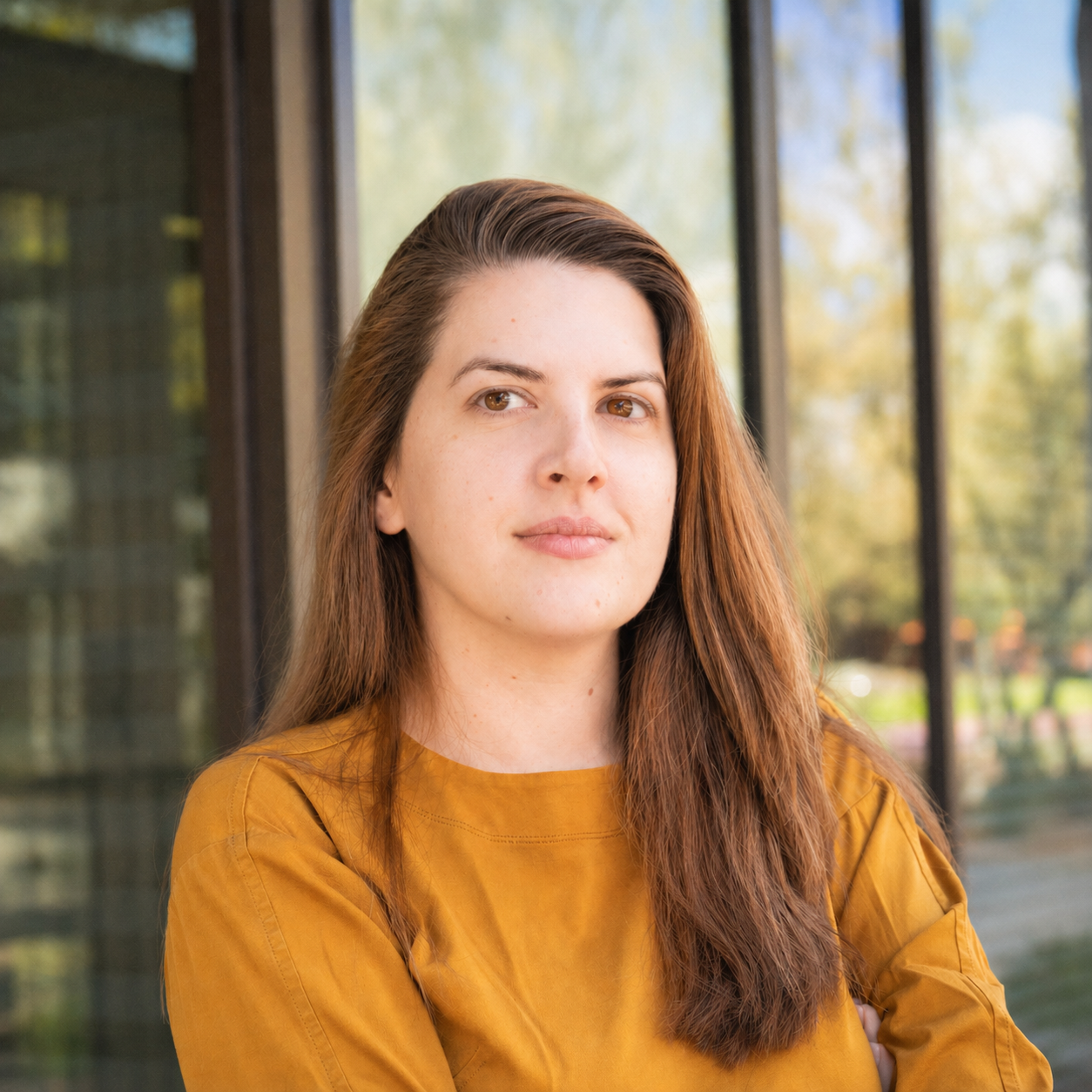
 Georgia Gkioxari
· 3 previous affiliations
- California Institute of TechnologySince 2023
- Assistant Professor · Since 2023
- Meta (United States)2016–2022
- Researcher · 2018–2022
- Postdoc · 2016–2018
- Graduate Student · 2010–2016
Research Overview
Georgia Gkioxari focuses on 2D and 3D visual perception, spatial reasoning, and the development of self-improving machine perception systems. Her trajectory spans foundational work in object detection and instance segmentation to embodied AI and 3D scene reconstruction. Currently, she investigates how vision-language models and agentic frameworks can acquire robust spatial understanding and continually refine their own reasoning capabilities.
Research Trajectory
Gkioxari’s early work concentrated on human pose and action recognition. She introduced a unified approach to person detection and keypoint prediction in Using k-Poselets for Detecting People and Localizing Their Keypoints, utilizing deformable part models to align configurations of keypoints. This was followed by Finding action tubes, which addressed action detection in videos by combining motion-salient region proposals with convolutional neural networks, contributing to the research direction of 3D Convolutions for Spatiotemporal Feature Learning.
A major progression in 2D perception involved her participation in developing Mask R-CNN, a flexible framework for object instance segmentation that simultaneously detects objects and generates high-quality segmentation masks. Building on human-centric visual understanding, she developed Detecting and Recognizing Human-Object Interactions. This research hypothesized that human appearance—such as pose and clothing—serves as a powerful cue for localizing interacted objects, advancing work in the area of Human Pose as a Spatial Prior for Object Localization.
Concurrently, her research expanded into active perception and embodied AI. She collaborated on Embodied Question Answering, introducing a task where agents navigate 3D environments to gather visual evidence and answer natural language questions. Furthering this trajectory, she contributed to Bayesian Relational Memory for Semantic Visual Navigation., which proposed a probabilistic relation graph over semantic entities to improve generalization in unseen environments. This work advanced the research directions of Semantically Guided Frontier Exploration for Embodied Agents and Decoupling Semantic Planning from Sensorimotor Control.
Bridging 2D recognition and 3D structure, she developed Mesh R-CNN, augmenting the Mask R-CNN architecture with a mesh prediction branch to output full 3D shapes of detected objects from real-world images. Recognizing the engineering bottlenecks in this domain, her group introduced Accelerating 3D Deep Learning with PyTorch3D, a library of differentiable operators that streamlined 3D deep learning research and provided tools for Overcoming Cubic Memory Scaling in 3D Deep Learning. Continuing to reduce reliance on expensive 3D ground truth, she proposed methods in Learning 3D Object Shape and Layout without 3D Supervision that rely solely on multi-view 2D supervision. This line of inquiry culminated in Multiview Compressive Coding for 3D Reconstruction, which leveraged self-supervised learning principles to infer 3D structures from single views.
Her expertise in representation learning has recently been applied to diverse data modalities. In time series analysis, her lab developed TOTEM: TOkenized Time Series EMbeddings for General Time Series Analysis, discretely tokenizing data to build generalist models. In bioimaging, she led the development of CellSAM: a foundation model for cell segmentation, adapting the Segment Anything Model to achieve robust performance across diverse cellular contexts. Returning to dynamic visual scenes, her group also introduced Is This Tracker On? A Benchmark Protocol for Dynamic Tracking to rigorously evaluate point tracking methods under real-world motion complexity.
Most recently, her focus has shifted toward enhancing the spatial reasoning capabilities of Vision-Language Models (VLMs) and agentic AI, directly addressing the broader area of The 2D to 3D Spatial Reasoning Gap. To improve fine-grained visual understanding, her lab introduced Same or Not? Enhancing Visual Perception in Vision-Language Models, utilizing reinforcement learning to teach instance-level discrimination. She also spearheaded Visual Agentic AI for Spatial Reasoning with a Dynamic API, a framework allowing LLM agents to dynamically generate Pythonic APIs for complex 3D queries. Further investigating the internal mechanics of these models, she collaborated on Linear Mechanisms for Spatiotemporal Reasoning in Vision Language Models, discovering "spatial IDs" that can be causally steered to alter a model's spatial beliefs. Finally, she co-developed No Labels, No Problem: Training Visual Reasoners with Multimodal Verifiers, a framework that trains visual reasoning models entirely without human labels by using larger models as critics.
Current Directions
The most recent papers in the evidence indicate a strong focus on bridging the gap between high-level semantic reasoning and grounded spatial understanding in multimodal models. Recent work investigates how Vision-Language Models and Large Language Models can be adapted to perform complex, fine-grained spatial reasoning without relying on massive human-annotated datasets. This includes developing agentic frameworks that dynamically synthesize their own tools and APIs to solve 3D queries, as well as utilizing larger models as automated verifiers to critique and refine the logic of smaller visual reasoners through reinforcement learning. Additionally, ongoing research explores the mechanistic interpretability of VLMs, identifying and causally steering internal representations of space and time to diagnose and improve model reliability.
Profile updated
Loading new papers…
Other researchers whose papers cluster into the same research directions — a proxy for overlapping technical interests and shared intellectual neighborhoods.
See something wrong? Report a mistake