

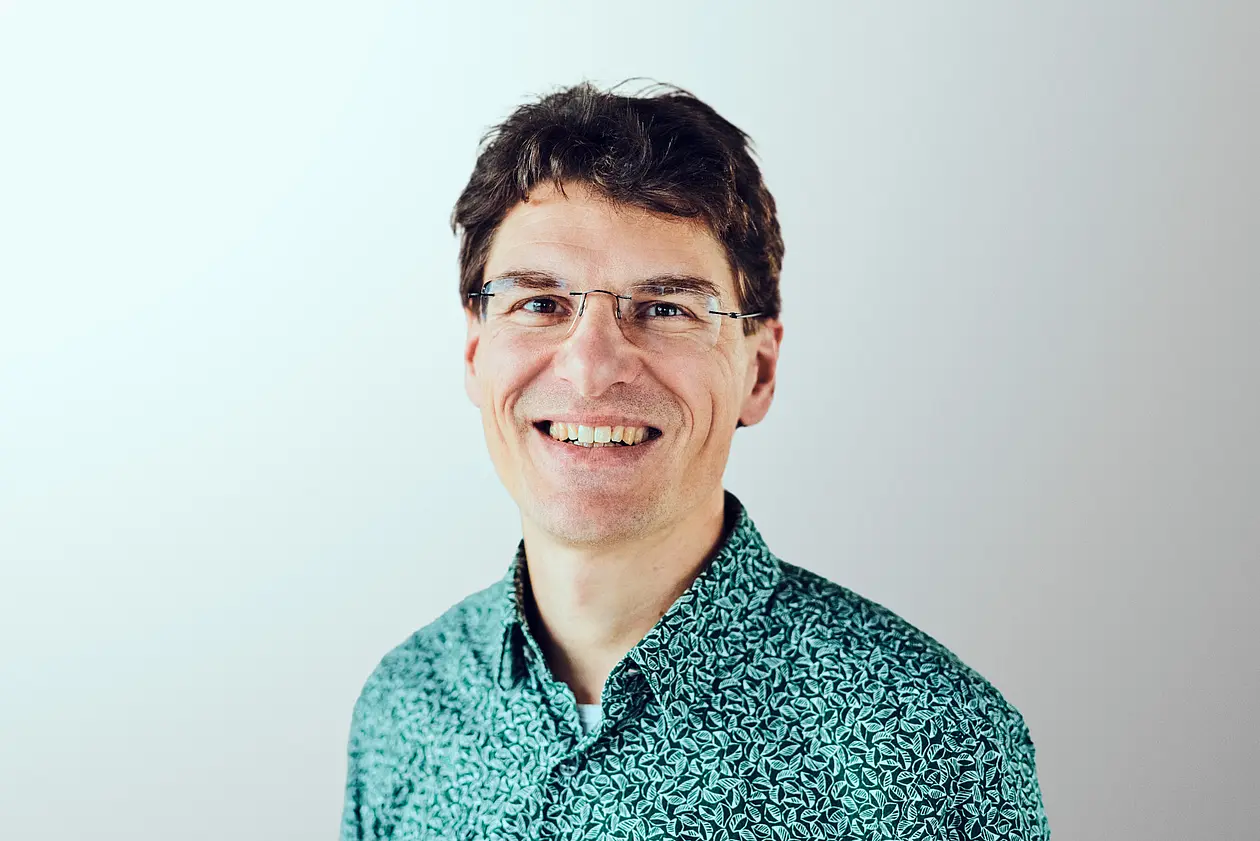
 Georg Martius
· 4 previous affiliations
- University of TübingenSince 2023
- Full Professor · Since 2023
- Research Sciientist · Since 2024
- Assistant Professor · 2017–2024
- Postdoc · 2014–2016
- Postdoc · 2010–2014
Research Overview
Georg Martius focuses on autonomous learning, embodied artificial intelligence, and the intersection of machine learning with physical systems. His trajectory spans early work in intrinsic motivation and sensorimotor self-organization to the development of interpretable neural networks and differentiable physics simulators. Currently, he investigates advanced robotic tactile sensing, offline reinforcement learning, and differentiable simulation for complex control tasks.
Research Trajectory
Martius's early research investigated how embodied agents can autonomously develop complex behaviors without predefined goals. In Information Driven Self-Organization of Complex Robotic Behaviors (2013), he introduced a method based on maximizing time-local predictive information, enabling high-dimensional robots to spontaneously discover coordinated movements like crawling and swinging. This contributed to the area of Bridging the Exteroceptive Sensing Gap in Robotic Locomotion. Building on biological mechanisms of self-organization, he subsequently co-developed a synaptic plasticity rule known as Differential Extrinsic Plasticity (DEP) in Novel plasticity rule can explain the development of sensorimotor intelligence (2015), demonstrating how artificial agents can develop sensorimotor intelligence from scratch through the tight coupling of body, brain, and environment.
Around 2017, his focus expanded to the interpretability and extrapolation capabilities of neural networks. He proposed the Equation Learner (EQL) architecture in Extrapolation and learning equations, which learns analytical expressions from data rather than acting as a black-box interpolator. This line of inquiry was further formalized in Learning Equations for Extrapolation and Control (2018), advancing the research direction of Distilling Neural Networks into Closed Form Expressions and addressing challenges in the area of Taming the Combinatorial Explosion in Symbolic Regression. Concurrently, he contributed to optimization techniques for deep learning, proposing a loss-based stepsize adaptation scheme in L4: Practical loss-based stepsize adaptation for deep learning (2018) that dynamically rescales gradients to make fixed predicted progress across various neural architectures.
By 2020, Martius was participating in efforts to integrate discrete algorithmic components into end-to-end neural architectures. He collaborated on Differentiation of Blackbox Combinatorial Solvers, which implemented an efficient backward pass through solvers with linear objective functions. Returning to continuous control and embodied exploration, his group addressed the limitations of standard white noise in reinforcement learning. In Pink Noise Is All You Need: Colored Noise Exploration in Deep Reinforcement Learning (2023), they demonstrated the efficacy of temporally correlated noise, contributing to the direction of Temporally Correlated Exploration in Continuous Control. That same year, he applied his earlier work on Differential Extrinsic Plasticity to modern RL in DEP-RL: Embodied Exploration for Reinforcement Learning in Overactuated and Musculoskeletal Systems, showing that DEP induces rapid state-space covering exploration in complex, muscle-actuated models.
In 2025, Martius's research advanced significantly in both robotic perception and model-based reinforcement learning. Addressing the broader area of Miniaturization and Scalability Constraints in Robotic Tactile Sensing, his team developed novel multimodal sensors. They introduced a mathematical framework for sub-millimeter tactile accuracy in Sensing multi-directional forces at superresolution using taxel value isoline theory and combined internal vision with high-frequency audio for fabric recognition in Adding Internal Audio Sensing to Internal Vision Enables Human-Like In-Hand Fabric Recognition with Soft Robotic Fingertips. In the reinforcement learning domain, he investigated the performance gap between offline and online model-based agents in Offline vs. Online Learning in Model-based RL: Lessons for Data Collection Strategies. His group also developed ZILOT, a framework for imitating unseen behaviors from a single demonstration using optimal transport, detailed in Zero-Shot Offline Imitation Learning via Optimal Transport. Additionally, he guided semantic exploration using foundation models to build versatile world models in SENSEI: Semantic Exploration Guided by Foundation Models to Learn Versatile World Models.
Moving into 2026, Martius has focused heavily on differentiable physics and simulation. His team released open-source libraries providing differentiable surrogates for discrete operations in SoftJAX & SoftTorch: Empowering Automatic Differentiation Libraries with Informative Gradients. This foundational work enabled more stable gradient calculations through physical contacts, as presented in Differentiable Simulation of Hard Contacts with Soft Gradients for Learning and Control, which facilitates complex robotic tasks like dexterous manipulation. He also explored visual dynamics modeling, introducing a framework to simulate 3D physics directly from multi-view video in Learning 3D-Gaussian Simulators from RGB Videos. These efforts align with the research direction of Enforcing Physical Consistency in Data-Driven Models. Finally, he collaborated on methodologies for training large language models, participating in the development of a curriculum-based synthetic data generation approach in GASP: Guided Asymmetric Self-Play For Coding LLMs.
Current Directions
The most recent papers in the evidence indicate a strong focus on differentiable simulation and the integration of physical consistency into machine learning models. Recent work investigates how to compute informative gradients through traditionally non-differentiable operations, such as hard physical contacts and discrete logic, enabling end-to-end optimization for complex robotic control and system identification. Additionally, current research addresses the extraction of 3D physical simulators directly from visual data using Gaussian splatting, alongside exploring guided self-play mechanisms to improve the reasoning and coding capabilities of large language models.
Profile updated
Loading new papers…
Other researchers whose papers cluster into the same research directions — a proxy for overlapping technical interests and shared intellectual neighborhoods.
See something wrong? Report a mistake