

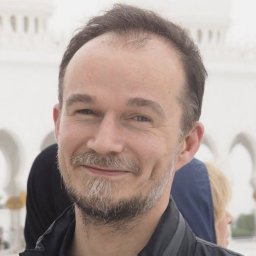
 Geoffroy Peeters
· 4 previous affiliations
- Telecom ParisSince 2018
- Full Professor · Since 2018
- Directeur de Recherche (senior researcher) · 2017–2018
- Project Manager · 2008–2016
- Research Scientist · 1999–2008
- Researcher · 1999–2018
- Université Pierre-et-Marie-Curie1996–2013
- Habilitation à Diriger des Recherches, Computer Science (Signal Processing and Machine Learning) · 2013
- Doctor of Philosophy (PhD), Computer Science, Signal Processing · 1996–2001
Research Overview
Geoffroy Peeters focuses on music information retrieval, audio signal processing, and machine learning for acoustic analysis. His trajectory spans from early foundational work on audio feature representation and similarity search to advanced deep learning architectures for source separation and rhythm analysis. Most recently, his research investigates self-supervised learning for audio and the privacy implications of generative models.
Research Trajectory
His early research addressed the foundational challenges of representing and organizing audio data. He participated in the development of standardized formats for audio features, as seen in Using the SDIF Sound Description Interchange Format for Audio Features, and contributed to real-time interactive audio processing environments with MuBu and Friends - Assembling Tools for Content Based Real-Time Interactive Audio Processing in Max/MSP. As digital music libraries grew, his focus expanded to the scalability of similarity search. He investigated the intrinsic dimensionality of multimedia descriptors in Estimating the indexability of multimedia descriptors for similarity searching, providing insights into how dataset properties affect indexing techniques. To handle databases exceeding a million items, he helped develop A fast algorithm for music search by similarity in large databases based on modified Symetrized Kullback Leibler Divergence, which optimized search strategies by adapting divergence measures for metric-based indexing structures like the M-tree.
Concurrently, he advanced the analysis of polyphonic music, focusing on isolating specific musical elements from complex mixtures. He introduced a spectro-temporal model for percussive sounds in Drum extraction from polyphonic music based on a spectro-temporal model of percussive sounds, which effectively removed drums while preserving frequency-modulated signals like singing voices. His work on melodic extraction included Statistical Characterisation of Melodic Pitch Contours and its Application for Melody Extraction and the subsequent development of A Pitch Salience Function Derived from Harmonic Frequency Deviations for Polyphonic Music Analysis. Recognizing the need for robust evaluation frameworks in Music Information Retrieval, he was instrumental in the MusiClef benchmarking initiative. He contributed to the design of the MusiClef: Multimodal Music Tagging Task and oversaw the curation of A professionally annotated and enriched multimodal data set on popular music, which provided researchers with expertly annotated audio features, editorial metadata, and web context.
As deep learning transformed audio signal processing, his methodologies evolved to incorporate neural architectures. He combined traditional source-filter Non-Negative Matrix Factorization (NMF) with Convolutional Recurrent Neural Networks (CRNNs) in Main Melody Estimation with Source-Filter NMF and CRNN. He further explored deep architectures for source separation in Improving singing voice separation using Deep U-Net and Wave-U-Net with data augmentation, comparing models operating on different input representations and leveraging data augmentation to improve performance. This period also saw him address complex retrieval tasks like identifying alternate versions of songs. In Combining musical features for cover detection, he explored how different musical features can be integrated. This work intersects with several broader research areas, including the direction of Heterogeneous Representation Fusion for Robust Audio Understanding and the area of Quality Aware Dynamic Weighting for Multimodal Sensor Fusion. Furthermore, the methodologies employed in this context align with the research direction of Deep Metric Learning for Audio Triplet Networks and the broader area of Transformation Invariant Representations for Musical Version Identification.
In recent years, his research has broadened to include environmental acoustics and self-supervised learning paradigms. He participated in evaluating urban noise monitoring systems in Cosmopolite Sound Monitoring (CoSMo): A Study of Urban Sound Event Detection Systems Generalizing to Multiple Cities, analyzing how well sound event detection models generalize across different urban environments. Returning to rhythm analysis, he developed A Contrastive Self-Supervised Learning Scheme for Beat Tracking Amenable to Few-Shot Learning, utilizing a Log-Mel-Spectrogram-Transformer encoder trained without ground-truth tempo data. He expanded on this self-supervised approach in Adapting Pitch-Based Self Supervised Learning Models for Tempo Estimation, successfully repurposing pitch-based Siamese networks for tempo estimation by representing audio via the Constant-Q transform of its onset-strength function. He also investigated the foundational properties of modern audio models, examining how the duration of input audio affects performance in On The Choice of the Optimal Temporal Support for Audio Classification with Pre-Trained Embeddings.
Most recently, his work has addressed the security and privacy implications of advanced generative models. In Where Rectified Flows Leak: Characterising Membership Signals Along the Interpolation Path, he investigated Rectified Flow models—such as those used in state-of-the-art audio generation—revealing how they leak training data information through predictable gaps in reconstruction error. This research enables highly accurate membership inference attacks and contributes to the broader research area of Weight Decomposition for Understanding Neural Generalization.
Current Directions
The most recent papers in the evidence indicate a dual focus on self-supervised learning for audio analysis and the evaluation of modern neural architectures. Recent work investigates how self-supervised paradigms can be adapted for rhythm and tempo estimation, reducing the reliance on large, annotated datasets by leveraging contrastive learning and pitch-shifting view generation. Concurrently, his research addresses the operational and security characteristics of large-scale models. This includes optimizing the temporal support for pre-trained audio embeddings and analyzing the privacy vulnerabilities of generative Rectified Flow models, specifically focusing on how membership signals leak along the interpolation path even in the absence of traditional overfitting.
Profile updated
Loading new papers…
Other researchers whose papers cluster into the same research directions — a proxy for overlapping technical interests and shared intellectual neighborhoods.
See something wrong? Report a mistake