

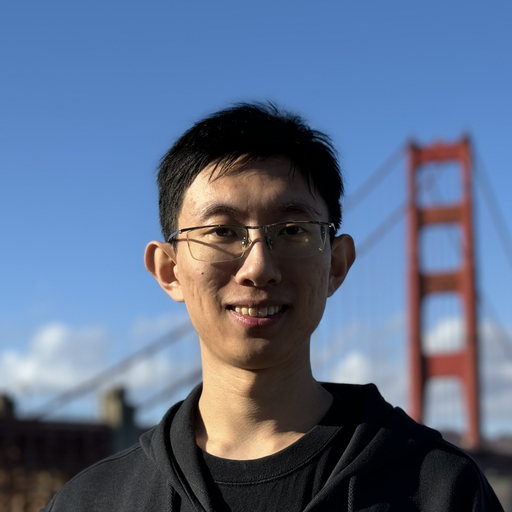
 Gengshan Yang
· 5 previous affiliations
- World LabsSince 2024
- Researcher · Since 2024
- Meta (United States)2021–2023
- Researcher · 2023
- Research intern · 2021
- Carnegie Mellon University2017–2023
- MS-PhD student · 2017–2023
- Research intern · 2020
- Argo AI2018
- Research intern · 2018
Research Overview
Gengshan Yang focuses on dynamic 3D reconstruction, articulated object modeling, and physical motion reasoning from monocular video. His trajectory spans early work in optical flow and depth estimation to the development of template-free methods for recovering deformable shapes in the wild. His current research investigates interactive behavior modeling and freeform 4D human reconstruction to build grounded, interactable representations of the physical world.
Research Trajectory
Yang’s early research addressed fundamental challenges in dense correspondence matching, depth estimation, and optical flow. In Volumetric Correspondence Networks for Optical Flow (2019), he investigated the research direction of The Data Hunger of Architectures Without Inductive Bias by addressing the memory and compute bottlenecks of 4D cost volumes in deep networks. Concurrently, he developed an end-to-end framework for real-time stereo matching on high-resolution imagery in Hierarchical Deep Stereo Matching on High-Resolution Images, contributing to the broader area of Asymmetric Augmentation Consistency for Robust Representation Learning. Recognizing the importance of uncertainty in geometric scene understanding, he recast continuous depth regression as a discrete binary classification problem to capture multi-modal uncertainty in Inferring Distributions Over Depth from a Single Image. He then bridged 2D and 3D motion estimation in Upgrading Optical Flow to 3D Scene Flow Through Optical Expansion (2020), demonstrating that dense optical expansion from monocular frame pairs could be integrated with camera intrinsics to infer normalized 3D scene flow.
Moving toward dynamic scene understanding in 2021, Yang began focusing on recovering non-rigid structures and articulated shapes without relying on multi-view setups or strong category priors. He contributed to the research direction of 3D Scene Flow for Physical Motion Reasoning with Learning To Segment Rigid Motions From Two Frames, proposing a modular network that leverages geometric motion segmentation to generalize across novel scenes. This period also marked a significant focus on work in the area of Template Free 3D Reconstruction of Generic Objects. He introduced ViSER: Video-Specific Surface Embeddings for Articulated 3D Shape Reconstruction, which inferred long-range correspondences by matching 2D pixels to a canonical deformable 3D mesh. He further advanced this analysis-by-synthesis strategy in LASR: Learning Articulated Shape Reconstruction From a Monocular Video, enabling the reconstruction of novel object categories from single videos. With collaborators, he also explored implicit surface models in NeRS: Neural Reflectance Surfaces for Sparse-view 3D Reconstruction in the Wild, learning neural shape representations of closed surfaces to guarantee water-tight reconstructions.
During his doctoral studies at Carnegie Mellon University, Yang scaled these reconstruction techniques to handle highly diverse, casual video data. In BANMo: Building Animatable 3D Neural Models from Many Casual Videos (2022), he merged classic deformable shape models, canonical embeddings, and volumetric neural radiance fields to create high-fidelity articulated models from casual RGB videos. He extended this framework to learn category-level deformable models in Reconstructing Animatable Categories from Videos (2023), disentangling instance-specific morphology from motion over time. Working with collaborators, he applied compositional 4D neural fields to embodied view synthesis in Total-Recon: Deformable Scene Reconstruction for Embodied View Synthesis, enabling novel camera trajectories derived from actor motion. Crucially, he integrated physical constraints into the reconstruction pipeline in PPR: Physically Plausible Reconstruction from Monocular Videos. By coupling differentiable physics simulation with differentiable rendering, this work ensured that the recovered 3D configurations of humans and animals satisfied dynamics and contact constraints, significantly reducing artifacts like scale ambiguity and foot swapping.
Now a Member of Technical Staff at World Labs, Yang’s recent work emphasizes explicit volumetric representations and interactive behavior modeling. With collaborators, he contributed to the area of Dense Visual SLAM with 3D Gaussian Splatting through SplaTAM: Splat, Track & Map 3D Gaussians for Dense RGB-D SLAM (2024), utilizing 3D Gaussians for high-fidelity reconstruction and precise camera tracking from unposed RGB-D data. He recently introduced Agent-to-Sim: Learning Interactive Behavior Models from Casual Longitudinal Videos (2025), a framework that transforms fragmented casual videos into interactive 3D behavior simulators. Most recently, he led the development of DressRecon: Freeform 4D Human Reconstruction from Monocular Video, which reconstructs time-consistent human body models interacting with handheld objects and wearing extremely loose clothing by fusing generic human priors with video-specific deformations. Extending generative 3D reasoning beyond visible surfaces, Yang also co-developed World Tracing: Generative Pixel-Aligned Geometry Beyond the Visible (2026), introducing a pixel-aligned multilayer representation trained with a flow-matching diffusion transformer to synthesize complete camera-space geometry along rays for static scenes, objects, and dynamic video clips.
Current Directions
The most recent papers in the evidence point toward a unified goal of building interactive, physically grounded world models from unconstrained visual data. Rather than stopping at passive 3D or 4D reconstruction, recent work investigates how to extract actionable behavior models directly from casual, longitudinal video captures. This involves bridging the gap between real-world observations and simulation by learning how agents interact with their environments and observers over time. Additionally, there is a strong focus on relaxing the strict priors traditionally required for human reconstruction and using generative diffusion models to complete occluded, multilayer 3D geometry while preserving pixel-aligned input camera frames.
Profile updated
Loading new papers…
Other researchers whose papers cluster into the same research directions — a proxy for overlapping technical interests and shared intellectual neighborhoods.
See something wrong? Report a mistake