

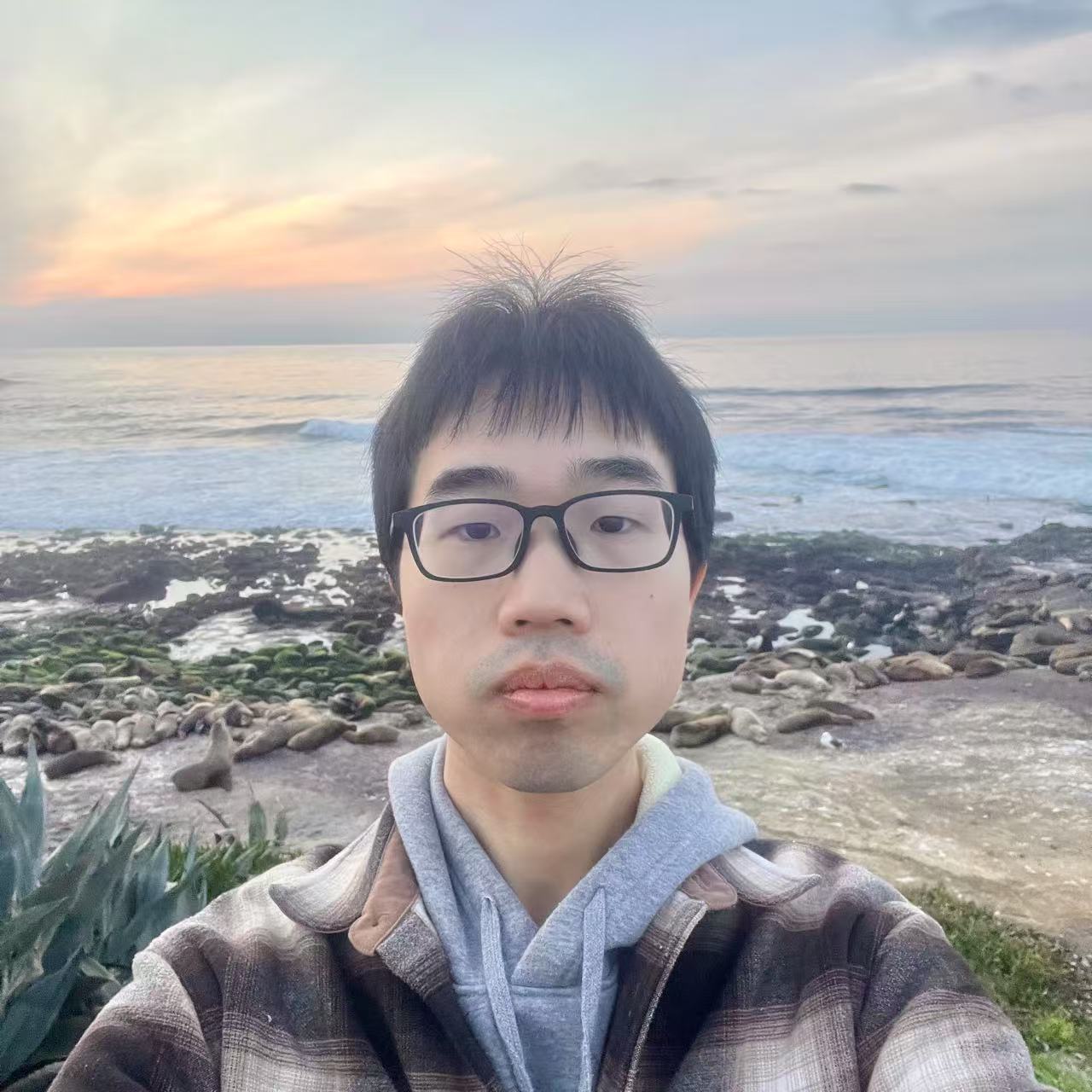
 Geng Chen
· 2 previous affiliations
- University of California San DiegoSince 2024
- MS student · Since 2024
- Shanghai Jiao Tong University2019–2023
- Undergrad student · 2019–2023
3 other authors named Geng Chen: Geng Chen (Northwestern Polytechnical University · 17 papers), Geng Chen (Beijing University of Post and Telecommunication · 1 paper), Geng Chen (Nankai University · 1 paper)
Research Overview
Geng Chen focuses on the intersection of robotics, computer vision, and machine learning, with a primary emphasis on developing embodied generalist agents. His research explores how robotic systems can acquire skills continually and adaptively, leveraging human demonstrations and foundation models to solve complex, long-horizon manipulation tasks. Currently, his work investigates humanoid control, 3D foundation policies, and the scaling of manipulation capabilities through the use of large-scale egocentric data.
Research Trajectory
Chen’s research trajectory began with a focus on world models and the challenges of predictive learning within non-stationary environments. In 2022, he addressed the problem of catastrophic forgetting in video prediction, a critical issue for agents that must adapt to sequentially arriving tasks without losing previously acquired knowledge of physical processes. This early work established a foundation in continual learning and temporal modeling, emphasizing the need for algorithms that can handle realistic, changing physical environments rather than static datasets.
Following this, Chen’s work shifted toward the integration of high-level reasoning with raw sensory input. By 2024, he was contributing to frameworks that bridge the gap between point-cloud data and symbolic planning. This phase of his research focused on discovering symbolic action spaces and latent state abstractions from language-annotated demonstrations. This transition marked a move toward long-horizon task completion and the use of natural language as a supervisory signal to improve robotic generalization across unseen object-concept combinations.
His most recent research (2025–2026) concentrates on the physical and cognitive requirements of humanoid agents and the development of robot foundation models. This includes addressing the complexities of extreme balance control in humanoid robots and the creation of 3D foundation policies for manipulation. A significant portion of this work involves scaling robot learning by utilizing diverse human video data. By categorizing egocentric data into "in-the-wild" and "on-task" categories, Chen has explored how to unlock the potential of large-scale human demonstrations for training robust, language-conditioned manipulation policies.
Representative Work
Continual Predictive Learning from Videos (2022) As the lead author, Chen investigated the problem of video prediction in environments where data arrives sequentially rather than simultaneously. The research identifies that most existing predictive learning methods suffer from severe catastrophic forgetting when faced with non-stationary physical environments. Chen proposed a continual predictive learning algorithm designed to maintain the accuracy of world models as they encounter new environments, ensuring that the agent retains its understanding of physical processes over time.
Learning Planning Abstractions from Language (2024) In this second-author contribution, Chen helped develop the PARL (Planning Abstraction from Language) framework. The research addresses the difficulty of planning for complex, long-horizon tasks by automatically discovering symbolic action spaces and latent state abstractions. By utilizing language-annotated demonstrations, the framework enables robots to bridge the gap between low-level sensory data and high-level reasoning. This allows for improved generalization when the robot encounters new combinations of objects and concepts that were not present during training.
In-and-On: Scaling Egocentric Manipulation with in-the-wild and on-task Data (2026) Participating as a third author, Chen contributed to a study on scaling manipulation policies using egocentric video data. The research provides a methodology for utilizing human data by distinguishing between "in-the-wild" data (general human activities) and "on-task" data (demonstrations specifically aligned with target manipulation tasks). The work involved the curation of the PHSD dataset, which contains over 1,000 hours of diverse egocentric data, and the development of Human0, a large-scale language-conditioned flow matching policy. The study demonstrates how domain-specific alignment can significantly enhance the utility of large-scale human video for robot learning.
HuB: Learning Extreme Humanoid Balance (2025) In this collaborative work, Chen participated in the development of the HuB framework for humanoid motor control. The research focuses on achieving high-difficulty balance tasks, such as standing on one foot or performing high kicks, which require precise control and stability. The study identifies three primary obstacles in humanoid reinforcement learning: instability arising from reference motion errors, learning difficulties due to morphological mismatches between humans and robots, and the sim-to-real gap caused by sensor noise and unmodeled dynamics. The HuB framework addresses these challenges to enable more robust humanoid balance in intensive tasks.
The provided evidence indicates a clear evolution from foundational predictive modeling to the application of foundation models and large-scale data in humanoid and robotic manipulation. While some taxonomy themes in the broader corpus suggest work in image restoration and medical imaging from 2016–2019, those appear to belong to a different researcher and are not reflected in Chen’s primary trajectory in robotics and embodied AI at UC San Diego and Jilin University.
Profile updated
| Title | Venue | Year |
|---|---|---|
| In-and-On: Scaling Egocentric Manipulation with in-the-wild and on-task Data | Openreview | 2026 |
| HuB: Learning Extreme Humanoid Balance | SAFE-ROL @ CoRL | 2025 |
| Learning Planning Abstractions from Language | ICLR | 2024 |
| Continual Predictive Learning from Videos | CVPR | 2022 |
Loading new papers…
Other researchers whose papers cluster into the same research directions — a proxy for overlapping technical interests and shared intellectual neighborhoods.
See something wrong? Report a mistake