

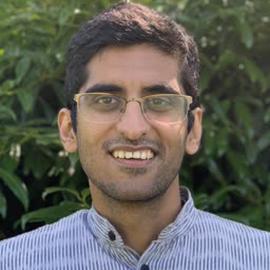
 Gautam Salhotra
· 2 previous affiliations
- Intrinsic InnovationSince 2023
- Researcher · Since 2023
- University of Southern California2018–2024
- PhD student · 2018–2024
Research Overview
Gautam Salhotra focuses on robotic manipulation, imitation learning, and reinforcement learning, with an emphasis on bridging morphological gaps and handling complex environments. His trajectory spans from hybrid motion planning and large-scale autonomous systems to specialized frameworks for cross-embodiment skill transfer and deformable object manipulation. Recent work investigates accelerated generative policies and diffusion models for high-frequency, reactive robot control.
Research Trajectory
Salhotra’s early published work explored the intersection of deep reinforcement learning (RL) and classical motion planning. In 2020, as a co-author on Motion Planner Augmented Reinforcement Learning for Robot Manipulation in Obstructed Environments, he contributed to the development of MoPA-RL. This framework was designed to solve contact-rich manipulation tasks in environments cluttered with obstacles. By augmenting the action space of an RL agent with the long-horizon, collision-free planning capabilities of traditional motion planners, the research addressed the sample inefficiency and exploration challenges that typically hinder standard RL in complex physical spaces.
Between 2021 and 2022, Salhotra participated in large-scale, multi-institutional robotics efforts focused on field autonomy. He was a contributing member of TEAM CoSTAR for the DARPA Subterranean Challenge, co-authoring NeBula: Quest for Robotic Autonomy in Challenging Environments; TEAM CoSTAR at the DARPA Subterranean Challenge. This work detailed an uncertainty-aware autonomy architecture deployed in extreme, unstructured environments such as tunnel networks and urban undergrounds, demonstrating how resilient perceptual autonomy can function outside of controlled laboratory settings.
In 2023, Salhotra’s focus shifted toward leading research in imitation learning, specifically addressing the challenges of embodiment mismatches and complex object dynamics. He was the first author of Learning Robot Manipulation from Cross-Morphology Demonstration, which introduced Morphological Adaptation in Imitation Learning (MAIL). Traditional imitation learning often struggles with the correspondence problem—mapping demonstrations from a teacher (like a human hand) to a student with a fundamentally different kinematic structure (like a parallel jaw gripper). MAIL provided a framework to bridge this gap, allowing agents to learn from suboptimal demonstrations provided by agents with significantly different morphologies. This work contributed directly to the broader research direction of Object-Centric Imitation for Cross-Embodiment Skill Transfer.
In parallel, Salhotra led research on the manipulation of highly compliant materials, serving as first author on Learning Deformable Object Manipulation from Expert Demonstrations. Deformable objects, such as ropes and cloths, present infinite degrees of freedom and complex state spaces that are notoriously difficult to model. The proposed method, Deformable Manipulation from Demonstrations (DMfD), balanced online environmental exploration with expert guidance to effectively navigate these high-dimensional spaces, improving performance on both state-based and image-based tasks. This research aligns with the broader challenge of Bridging the Gap Between Privileged Supervision and Raw Sensing, as it seeks to translate expert knowledge into actionable policies for complex physical systems.
Reflecting a growing community interest in generalist robot policies, Salhotra was also a contributing author to the massive collaborative effort Open X-Embodiment: Robotic Learning Datasets and RT-X Models in 2023. This project provided standardized datasets across multiple robot platforms to facilitate the training of "X-robot" policies, supporting ongoing work in themes such as Bridging the Embodiment Gap in Robot Learning.
Most recently, in 2025, his collaborative work has explored the application of generative models to robotic control. As a co-author of Latent Weight Diffusion: Generating reactive policies instead of trajectories, Salhotra helped address the inference speed bottlenecks inherent in diffusion policies. While diffusion models excel at learning multimodal action distributions, their size and slow inference times limit their utility for high-frequency control. By generating reactive policies rather than full trajectories, this research aims to maintain the benefits of diffusion models while enabling the rapid control loops required for dynamic manipulation and locomotion.
Current Directions
Salhotra’s most recent research trajectory points toward refining the efficiency, responsiveness, and adaptability of generative models in robotics. A primary focus is the area of Accelerated Generative Policies for Real-Time Robot Control. In this domain, the objective is to harness the expressive, multimodal capabilities of diffusion models without sacrificing the high-frequency inference speeds necessary for reactive, real-world manipulation.
Additionally, his recent collaborative efforts intersect with emerging themes such as the Unsupervised Discovery of Latent Behavioral Primitives and Differentiable Simulation for Gradient Based Robotic Control. These directions collectively aim to move beyond monolithic, slow-to-evaluate policies. By exploring how robots can leverage structured latent spaces and more efficient optimization techniques, this work seeks to enable rapid adaptation to complex, dynamic environments while minimizing the computational overhead traditionally associated with advanced generative control.
Profile updated
Loading new papers…
Other researchers whose papers cluster into the same research directions — a proxy for overlapping technical interests and shared intellectual neighborhoods.
See something wrong? Report a mistake