

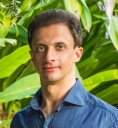
 Francesco Gullo
· 6 previous affiliations
- University of L'AquilaSince 2024
- Associate Professor of Computer Science · Since 2024
- UniCredit (Italy)2015–2024
- Senior Researcher - 'Group Data & Intelligence' department · 2022–2024
- Senior Researcher - UniCredit Services, 'AI, D&A ICT' dept., 'Applied Research & Innovation' unit · 2020–2022
- Senior Researcher · 2015–2020
- Barcelona Media2015
- Research Scientist · 2015
- Yahoo (United States)2011–2015
- Research Scientist, Yahoo Labs · 2013–2015
- Postdoctoral Researcher, Yahoo Labs · 2011–2013
- Yahoo (Spain)2011–2015
- Research Scientist · 2013–2015
- Postdoc · 2011–2013
- University of Calabria2003–2011
- Postdoc · 2010–2011
- Doctor of Philosophy (Ph.D.), Computer and Systems Engineering · 2006–2009
- Master's degree (M.Sc.), Computer Engineering · 2003–2005
Research Overview
Francesco Gullo focuses on graph mining, network analysis, and the algorithmic foundations of complex data structures. His trajectory spans the processing of uncertain graphs and the decomposition of multilayer and temporal networks, where he has led efforts to identify dense substructures over time. Most recently, his collaborative work investigates the reliability of knowledge graph embeddings for downstream tasks.
Research Trajectory
Gullo’s early research in the 2010s addressed the algorithmic challenges of clustering and querying complex graph structures. He participated in the development of randomized algorithms for categorical graph clustering, as seen in Chromatic correlation clustering (2012). This work introduced an objective function designed to group vertices connected by edges of similar types, providing an approximation guarantee proportional to the maximum degree of the input graph.
During this period, a major focus of his work was the efficient processing of uncertain graphs—networks where edges exist only with a certain probability. Because exact query processing on these graphs requires evaluating an exponential number of instantiations, traditional Monte-Carlo sampling is often prohibitively expensive. As a key contributor, Gullo helped develop algorithms to extract deterministic representative instances that preserve underlying graph properties, such as expected vertex degrees. This approach, detailed in The pursuit of a good possible world: extracting representative instances of uncertain graphs (2014), significantly improved query efficiency by bypassing the need for vast numbers of probabilistic samples.
Moving into the late 2010s, Gullo took on senior leadership roles as a principal investigator in the study of dense subgraph extraction, expanding traditional core decomposition techniques to more complex network paradigms. In Core Decomposition and Densest Subgraph in Multilayer Networks (2017), he guided research addressing the challenge of multilayer networks. Unlike single-layer networks where cores are strictly nested and computable in linear time, multilayer cores lack a total order and instead form an exponentially sized lattice, requiring novel algorithmic interventions to extract dense subgraphs.
He similarly led efforts to analyze temporal networks, where the goal is to identify dense structures alongside the specific time periods during which that density holds. This research introduced the concept of "span-cores" in Mining (maximal) Span-cores from Temporal Networks (2018). By exploiting containment properties among these temporal structures, his team provided algorithms to efficiently compute span-cores despite the quadratic number of possible time intervals in the temporal domain.
Parallel to his work on network decomposition, Gullo also contributed to causal data science within social networks. In Probabilistic Causal Analysis of Social Influence (2018), he co-authored a principled approach rooted in the theory of probabilistic causation. This work sought to separate genuine social influence from temporal correlations and homophily in information-propagation data, moving beyond standard statistical independence tests.
In the early 2020s, Gullo returned to correlation clustering to examine global constraints and fairness. He led the introduction of global weight bounds in Correlation Clustering with Global Weight Bounds (2021) and Correlation Clustering: from Local to Global Constraints (2022), relaxing traditional pairwise probability conditions while preserving approximation guarantees for algorithms such as Pivot. Additionally, he led an empirical evaluation of correlation clustering under fairness constraints in When Correlation Clustering Meets Fairness Constraints (2022), comparing its performance against standard fair-clustering methods across quality metrics.
In more recent years, his collaborative efforts have extended to the evaluation of representation learning on graphs. He participated in the development of metrics to assess the a priori performance of knowledge graph embeddings, as detailed in ReliK: A Reliability Measure for Knowledge Graph Embeddings (2023), which explores how well embeddings capture relationships for specific downstream web tasks.
Current Directions
The most recent papers in the evidence, dating to 2023, indicate an ongoing interest in the robustness and evaluation of representation learning within complex networks. Specifically, recent collaborative efforts investigate the reliability of knowledge graph embeddings. This direction addresses the open problem of anticipating how well a given embedding will perform on specific downstream tasks—such as relationship prediction—and within localized regions of a knowledge graph. By developing targeted reliability measures, this work moves beyond standard global optimization scores to provide more predictable and interpretable graph representations for practical applications.
Profile updated
Loading new papers…
Other researchers whose papers cluster into the same research directions — a proxy for overlapping technical interests and shared intellectual neighborhoods.
See something wrong? Report a mistake