

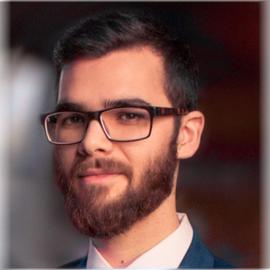
 Florent Delgrange
· 1 previous affiliation
- Vrije Universiteit BrusselSince 2020
- Postdoc · Since 2024
- PhD student · 2020–2024
Research Overview
Florent Delgrange focuses on the intersection of artificial intelligence and formal verification, specifically targeting theoretical aspects of reinforcement learning, representation learning, and model-checking in stochastic systems. His trajectory spans from synthesizing controllers in multi-objective Markov decision processes to developing reliable latent space models for partially observable environments. Currently, his work addresses safe policy improvement and the integration of formal guarantees into deep reinforcement learning via world models.
Research Trajectory
Delgrange's early research investigates formal verification and strategy synthesis within stochastic environments. With collaborators, he explored the extension of window objectives to stochastic settings in Life Is Random, Time Is Not: Markov Decision Processes with Window Objectives, enabling the synthesis of system controllers that meet time-bounded specifications along infinite executions. He subsequently expanded on decision-making frameworks by analyzing strategy formulation in Simple Strategies in Multi-Objective MDPs.
A major theme in his trajectory is the integration of formal guarantees into continuous and deep reinforcement learning (RL) environments. To address the lack of safety assurances in standard deep RL, he introduced methods for policy simplification and verification. In Distillation of RL Policies with Formal Guarantees via Variational Abstraction of Markov Decision Processes, he derived bisimulation bounds to recover guarantees for complex environments involving reachability and safety constraints. Building on this, he developed Variational Markov Decision Processes (VAE-MDPs) to distill formally verifiable controllers from RL policies. This work, detailed in Wasserstein Auto-encoded MDPs: Formal Verification of Efficiently Distilled RL Policies with Many-sided Guarantees, contributes to the broader research direction of Formal Safety Shields for Deep Reinforcement Learning and addresses learning instabilities related to the area of Posterior Collapse in Variational Autoencoders.
Extending these mathematically grounded latent space models to partially observable environments, he proposed the Wasserstein Believer (WBU) algorithm in The Wasserstein Believer: Learning Belief Updates for Partially Observable Environments through Reliable Latent Space Models. By utilizing Wasserstein metrics and normalizing flows, this approach provides theoretical guarantees for latent belief updates, advancing work in the area of Bridging the Gap Between Privileged Supervision and Raw Sensing.
In 2024, his focus expanded to the synthesis of hierarchical controllers for large, complex domains. He developed a framework that trains low-level deep RL policies for individual sub-environments—or "rooms"—and applies reactive synthesis to construct a high-level planner. This approach was formalized in Synthesis of Hierarchical Controllers Based on Deep Reinforcement Learning Policies and further refined in Controller Synthesis from Deep Reinforcement Learning Policies. By combining the scalability of RL with the rigor of formal methods, this hybrid architecture yields Probably Approximately Correct (PAC) performance bounds, as demonstrated in Composing Reinforcement Learning Policies, with Formal Guarantees.
Most recently, his research has shifted toward the design of reliable world models to facilitate safe policy improvement and planning. Leading a collaborative effort, he introduced Optimal Transport MDPs in Integrating RL and Planning through Optimal Transport World Models, framing model learning as an optimal transport problem to capture more faithful latent representations of environment dynamics. He continued this trajectory with Deep SPI: Safe Policy Improvement via World Models, which bridges theoretical safe policy improvement with practical deep RL by constraining policy updates to ensure monotonic improvement. This recent work actively contributes to research directions such as Locally Accurate World Models for Reinforcement Learning and the broader area of Trust Region and Divergence Regularization for Stable Policy Optimization.
Current Directions
The most recent papers in the evidence indicate a strong focus on the intersection of world models, optimal transport, and safe policy improvement. Current work investigates how to learn faithful latent representations of environment dynamics—such as through Optimal Transport MDPs—to better integrate reinforcement learning with planning techniques. A key open problem in this domain is ensuring monotonic improvement and stable representations in high-dimensional spaces. By coupling principled world model losses with constrained policy updates, this research aims to bridge the gap between theoretical safety guarantees and the practical deployment of deep reinforcement learning agents in complex, non-static environments.
Profile updated
Loading new papers…
Other researchers whose papers cluster into the same research directions — a proxy for overlapping technical interests and shared intellectual neighborhoods.
See something wrong? Report a mistake