

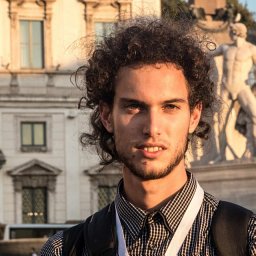
 Federico Stella
· 6 previous affiliations
- École Polytechnique Fédérale de LausanneSince 2021
- PhD Student in Computer Science · Since 2021
- Intern · 2025
- illuminem2020–2022
- Chief Technology Officer · 2020–2022
- ITTS "Belluzzi - da Vinci"2021
- Teacher of Computer Science, Networks and Systems · 2021
- University of Bologna2014–2020
- Graduate Teaching Assistant · 2019–2020
- Master's Degree, Computer Engineering · 2017–2020
- Undergrad student · 2014–2017
- Collegio Superiore - University of Bologna2017–2020
- Honours program of the University of Bologna · 2017–2020
Research Overview
Federico Stella focuses on 3D computer vision, geometric deep learning, and neural surface reconstruction. His early work explored rotation-equivariant representations for point clouds, while his recent research centers on extracting high-fidelity meshes from implicit representations of open surfaces. Currently, he investigates advanced techniques for unsigned distance fields to enable robust, differentiable modeling of complex non-watertight geometries.
Research Trajectory
Stella’s research trajectory begins with foundational work in geometric deep learning, specifically addressing how machines can learn robust spatial understandings of 3D objects. In 2020, he collaborated on Learning to Orient Surfaces by Self-supervised Spherical CNNs, which investigated the extraction of canonical orientations for 3D surfaces represented as point clouds. Rather than relying on handcrafted geometric cues, this work demonstrated that canonical orientation could be learned through self-supervision by enforcing equivariance to 3D rotations. This contribution advanced several overlapping research directions, including the area of Rotation Equivariant Representations with Spherical CNNs, the broader field of Self Supervised Discovery of Canonical 3D Orientations, and the study of The Discretization Gap in Equivariant Neural Networks.
Following this work on point cloud orientation, Stella shifted his focus toward the challenges of implicit surface representation, particularly the reconstruction of non-watertight geometries. Traditional Signed Distance Functions (SDFs) are limited to closed, watertight surfaces, prompting the field to explore Unsigned Distance Fields (UDFs) for open surfaces like clothing or car interiors. However, extracting explicit 3D meshes from UDFs remained computationally expensive and difficult to optimize. To address this, Stella introduced MeshUDF: Fast and Differentiable Meshing of Unsigned Distance Field Networks. This algorithm extended the classic Marching Cubes framework by utilizing gradient-based "pseudo-signs" rather than traditional sign flips. The resulting method allowed for high-fidelity surface extraction in seconds rather than hours and enabled direct optimization against sparse data such as point clouds. This work became a key development in the research direction of Meshing Non-Watertight Surfaces from Unsigned Distance Fields, while also contributing to the area of Differentiable Surface Extraction for Mesh Optimization.
Building on the foundation of MeshUDF, Stella continued to refine the conversion of implicit UDFs into explicit geometry. In Neural Surface Detection for Unsigned Distance Fields, he and his collaborators developed a deep-learning approach that locally converts UDFs into pseudo-SDFs. By predicting sign configurations for individual grid cells, the method allowed standard, robust meshing algorithms to process complex open surfaces with significantly higher accuracy and fewer artifacts than prior hand-crafted or end-to-end neural techniques. This further solidified his contributions to the area of Surface Extraction from Unsigned Distance Fields.
Most recently, Stella’s work has tackled the inherent brittleness and scaling limitations of UDFs at high resolutions. In High Resolution UDF Meshing via Iterative Networks, he proposed an iterative neural network architecture designed to resolve the noise and ambiguities that plague high-resolution UDF meshing. By allowing the network to aggregate information from neighboring voxels over multiple passes, the system successfully fills missing gaps and reconstructs high-fidelity 3D geometry where traditional methods typically leave holes. Concurrently, he explored fundamental alternatives to the UDF formulation itself. In Gradient Distance Function, Stella and his co-authors addressed the critical flaw that UDFs are non-differentiable exactly at the surface boundary—making them difficult to learn in a deep learning framework. They introduced Gradient Distance Functions (GDFs), which associate each 3D point with a vector whose norm represents the unsigned distance and whose orientation points toward the closest surface point. This formulation maintains differentiability at the surface while preserving the ability to represent open, non-watertight geometries.
In 2026, Stella expanded into multi-object representation, generative shape optimization, and efficient neural rendering. Addressing physical plausibility in compositional implicit surfaces, Stella co-authored S2MDF: A Plug-And-Play Layer for Intersection-Free Multi-Object Signed Distance Fields, which introduces a lightweight hard constraint module preventing interpenetration across multi-object SDFs. Turning to latent generative modeling, Stella contributed to Flow-Corrected Shape Optimization: Taming Manifold Drift in High-Dimensional 3D Models, proposing an alternating optimizer-corrector framework combining gradient objective steps with guided flow matching to counter manifold drift. Additionally, Stella collaborated on AnyPrune: Optimization-Free Pruning for Any Feedforward 3D Gaussian Splatting Pipeline, developing a transformer-based module that strips redundant Gaussians across feedforward pipelines without requiring expensive re-optimization.
Current Directions
The most recent papers in the evidence indicate a sustained focus on overcoming the mathematical and computational bottlenecks of implicit 3D representations. Stella’s current work investigates how to make the modeling of open, non-watertight surfaces both highly accurate and fully differentiable. A major theme in his recent research is the mitigation of artifacts and noise in high-resolution meshing, achieved by replacing rigid, hand-crafted extraction rules with learned, iterative neural processes that can resolve local geometric ambiguities. Furthermore, Stella is exploring intersection-free constraints for compositional multi-object SDFs, flow-corrected latent shape optimization, and efficient optimization-free pruning methods for feedforward 3D Gaussian splatting.
Profile updated
Loading new papers…
Other researchers whose papers cluster into the same research directions — a proxy for overlapping technical interests and shared intellectual neighborhoods.
See something wrong? Report a mistake