

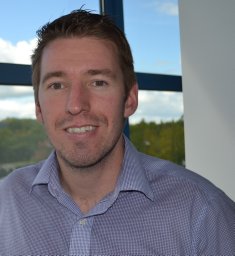
 Fearghal O'Donncha
· 6 previous affiliations
- Principal Researcher · Since 2011
- IBMSince 2012
- Research Scientist · Since 2012
- IBM ResearchCurrent
- Current
- IBM Smarter Cities2011
- Research Intern · 2011
- Researcher · 2006–2011
- PhD student · 2007–2011
- Bachelor of Engineering (BEng), Civil Engineering · 2002–2006
- Clare County Council2005
- Engineering Technician (Professional Experience Program) · 2005
Research Overview
Fearghal O'Donncha focuses on the intersection of artificial intelligence, mathematical modeling, and digital twin technologies for complex physical systems. His trajectory spans from causal discovery in time-series data to unsupervised anomaly detection in industrial environments. Most recently, his work investigates the use of agentic large language models and time series foundation models to optimize operations and monitoring in domains such as maritime shipping.
Research Trajectory
O'Donncha's research initially focused on advancing time-series forecasting and causal inference. In 2023, he introduced Causal Temporal Graph Convolutional Neural Networks (CTGCN), a framework designed to automate the discovery of hidden relationships in complex time-series data. By employing a divide-and-conquer decomposition strategy alongside causal inference, this approach eliminated the need for manually defined graph structures, contributing to the area of Scaling Causal Graph Discovery to High Dimensions.
Moving into 2024, his focus expanded to address industrial monitoring challenges. He explored unsupervised methods for industrial data in Optimal Transport for Efficient, Unsupervised Anomaly Detection on Industrial Data. That same year, his senior-authored work Agentic Anomaly Detection for Shipping applied large language models (LLMs) to the maritime sector. This system integrated knowledge graphs and external tools with LLM reasoning to provide actionable insights into ship system anomalies, advancing the broader area of Interpretable Anomaly Detection.
This agentic approach naturally extended into the development of digital twins for the maritime domain in 2025. In Agentic AI for Digital Twin, O'Donncha and his collaborators developed a framework that utilizes LLMs to autonomously select and orchestrate specialized tools, simplifying complex data integration for shipping digital twins. This work aligns with the research direction of Large Language Models as Central Orchestrators for Specialized Tools. He further demonstrated the practical utility of these systems in Agentic AI for ship routing, showing how agentic LLMs can leverage pre-trained knowledge and real-time data streams to optimize ship routes, fuel consumption, and overall operational efficiency.
Most recently, in 2026, O'Donncha's collaborative research has investigated the zero-shot capabilities of modern forecasting architectures. The paper Adaptive Conformal Anomaly Detection with Time Series Foundation Models for Signal Monitoring. introduces $W_1$-ACAS, a method that combines Time Series Foundation Models (TSFMs) with adaptive conformal prediction. This technique translates opaque forecasting errors into interpretable, calibrated false alarm rates that remain robust even under data distribution shifts, without requiring model fine-tuning. This contribution spans several emerging areas, including Zero Shot Generalization in Time Series Foundation Models, Temporal Aggregation for Robust Time Series Classification, and the area of Conformal Inference under Exchangeability Violations.
Current Directions
Recent work investigates the integration of agentic artificial intelligence with digital twin technologies, particularly for complex logistical domains like the shipping industry. The most recent papers in the evidence address how large language models can act as central orchestrators, autonomously selecting tools and processing real-time data streams to optimize physical operations such as ship routing and fuel consumption. Concurrently, ongoing research explores the application of time series foundation models to industrial signal monitoring, focusing on adaptive conformal prediction methods that maintain calibrated anomaly detection even when underlying data distributions shift.
Profile updated
Loading new papers…
Other researchers whose papers cluster into the same research directions — a proxy for overlapping technical interests and shared intellectual neighborhoods.
See something wrong? Report a mistake