

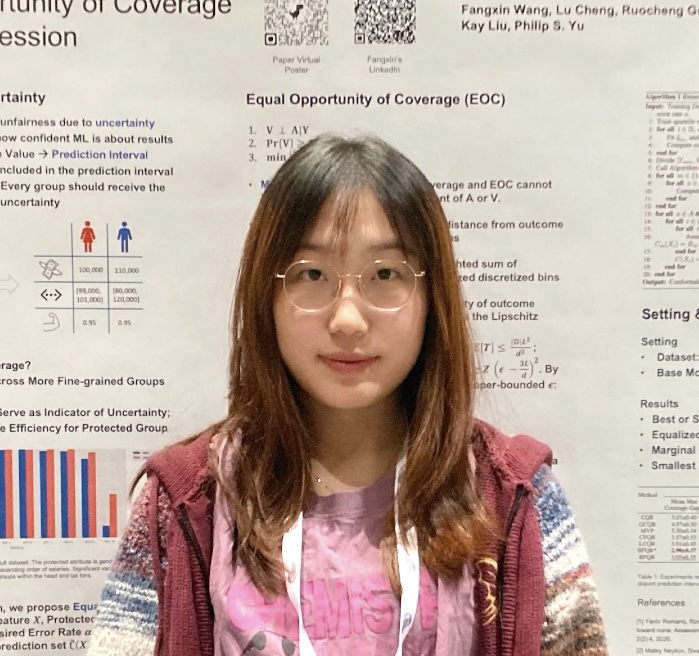
 Fangxin Wang
· 7 previous affiliations
- Intuit (United States)Since 2026
- Research Intern · Since 2026
- University of Illinois ChicagoSince 2023
- Doctor of Philosophy - PhD, Computer Science · 2023–2027
- TikTok2026
- Machine Learning Intern · 2026
- Research Intern · 2025
- Columbia University2021–2023
- MS student · 2022–2023
- Master of Science - MS, Operations Research · 2021–2022
- Data scientist intern · 2022
- Nanjing University2017–2021
- Undergrad student · 2017–2021
1 other author named Fangxin Wang: Fangxin Wang (Shenzhen Research Institute of Big Data · 63 papers)
Research Overview
Fangxin Wang focuses on uncertainty quantification, algorithmic fairness, and graph machine learning. His work develops robust statistical methods to ensure equitable and reliable model predictions, particularly in complex structured data environments like graph neural networks and stream networks. Recently, he has been investigating game-theoretic approaches for graph self-training and preference optimization for molecular foundation models.
Research Trajectory
In 2023, Wang's research addressed the intersection of predictive reliability and equity, contributing to the area of Algorithmic Fairness for Continuous Regression Outcomes. In Equal Opportunity of Coverage in Fair Regression, he introduced Equal Opportunity of Coverage (EOC), a novel fairness notion designed to ensure that prediction intervals remain equally reliable across different demographic groups exhibiting similar outcomes. To operationalize this metric, he developed Binned Fair Quantile Regression (BFQR). This distribution-free method advances the broader direction of Post-Hoc Fairness Adjustment for Machine Learning and intersects with the research direction of The Fairness Efficiency Tradeoff in Conformal Prediction by maintaining narrow, informative prediction intervals while strictly satisfying fair coverage constraints.
Moving into 2024, Wang expanded his focus to structured data, specifically examining how uncertainty and data imbalance affect graph neural networks (GNNs). He provided a comprehensive systematization of this field in Uncertainty in Graph Neural Networks: A Survey. This work synthesizes existing theories and methods for identifying, quantifying, and utilizing predictive uncertainty stemming from inherent data randomness and model training errors. The survey contributes significantly to the research direction of Confidence Calibration in Graph Neural Networks and touches upon related areas like Single Pass Uncertainty Estimation. During this period, he also collaborated on Data Augmentation for Supervised Graph Outlier Detection via Latent Diffusion Models. This research tackled the critical issue of class imbalance in graph outlier detection by leveraging latent diffusion models to synthesize realistic outlier data, offering new techniques for improving algorithmic performance in challenging domains.
In 2025, Wang's trajectory demonstrates a continued emphasis on robust graph learning and uncertainty quantification across specialized, high-stakes domains. With collaborators, he explored the unique constraints of directional data pathways in Topology-Aware Conformal Prediction for Stream Networks, developing statistical methods to quantify predictive uncertainty in complex systems such as river networks and urban traffic grids where data movement is strictly constrained by topology. Concurrently, he addressed out-of-distribution (OOD) reliability in scientific applications through Can Molecular Foundation Models Know What They Don't Know? A Simple Remedy with Preference Optimization. This work introduced Molecular Preference-Aligned Instance Ranking (Mole-PAIR), a plug-and-play module designed to mitigate chemical hallucination—where models make high-confidence but incorrect predictions for unknown molecules—through cost-effective post-training. Further advancing graph learning methodologies, he developed BANGS: Game-theoretic Node Selection for Graph Self-Training, formulating a novel game-theoretic approach to optimize node selection processes in self-supervised graph environments.
Current Directions
The most recent papers in the evidence indicate a strong ongoing focus on improving the reliability, safety, and training efficiency of models operating on complex graph structures. Current work investigates advanced node selection strategies for graph self-training, utilizing game-theoretic frameworks to optimize learning without extensive labeled data. Additionally, Wang is actively exploring domain-specific uncertainty quantification, adapting conformal prediction techniques to handle the strict topological constraints of stream networks. Another prominent theme in his recent research involves enhancing the out-of-distribution robustness of molecular foundation models, ensuring that predictive systems in high-stakes domains like drug discovery can accurately gauge their own uncertainty and avoid hallucinations when encountering novel chemical structures.
Profile updated
| Paper | Venue | Year |
|---|---|---|
| Equal Opportunity of Coverage in Fair RegressionGitHubfangxin-wang/ | NeurIPS | 2023 |
Loading new papers…
Other researchers whose papers cluster into the same research directions — a proxy for overlapping technical interests and shared intellectual neighborhoods.
See something wrong? Report a mistake