

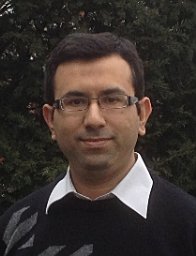
 Faisal Shafait
· 12 previous affiliations
- Professor · Since 2015
- DCUBE | D3Since 2016
- Founder & CEO · Since 2016
- Full Professor · Since 2018
- Associate Professor · 2015–2018
- Technology Advisor · Since 2025
- Veeve2019–2022
- Chief Scientist · 2019–2022
- VisionX2018–2019
- Co-Founder & Chief Technology Officer (CTO) · 2018–2019
- PackageX2018–2019
- Co-Founder & Chief Scientist · 2018–2019
- The University of Western Australia2013–2015
- Assistant Professor · 2013–2015
- German Research Center for AI2005–2012
- Researcher · 2005–2012
- Google (United States)2008–2009
- Postdoc · 2008–2009
- Doctor of Philosophy (PhD), Computer Engineering · 2005–2008
- Hamburg University of Technology2002–2005
- Master of Science (MS), Information and Communication Systems · 2002–2005
Research Overview
Faisal Shafait focuses on document image analysis, hyperspectral imaging, and applied computer vision. His trajectory spans foundational work in robust reading and sparse representations for hyperspectral data to recent developments in multilingual optical character recognition and resource-constrained object detection. Currently, his research addresses unconstrained handwriting recognition, localized forgery detection, and efficient neural architectures for autonomous systems.
Research Trajectory
Faisal Shafait’s early work established a dual focus on document analysis and the enhancement of hyperspectral imagery. In the document analysis community, he participated in the organization and evaluation of the ICDAR 2013 Robust Reading Competition, which benchmarked text extraction across born-digital images, real scenes, and video. Concurrently, he developed methods to overcome the hardware constraints that typically result in low spatial resolution for hyperspectral cameras. In Sparse Spatio-spectral Representation for Hyperspectral Image Super-resolution (2014), he and his collaborators introduced an approach that extracts distinct reflectance spectra and leverages signal sparsity to estimate high-resolution images. This framework was expanded the following year in Bayesian sparse representation for hyperspectral image super resolution, which utilized non-parametric Bayesian sparse coding to fuse high-resolution images with low-resolution hyperspectral data. He also contributed to hyperspectral unmixing with Futuristic Greedy Approach to Sparse Unmixing of Hyperspectral Data, proposing the OMP-Star algorithm to handle highly correlated material spectra. Returning to document analysis benchmarks, he contributed to the ICDAR 2015 competition on Robust Reading., which introduced new challenges for incidental scene text and end-to-end system evaluation.
Between 2016 and 2017, his work on Bayesian representations matured while his computer vision research expanded into video analysis. He co-developed Discriminative Bayesian Dictionary Learning for Classification, which inferred probability distributions over dictionary atoms using a finite approximation of the Beta Process. In Hierarchical Beta Process with Gaussian Process Prior for Hyperspectral Image Super Resolution, this Bayesian framework was extended to account for spectral smoothness and spatial consistency. Branching into egocentric vision, he explored action recognition in Modeling Sub-Event Dynamics in First-Person Action Recognition, proposing a temporal feature pooling function and recursive Fast Fourier Transforms to track sub-event dynamics in first-person videos characterized by heavy motion.
A major theme of his subsequent research has been the advancement of optical character recognition (OCR) for cursive and low-resource scripts. He guided the development of A Multi-faceted OCR Framework for Artificial Urdu News Ticker Text Recognition (2018), presenting a comprehensive dataset and system for automating the transcription of Urdu news video content. In the broader machine learning domain, his research group investigated cross-modal retrieval evaluation in Do Cross Modal Systems Leverage Semantic Relationships? (2019), proposing the SemanticMap measure to better assess latent embedding space similarities. Additionally, he oversaw work on An Open-World Extension to Knowledge Graph Completion Models., which combined graph-based link prediction with textual word embeddings to predict facts for unseen entities, touching on areas such as inductive relation reasoning and capturing relational asymmetry with complex vector spaces.
In recent years, his research has addressed both computational efficiency and complex document analysis tasks. To enable object detection on resource-constrained unmanned aerial vehicles (UAVs), he led the design of QuantYOLO: A High-Throughput and Power-Efficient Object Detection Network for Resource and Power Constrained UAVs (2021), exploring precision pruning and binarized weights. His focus on Urdu OCR culminated in A convolutional recursive deep architecture for unconstrained Urdu handwriting recognition (2022), which introduced the NUST-UHWR dataset and an end-to-end CNN-RNN architecture to handle complex Nastaleeq ligatures. He also merged his expertise in hyperspectral imaging and document analysis in Localized Forgery Detection In Hyperspectral Document Images, utilizing anomaly detection and unsupervised clustering to distinguish visually similar inks without prior knowledge of their proportions. Finally, he extended scene-text detection to multilingual contexts with TraffSign: Multilingual Traffic Signboard Text Detection and Recognition for Urdu and English, providing a new dataset to assist navigation systems in regions utilizing multiple scripts.
Current Directions
The most recent papers in the evidence address the intersection of deep learning architectures with specialized, real-world constraints. One primary direction involves advancing multilingual and cursive script recognition in unconstrained environments, such as handwritten documents and traffic signboards. Another active area focuses on the practical deployment of computer vision models, including the development of high-throughput, quantized neural networks for power-constrained platforms like UAVs. Furthermore, recent work investigates the application of hyperspectral image analysis to document forensics, specifically utilizing unsupervised clustering and anomaly detection for localized forgery identification.
Profile updated
Loading new papers…
Other researchers whose papers cluster into the same research directions — a proxy for overlapping technical interests and shared intellectual neighborhoods.
See something wrong? Report a mistake