

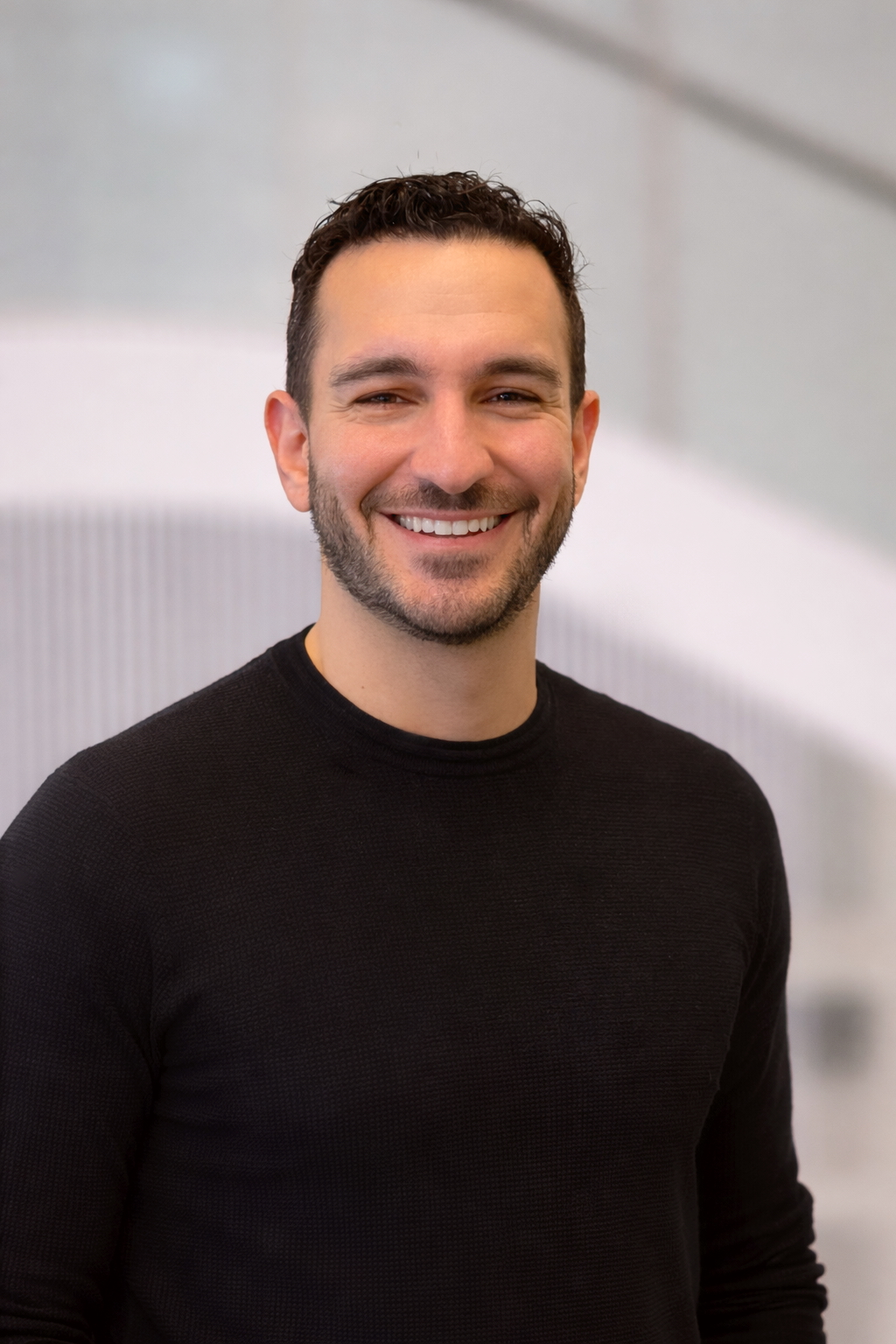
 Fadel Adib
· 2 previous affiliations
- Massachusetts Institute of TechnologySince 2011
- Professor · Since 2026
- Associate Professor · Since 2016
- Associate Professor (with Tenure) · 2022–2026
- Associate Professor & Doherty Chair · 2020–2022
- PhD student · 2013–2016
- Master's degree, Computer Science · 2011–2013
- Cartesian Therapeutics, Inc.Since 2023
- Co-Founder · Since 2023
Research Overview
Fadel Adib focuses on wireless systems, low-power sensing, and millimeter-wave imaging. His early work explored algorithmic improvements for GPS signal processing, while his subsequent research expanded into battery-free underwater networking and machine learning. His most recent investigations address non-line-of-sight 3D object reconstruction using advanced radio frequency techniques.
Research Trajectory
Adib's early research addressed the computational efficiency of fundamental wireless systems. In 2012, he collaborated on Faster GPS via the sparse fourier transform, a project motivated by the high power consumption associated with GPS receivers locking onto satellite signals. Because the locking process traditionally requires hundreds of millions of hardware multiplications, the research team sought to improve upon the standard O(n log n) Fourier transform-based algorithms. The resulting work introduced an algorithm leveraging the sparse Fourier transform that reduced the locking complexity to O(n√(log n)), and demonstrated that the process could operate in linear time under favorable signal-to-noise ratios.
A decade later, his work expanded into extreme environments and ultra-low-power systems. He participated in a multi-institutional effort exploring Towards battery-free machine learning and inference in underwater environments. This 2022 study examined the feasibility of bridging battery-free networking with low-power machine learning. The research demonstrated that battery-free inference is possible underwater, laying the groundwork for a new generation of sensing devices designed for environmental monitoring, scientific exploration, and climate prediction without the maintenance overhead of traditional power sources.
More recently, Adib has directed research in advanced radio frequency imaging and computational perception. In Non-Line-of-Sight 3D Object Reconstruction via mmWave Surface Normal Estimation, his group presented mmNorm, a highly accurate method for reconstructing hidden 3D objects using millimeter-wave (mmWave) signals. In contrast to past approaches for mmWave-based imaging that rely on backprojection, this work introduced a novel algorithm to directly estimate the surface normal vector field from mmWave reflections. By inverting the normal field, the system reconstructs structural isosurfaces and solves for the exact surface geometry through a specialized mmWave optimization framework.
Current Directions
The most recent papers in the evidence indicate a strong focus on computational imaging and millimeter-wave sensing. Current work investigates how radio frequency signals can be leveraged for non-line-of-sight perception and high-accuracy 3D object reconstruction. This involves developing novel optimization frameworks and signal processing algorithms—such as surface normal estimation from mmWave reflections—to extract detailed structural information from environments where traditional optical sensors fail.
Profile updated
Loading new papers…
Other researchers whose papers cluster into the same research directions — a proxy for overlapping technical interests and shared intellectual neighborhoods.
See something wrong? Report a mistake