

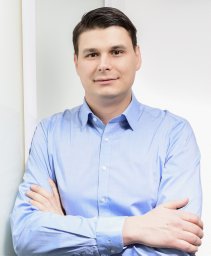
 Evgeny Kharlamov
· 7 previous affiliations
- Bosch Center for Artificial IntelligenceSince 2018
- Bosch Center for Artificial Intelligence · Since 2018
- Current
- University of OsloSince 2018
- Associate Professor · Since 2018
- Current
- Scientific Coordinator @ SIRIUS - SFI Research Center · 2021–2023
- Robert Bosch (Germany)Since 2020
- GenAI Accelerator Responsible · Since 2025
- Senior AI Expert · Since 2021
- Senior Manager: EU Level and Bosch Internal Projects · Since 2020
- Member · Since 2025
- University of Oxford2013–2018
- Senior Research Fellow · 2013–2018
- Senior post-doctoral researcher · 2013
- Free University of Bozen-Bolzano2007–2013
- Research Assistant · 2010–2013
- Postdoc · 2011–2013
- PhD, Computer Science · 2007–2011
- Télécom Paris2008–2010
- PhD, Computer Science · 2008–2010
Research Overview
Evgeny Kharlamov focuses on knowledge representation, ontology-based data access, and neuro-symbolic artificial intelligence. His trajectory spans foundational work in description logics and semantic data integration to the deployment of large-scale industrial knowledge graphs. Most recently, his research addresses the intersection of large language models and structured knowledge, emphasizing retrieval-augmented generation and adaptive reasoning under incomplete information.
Research Trajectory
Evgeny Kharlamov’s early work investigated the theoretical foundations of data integration and knowledge base evolution. This began with Incompleteness in information integration in 2008. With collaborators, he then explored the evolution of description logics in Evolution of DL-Lite Knowledge Bases, focusing on the DL-Lite family and OWL 2 QL to establish fundamental principles that knowledge base evolution should respect. Expanding on OWL 2 QL, he contributed to the research direction of Inconsistency Tolerant Query Answering with Inconsistency Tolerance in OWL 2 QL Knowledge and Action Bases. This work proposed a repair-based semantics for data-centric business processes, allowing systems to resolve conflicts and continue execution rather than rejecting process states when new data violates business rules.
By 2016, his focus had expanded to industrial ontology-based data access (OBDA). In Ontology-Based Integration of Streaming and Static Relational Data with Optique, he demonstrated how semantic technologies can integrate heterogeneous data streams to simplify complex machine diagnostics. This applied research continued with Ontology Based Data Access in Statoil, which detailed the practical challenges and solutions for deploying OBDA systems in data-intensive petroleum environments, using ontologies to abstract away technical schema-level details.
Around 2022, his trajectory broadened to include content-based dataset retrieval and industrial modeling. He oversaw the development of ACORDAR: A Test Collection for Ad Hoc Content-Based (RDF) Dataset Retrieval, providing a specialized benchmark and dashboard for evaluating dataset search systems based on actual data content rather than just metadata. He also examined the intersection of semantic technologies and industrial modeling in Semantic Digital Twins: Trends and Shortcomings (Keynote), touching on themes of unifying distributed information islands and integrating neural perception with symbolic logic. In 2023, he guided the creation of Semantic Cloud System for Scaling Data Science Solutions for Welding at Bosch, a semantics-enhanced system combining knowledge graphs with Datalog-based machine learning rules to automate cloud resource configuration for industrial ETL processes.
From 2024 onward, his research shifted heavily toward integrating structured knowledge with large language models (LLMs) and advancing neuro-symbolic reasoning. Integrating I4.0 Knowledge Graphs with Large Language Models Beyond SPARQL Endpoints presented a framework allowing factory engineers to query complex digital twin data using natural language, grounding generative models in live external knowledge to bypass specialized query syntax.
In 2025, several papers addressed the reliability and reasoning capabilities of Retrieval-Augmented Generation (RAG). He participated in developing ArgRAG: Explainable Retrieval Augmented Generation using Quantitative Bipolar Argumentation, which replaces black-box reasoning with a structured argumentation framework to manage stochastic instability in LLM reasoning and improve fact-verification accuracy. He also directed work on GQC: LLM-Based Grouped QA Consolidation for Open-Domain Fact Verification at AVeriTeC, introducing a modular refinement step to filter and cluster redundant question-answer pairs at the claim level, thereby mitigating information overlap.
Investigating the fundamental limits of these systems, his team introduced What Breaks Knowledge Graph based RAG? Empirical Insights into Reasoning under Incomplete Knowledge. This work proposed the BRINK benchmark to test logical inference versus LLM memorization, revealing that many models fail when direct evidence is missing. To address these limitations, he oversaw GR-Agent: Adaptive Graph Reasoning Agent under Incomplete Knowledge, a framework that simulates agent-environment interactions to infer answers over incomplete facts, advancing neural reasoning for complex logical queries on knowledge graphs.
Alongside LLM integration, he continued advancing graph neural network architectures, directing research on Alleviating over-smoothing via aggregation over compact manifolds (extended version). This work proposed shifting feature aggregation to compact manifolds to address feature homogenization in deep networks. Finally, building on earlier RDF retrieval work, the 2026 paper Caddie: A prototype of content-based ad hoc RDF dataset retrieval systematically investigated methods for handling the large size and complex structure of RDF data to facilitate dataset retrieval, deduplication, and snippet extraction.
Current Directions
The most recent papers in the evidence address the intersection of large language models and structured knowledge graphs, with a particular emphasis on improving the reliability and explainability of Retrieval-Augmented Generation (RAG). Current work investigates how to overcome the brittleness of LLMs when reasoning over incomplete knowledge, developing adaptive graph reasoning agents and structured argumentation frameworks for fact verification. Additionally, ongoing research explores geometric deep learning techniques to alleviate over-smoothing in deep graph neural networks, alongside continued advancements in content-based retrieval for large-scale RDF datasets.
Profile updated
Loading new papers…
Other researchers whose papers cluster into the same research directions — a proxy for overlapping technical interests and shared intellectual neighborhoods.
See something wrong? Report a mistake