

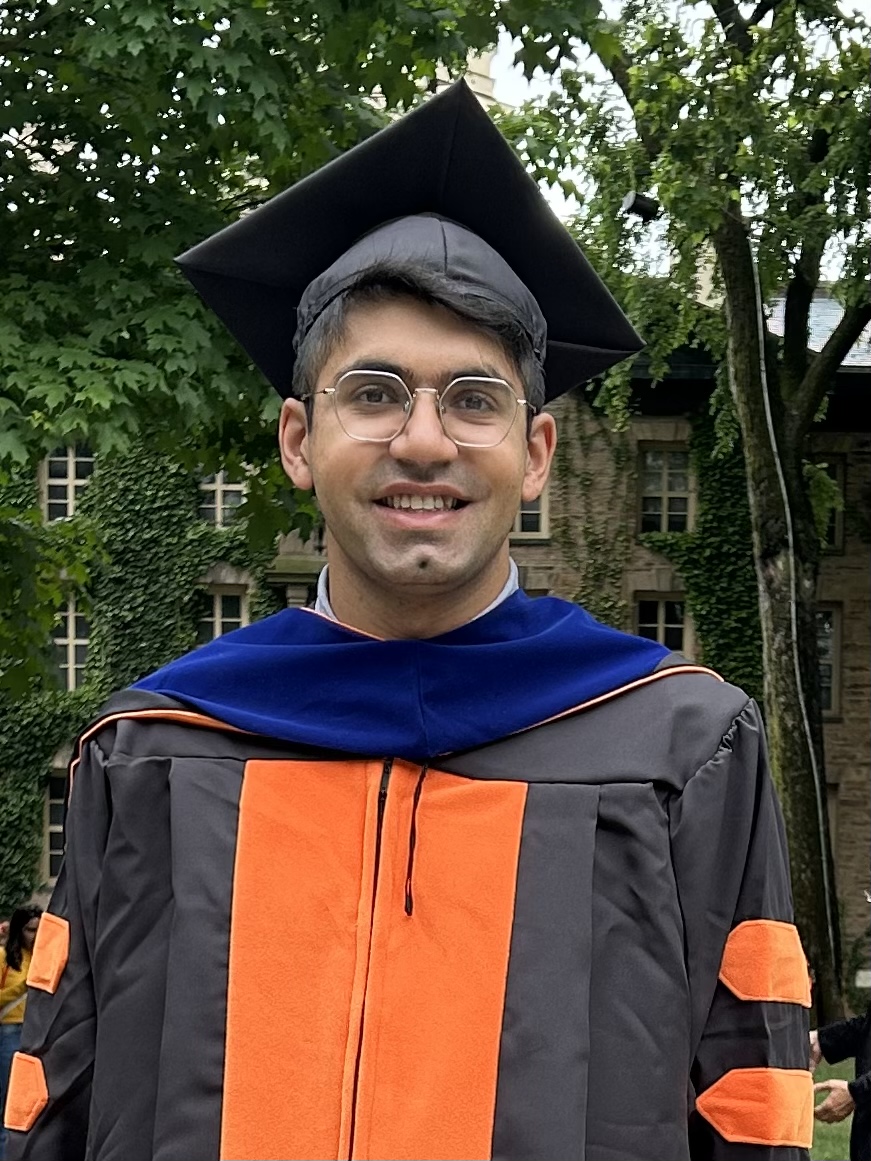
 Eshaan Nichani
· 2 previous affiliations
- Princeton UniversitySince 2021
- PhD student · Since 2021
- MS student · 2020–2021
- Undergrad student · 2016–2020
Research Overview
Eshaan Nichani focuses on the mathematical foundations of deep learning, specifically feature learning, optimization dynamics, and the mechanistic capabilities of transformers. His trajectory spans early work on implicit regularization in linear networks to establishing provable sample complexity advantages for deep feature learning. Most recently, he investigates how transformers acquire structural knowledge and factual recall during training.
Research Trajectory
Eshaan Nichani’s research trajectory begins with investigations into the implicit regularization of neural networks, particularly focusing on the mathematical structures that emerge naturally during training. Early work examined the area of Singular Vector Alignment in Deep Networks. In Balancedness and Alignment are Unlikely in Linear Neural Networks (2020), he explored whether alignment serves as the primary mechanism for implicit regularization in deep linear models, questioning its ubiquity and role in generalization.
Moving beyond linear models, his focus shifted toward understanding how neural networks escape the "lazy training" or Neural Tangent Kernel (NTK) regime. This work contributes to the broader research direction of Beyond the Lazy Training Regime of Neural Networks. In Identifying good directions to escape the NTK regime and efficiently learn low-degree plus sparse polynomials (2022), he demonstrated how gradient-based algorithms can achieve better sample complexity than the NTK by actively learning features, tying into the area of Feature Learning to Overcome the Curse of Dimensionality.
This foundation led to a series of theoretical breakthroughs in 2023 regarding the capabilities of three-layer neural networks. He established rigorous proofs in the research direction of The Sample Complexity Advantage of Feature Learning. In Learning Hierarchical Polynomials with Three-Layer Neural Networks, he proved that these networks can efficiently learn hierarchical functions by optimizing internal features and link functions sequentially, significantly outperforming kernel methods. This was expanded in two closely related works, Provable Guarantees for Nonlinear Feature Learning in Three-Layer Neural Networks and its corresponding publication Provable Guarantees for Nonlinear Feature Learning in Three-Layer Neural Networks, which provided a concrete optimization-based depth separation by showing that three-layer networks trained with gradient descent can learn nonlinear features that two-layer networks cannot. This body of work advanced the theoretical understanding of Joint Optimization for Deep Hierarchical Feature Learning.
Parallel to his work on feature learning, he investigated the optimization dynamics of modern neural networks. With collaborators, he analyzed the phenomenon of progressive sharpening in Self-Stabilization: The Implicit Bias of Gradient Descent at the Edge of Stability (2023), contributing to the research direction of Gradient Descent at the Edge of Stability by detailing how training sharpness hovers at the boundary of instability.
In recent years, his trajectory has expanded to the mechanistic and theoretical analysis of transformer architectures. In 2024, he investigated how these models acquire structural knowledge in How Transformers Learn Causal Structure with Gradient Descent. He subsequently developed a theoretical framework for memory and retrieval in Understanding Factual Recall in Transformers via Associative Memories (2025), proving that shallow transformers can achieve near-optimal storage capacity and identifying a "hallucination" stage during early training. Continuing this line of inquiry, he collaborated on Fine-Tuning Dynamics of In-Context Factual Recall in Transformers (2026), which formalized how large language models combine prompt examples with internal knowledge via unique pairwise attention patterns. Finally, he addressed the persistent challenge of sequence scaling in Quantitative Bounds for Length Generalization in Transformers (2026), providing theoretical bounds on the training data required for transformers to generalize to sequence lengths unseen during training.
Current Directions
Recent work investigates the theoretical and mechanistic properties of transformer architectures, particularly how they store, retrieve, and generalize information. A major focus is the formalization of factual recall, modeling how transformers act as associative memories and how they integrate encyclopedic knowledge with in-context prompt examples during fine-tuning. Additionally, current research addresses the mathematical bounds of length generalization, seeking to quantify the exact data requirements necessary for language models to successfully process sequences longer than those encountered during pre-training.
Profile updated
Loading new papers…
Other researchers whose papers cluster into the same research directions — a proxy for overlapping technical interests and shared intellectual neighborhoods.
See something wrong? Report a mistake