

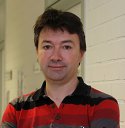
 Eneko Agirre
· 1 previous affiliation
- University of the Basque CountrySince 1999
- Full Professor · Since 1999
Research Overview
Eneko Agirre focuses on natural language processing, specifically advancing word sense disambiguation, semantic textual similarity, and cross-lingual representation learning. His trajectory spans early foundational work in Basque language technologies and graph-based lexical semantics to recent methodologies for adapting large language models across diverse linguistic contexts. Currently, he investigates zero-shot information extraction, vision-language compositionality, and robust evaluation frameworks for generative models.
Research Trajectory
Agirre’s early research established foundational computational resources for morphologically rich languages. In the early 1990s, he led the development of XUXEN: A Spelling Checker/Corrector for Basque Based on Two-Level Morphology, applying two-level morphology to Basque. By the mid-1990s, his focus expanded into lexical semantics, particularly word sense disambiguation (WSD). He introduced Word Sense Disambiguation using Conceptual Density, leveraging conceptual distance to identify intended meanings. He further explored the area of Ordered Decision Lists for Linguistic Disambiguation through comparative studies like Decision Lists for English and Basque, examining how syntactic and semantic processing adapts to flexible word order.
Moving into the 2000s, his work shifted toward unsupervised and graph-based methods for WSD. He optimized parameters for unsupervised induction in Two graph-based algorithms for state-of-the-art WSD. This research matured into the broader direction of Graph Based Word Sense Disambiguation, culminating in comprehensive approaches like Random Walks for Knowledge-Based Word Sense Disambiguation. This algorithm utilized large lexical knowledge bases like WordNet and contributed to the broader area of Coarse Grained Word Sense Disambiguation. Concurrently, he helped establish the evaluation of semantic similarity, organizing SemEval-2012 Task 6: A Pilot on Semantic Textual Similarity. This initiative formalized the area of Continuous Scales for Semantic Similarity and laid groundwork for the direction of Interpretable Semantic Similarity Metrics.
In the late 2010s, Agirre’s research transitioned into cross-lingual representation learning. He guided the development of A robust self-learning method for fully unsupervised cross-lingual mappings of word embeddings, which exploited structural similarities in embedding spaces without relying on parallel data. He synthesized this growing field in his comprehensive overview, Cross-Lingual Word Embeddings. Returning to his roots in low-resource and typologically distinct languages, he directed IKER-GAITU: Research on Language Technology for Basque and Other Low-Resource Languages, advancing the direction of Continual Pre-training for Cross-Lingual Language Adaptation. He also oversaw Event Extraction in Basque: Typologically motivated Cross-Lingual Transfer-Learning Analysis, analyzing how shared linguistic characteristics impact transfer quality.
More recently, his trajectory addresses the capabilities, adaptation, and evaluation of large language models (LLMs). In information extraction, he guided the development of GoLLIE: Annotation Guidelines improve Zero-Shot Information-Extraction and GUIDEX: Guided Synthetic Data Generation for Zero-Shot Information Extraction, using LLM pipelines to automate schema design and data labeling. He also introduced new evaluation paradigms, such as the PhrasIS: Phrase Inference and Similarity benchmark and WiCkeD: A Simple Method to Make Multiple Choice Benchmarks More Challenging, which mitigates process-of-elimination shortcuts in AI evaluation.
Continuing his work on cross-lingual adaptation, he proposed EnerGIZAr: Leveraging GIZA++ for Effective Tokenizer Initialization, utilizing statistical word alignment to map embeddings for new languages. He further investigated the mechanics of this adaptation in Emergent Abilities of Large Language Models under Continued Pre-training for Language Adaptation, revealing how omitting English data can disrupt in-context learning. Finally, expanding into multimodal domains, he collaborated on Adding simple structure at inference improves Vision-Language Compositionality, addressing the "bag-of-words" bias in vision-language models, and participated in the creation of TABLET: A Large-Scale Dataset for Robust Visual Table Understanding, grounding visual reasoning in complex real-world document layouts.
Current Directions
The most recent work in the evidence addresses the adaptation, evaluation, and multimodal expansion of large language models. A primary focus is cross-lingual language adaptation, specifically investigating how to effectively initialize tokenizers for new languages and understanding the parameter dynamics that cause models to lose in-context learning abilities during continued pre-training. In parallel, recent research explores zero-shot information extraction, utilizing LLM pipelines to automate schema design and generate synthetic training data for complex domains.
Another major theme is the robust evaluation of generative models. This includes developing methodologies to prevent models from relying on process-of-elimination shortcuts in multiple-choice benchmarks, ensuring that evaluations measure genuine reasoning rather than dataset artifacts. Finally, current directions extend into multimodal AI, focusing on improving vision-language compositionality to overcome "bag-of-words" biases and building large-scale datasets to teach models how to parse and understand complex visual tables in real-world document layouts.
Profile updated
Loading new papers…
Other researchers whose papers cluster into the same research directions — a proxy for overlapping technical interests and shared intellectual neighborhoods.
See something wrong? Report a mistake