

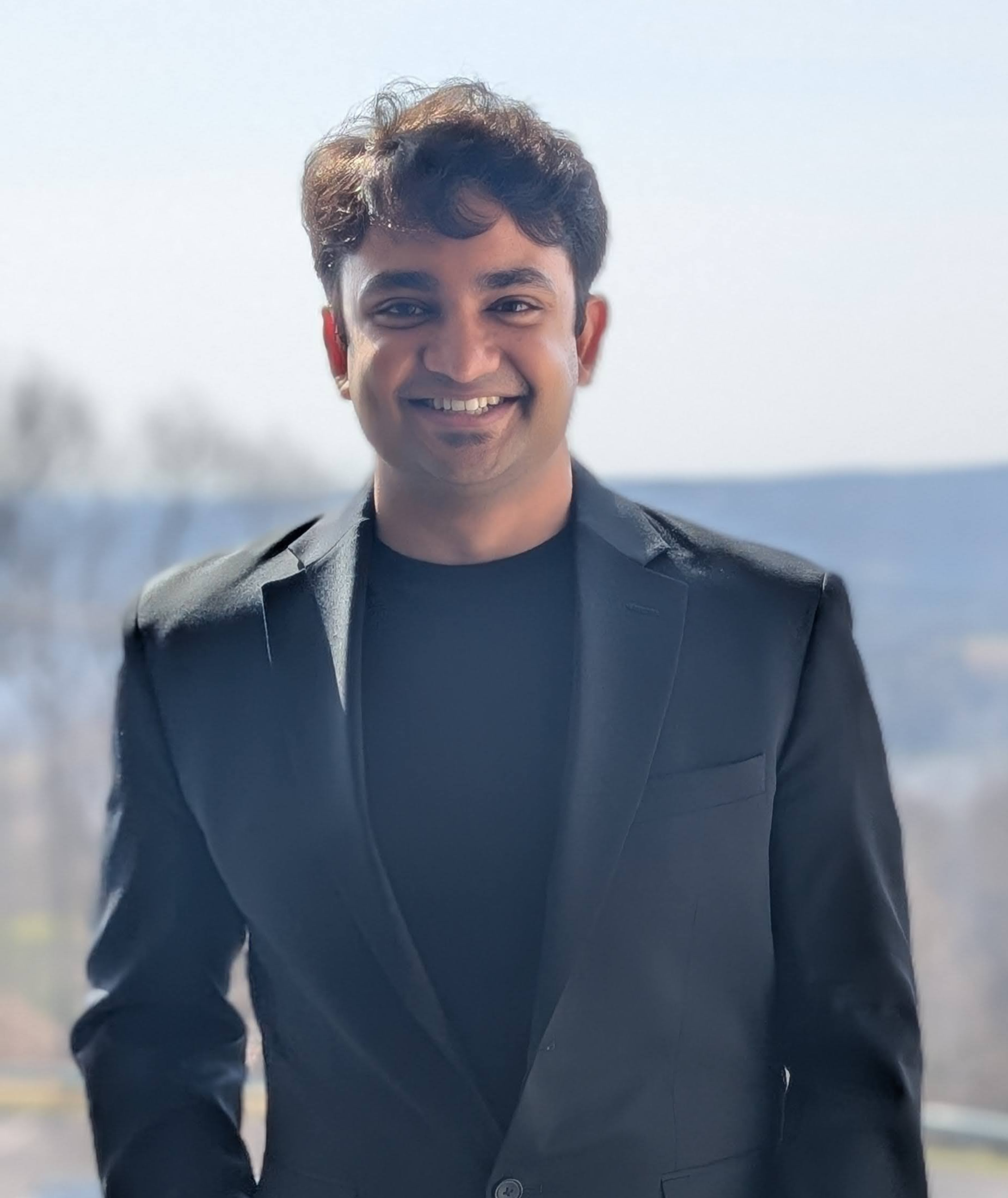
 Eashan Adhikarla
· 4 previous affiliations
- LenovoSince 2026
- Saff Researcher, AI Model · Since 2026
- Intern · 2022–2024
- Lehigh University2020–2026
- PhD student · 2020–2026
- Master of Science - MS, Computer Science
- PhD Summer Intern · 2021
- Data Science Intern · 2019
- Persistent Systems (India)2016
- AI/ML Intern · 2016
Research Overview
Eashan Adhikarla focuses on computer vision, adversarial robustness, and efficient image enhancement. His early work explored defense mechanisms against adversarial attacks using memory-masking autoencoders to purify perturbed inputs. More recently, he investigates computationally efficient architectures, such as frequency state space models, for low-light image enhancement and mixed exposure correction on edge devices.
Research Trajectory
Adhikarla’s research trajectory begins with investigations into the security and reliability of deep learning models, specifically addressing their vulnerability to adversarial attacks. In 2022, he developed Memory Defense: More Robust Classification via a Memory-Masking Autoencoder. This work counters adversarial perturbations—tiny, calculated modifications designed to trigger misclassification—by purifying input images before they reach the classifier. By isolating class-specific features and masking out irrelevant data during the reconstruction phase, the framework mitigates latent space confusion. This contribution advances the broader area of Mechanisms for Adversarial Resilience in Neural Networks by demonstrating how autoencoder-based purification can improve classification robustness without requiring fundamental changes to the downstream model.
Following this work on model robustness, Adhikarla shifted his focus toward computational efficiency and image restoration, particularly for resource-constrained environments. In 2024, he introduced ExpoMamba: Exploiting Frequency SSM Blocks for Efficient and Effective Image Enhancement. Recognizing that state-of-the-art foundation models like transformers and diffusion models are often too computationally expensive for edge devices, this research proposes a novel architecture that integrates frequency state space model (SSM) components into a modified U-Net. The resulting model is specifically optimized to handle mixed exposure challenges and low-light conditions efficiently. This research intersects with several key domains, including the research direction of Enhancing Low-Light Images for Downstream Machine Vision and the area of Decoupling Style and Structure with Fourier Phase and Amplitude. By balancing computational constraints with high-fidelity outputs, the work also contributes to the field of Preserving Chromatic Fidelity in Image Restoration and the broader area of Multi-Resolution Training for Scale-Invariant Neural Networks.
Current Directions
The most recent papers in the evidence indicate a strong focus on efficient architectures for computational photography and image restoration. Adhikarla is currently investigating how state space models can be adapted for high-resolution vision tasks that traditionally rely on computationally heavy architectures. A primary theme in this recent work is the optimization of these models for edge devices, ensuring that complex tasks like mixed exposure correction and low-light enhancement can be performed with minimal latency and hardware overhead. Additionally, this research explores frequency-domain processing to maintain structural and chromatic fidelity, addressing the specific challenges of deploying advanced restorative vision models in resource-constrained environments.
Profile updated
Loading new papers…
Other researchers whose papers cluster into the same research directions — a proxy for overlapping technical interests and shared intellectual neighborhoods.
See something wrong? Report a mistake