

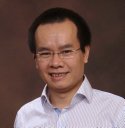
 Dzung T. Phan
· 1 previous affiliation
- Researcher · Since 2010
Research Overview
Dzung T. Phan focuses on mathematical optimization, distributed algorithms, and interpretable machine learning. His trajectory spans early work in distributed control for energy systems to foundational contributions in non-convex optimization, anomaly detection, and deep learning theory. Recently, his research addresses scalable federated learning and the development of inherently interpretable models for complex industrial and clustering applications.
Research Trajectory
His early research focused on distributed optimization methods for physical infrastructure and imaging systems. In 2012, he developed distributed algorithms for energy grids, specifically addressing security-constrained optimal power flow in Distributed methods for solving the security-constrained optimal power flow problem and designing mechanisms for fair electric vehicle charging under transmission constraints in A distributed scheme for fair EV charging under transmission constraints. Around the same time, he participated in research applying variable splitting techniques to total variation-based image reconstruction for partially parallel magnetic resonance imaging in Fast Algorithms for Image Reconstruction with Application to Partially Parallel MR Imaging.
By 2016, his focus expanded to time-series analysis and anomaly detection. He contributed to the research direction of Explaining and Diagnosing Distribution Shifts through work on Change Detection Using Directional Statistics, which leveraged regularized maximum likelihood equations for the von Mises-Fisher distribution to detect changes in noisy multivariate time-series data. He then introduced novel sparsity-constrained models for sensor networks, developing an $\ell_0$-constrained Gaussian graphical model for anomaly localization in A Novel l0-Constrained Gaussian Graphical Model for Anomaly Localization. This interest in complex system monitoring continued with Multi-task Multi-modal Models for Collective Anomaly Detection, where he helped design a multi-task learning framework using sparse mixtures of Gaussian graphical models to detect collective anomalies across multiple operational states.
In 2019, his work increasingly engaged with the theoretical foundations of deep learning and stochastic optimization. He oversaw research characterizing convex objective functions to establish optimal expected convergence rates for stochastic gradient descent in Characterization of Convex Objective Functions and Optimal Expected Convergence Rates for SGD. He also collaborated on modified SARAH algorithms for finite-sum smooth non-convex optimization in Optimal Finite-Sum Smooth Non-Convex Optimization with SARAH. In the broader area of Reparameterization Invariant Sharpness in Deep Learning, he participated in developing a mathematically rigorous, scale-invariant flatness measure based on Riemannian geometry to better understand neural network generalization in A Scale Invariant Flatness Measure for Deep Network Minima.
Returning to sparsity and discrete optimization in 2020, he proposed $\ell_0$-constrained optimization models for the layer-by-layer pruning of deep neural networks in Pruning Deep Neural Networks with $\ell_{0}$-constrained Optimization. He also contributed to the area of Scalable Global Optimization of Decision Trees by helping formulate a mixed-integer programming approach based on a 1-norm support vector machine model to train optimal binary oblique decision trees in A Scalable MIP-based Method for Learning Optimal Multivariate Decision Trees. His work on temporal event data included participation in a cardinality-regularized Hawkes-Granger model to address singularities in sparse causal learning in Cardinality-Regularized Hawkes-Granger Model. Concurrently, he applied regression optimization to physical systems, introducing a generalized prediction-optimization framework for system-level production control in Regression Optimization for System-level Production Control.
Most recently, his trajectory has encompassed federated learning and interpretable machine learning. He contributed to the research directions of Distributed Optimization with Inexact Local Updates and Scaling Decentralized Optimization for Real-World Federated Learning through the development of FedDR, a randomized Douglas-Rachford splitting algorithm for nonconvex federated composite optimization in FedDR – Randomized Douglas-Rachford Splitting Algorithms for Nonconvex Federated Composite Optimization. In the industrial domain, he collaborated on an AI-based prediction and set-point recommendation engine for process manufacturing in AI-Based Real-Time Site-Wide Optimization for Process Manufacturing. Finally, advancing the area of Geometric Concept Representation with Convex Polyhedra, he participated in designing a novel interpretable clustering framework that constructs explanatory polytopes around discovered data clusters in Interpretable Clustering via Multi-Polytope Machines.
Current Directions
The most recent papers in the evidence indicate a dual focus on scalable distributed optimization and inherently interpretable machine learning, often applied to complex industrial systems. Work in federated learning addresses the challenges of statistical and system heterogeneity through asynchronous, randomized splitting algorithms for nonconvex composite optimization. Simultaneously, recent research emphasizes interpretability in unsupervised learning, utilizing geometric structures like convex polytopes to explain data clusters. This theoretical work is complemented by applied research into AI-driven, site-wide optimization frameworks that integrate machine learning predictions with set-point controls for process manufacturing.
Profile updated
Loading new papers…
Other researchers whose papers cluster into the same research directions — a proxy for overlapping technical interests and shared intellectual neighborhoods.
See something wrong? Report a mistake