

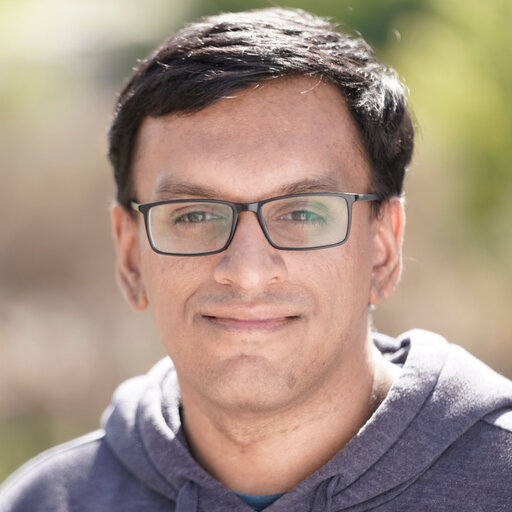
 Druv Pai
· 5 previous affiliations
- Thinking Machines LabSince 2026
- Member of Technical Staff · Since 2026
- University of California, BerkeleySince 2018
- PhD student · 2023–2027
- Current
- Course Staff · 2020–2024
- Master of Science - MS, Electrical Engineering and Computer Science · 2022–2023
- Bachelor of Arts - BA, Computer Science · 2018–2022
- Student Researcher · Since 2021
- Student Researcher · 2025
- Nexusflow2024
- Machine Learning Engineer Intern · 2024
Research Overview
Druv Pai focuses on developing principled methodologies for large-scale deep learning, representation learning, and the mathematical foundations of neural architectures. His trajectory spans from classical subspace learning to the derivation of mathematically interpretable, white-box transformer models. Most recently, his work investigates the mechanics of memorization in generative models and the design of efficient, linear-time attention mechanisms.
Research Trajectory
His early research established mathematical foundations for representation learning by bridging classical subspace methods with modern deep learning. In 2022, he introduced a framework for this in Pursuit of a Discriminative Representation for Multiple Subspaces via Sequential Games. This work framed representation learning as a sequential game, utilizing the principle of rate reduction to prove that a closed-loop system can perfectly recover and orthogonalize low-dimensional subspaces from high-dimensional data.
In 2023, this mathematical foundation was extended to transformer architectures. He contributed to the development of mathematically interpretable models in White-Box Transformers via Sparse Rate Reduction, addressing the broader research direction of Self-Explainable Neural Networks without Performance Loss. This line of inquiry sought to replace heuristic components with principled, sparse coding blocks. Alongside this, he investigated how architectural design influences emergent properties, demonstrating in Emergence of Segmentation with Minimalistic White-Box Transformers that segmentation capabilities can arise from proper architectural constraints rather than relying solely on complex self-supervised learning mechanisms.
Throughout 2024, his research expanded on these interpretable architectures and their underlying geometry. He led the development of CRATE-MAE in Masked Completion via Structured Diffusion with White-Box Transformers, linking data compression and denoising diffusion to create a parameter-efficient, mathematically interpretable model for large-scale unsupervised learning. To further solidify the theoretical grounding of these methods, he participated in analyzing the optimization landscape of the Maximal Coding Rate Reduction objective in A Global Geometric Analysis of Maximal Coding Rate Reduction, proving that its local maximizers consistently yield high-quality representations. Concurrently, he explored explicit geometric structures in Representation Learning via Manifold Flattening and Reconstruction, introducing a layer-wise autoencoder that iteratively flattens data manifolds into linear subspaces.
His work also scaled these principled models to competitive performance levels. In Scaling White-Box Transformers for Vision, he and his collaborators introduced CRATE-$\alpha$, demonstrating that interpretable models can match the accuracy of standard architectures on large-scale benchmarks like ImageNet-1K. Shifting focus to the internal mechanics of large language models, he investigated extreme-token phenomena in Active-Dormant Attention Heads: Mechanistically Demystifying Extreme-Token Phenomena in LLMs. This research identified an active-dormant mechanism explaining how specific attention heads become sinks for domain-specific inputs.
In 2025, his focus broadened to include architectural simplification, computational efficiency, and the dynamics of generative models. He contributed to the area of Preventing Representation Collapse in Joint Embedding Architectures through Simplifying DINO via Coding Rate Regularization, which streamlines self-supervised vision models. Continuing the refinement of transformer architectures, he participated in designing the Attention-only Transformer in Attention-Only Transformers via Unrolled Subspace Denoising, proving that self-attention alone, when framed as a subspace denoising problem, can linearly improve the signal-to-noise ratio without relying on multi-layer perceptrons.
Addressing computational bottlenecks, he contributed to the research direction of Linear Attention for Sub-quadratic Sequence Modeling with the introduction of the Token Statistics Transformer in Token Statistics Transformer: Linear-Time Attention via Variational Rate Reduction. This work replaces quadratic-time self-attention with a linear-scaling mechanism derived from white-box optimization principles, advancing the broader field of Overcoming the Softmax Summation Constraint in Transformers. Finally, he explored the theoretical boundaries of generative models in On the Edge of Memorization in Diffusion Models. This research provides a mathematical framework to predict the phase transition between generalization and memorization, contributing to the areas of Understanding Training Data Memorization in Generative Models and Data Duplication and the Mechanics of Model Memorization.
Current Directions
The most recent papers in the evidence indicate a dual focus on optimizing transformer architectures for efficiency and understanding the fundamental limits of generative models. One major current direction involves stripping down and scaling transformer components, such as replacing quadratic self-attention with linear-time mechanisms and removing multi-layer perceptrons entirely to rely on unrolled subspace denoising. Concurrently, recent work investigates the theoretical dynamics of diffusion models, specifically mapping the mathematical phase transitions where models shift from generalizing to memorizing their training data. This dual emphasis continues to bridge rigorous mathematical theory with the practical demands of large-scale deep learning.
Profile updated
Loading new papers…
Other researchers whose papers cluster into the same research directions — a proxy for overlapping technical interests and shared intellectual neighborhoods.
See something wrong? Report a mistake