

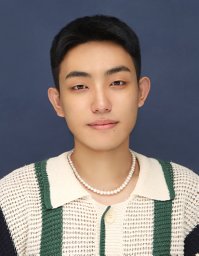
 Donghwan Kim
· 3 previous affiliations
- Current
- Doctor of Philosophy - PhD, Computer Science · 2025
- Master of Science - MS, Computer Science · 2023–2025
- Undergrad student · 2018–2022
- PLUME.D2022–2024
- Researcher · 2023–2024
- Developer · 2022–2023
- Student Intern · 2021
2 other authors named Donghwan Kim: Donghwan Kim (Korea Advanced Institute of Science and Technology · 23 papers), Donghwan Kim (1 paper)
Research Overview
Donghwan Kim focuses on 3D human reconstruction, human mesh recovery, and the modeling of articulated hand and body dynamics. His trajectory spans from neural 4D representations of hand motion to generative diffusion frameworks that resolve severe occlusions in monocular video. Most recently, his work investigates physics-based reconstruction of human interactions with deformable objects and autoregressive modeling on rotation manifolds.
Research Trajectory
Early work involved collaborative research in the area of Temporal Consistency for Dynamic 3D Reconstruction. With co-authors, he contributed to FourierHandFlow: Neural 4D Hand Representation Using Fourier Query Flow (2023), a method for generating spatio-temporally continuous hand shapes directly from monocular RGB videos. By parameterizing hand trajectories as a series of Fourier coefficients, this approach ensures smooth, jitter-free motion. This work also intersects with the broader research direction of Temporal Correspondence for Dynamic Point Clouds and the field of Disentangling Skeletal Articulation from Non-Rigid Surface Deformation, offering a highly efficient alternative to previous 4D implicit methods.
Building on these foundations in dynamic modeling, he introduced Multi-hypotheses Conditioned Point Cloud Diffusion for 3D Human Reconstruction from Occluded Images (2024). Addressing the challenge of severe occlusion in human reconstruction, this pipeline integrates a multi-hypothesis conditioning mechanism with point cloud diffusion. The framework effectively infers missing body parts and corrects misaligned shape priors, improving reconstruction accuracy in both synthetic and real-world environments.
Continuing his focus on generative approaches for human pose, he developed LieHMR: Autoregressive Human Mesh Recovery with SO(3) Diffusion (2025). This framework models the inherent depth ambiguity of 2D images by applying diffusion processes directly on the SO(3) rotation manifold, advancing the research direction of Riemannian Manifolds for Articulated Human Motion. By separating a hierarchical transformer from a per-joint denoising model—a technique relevant to the area of Decoupling Static Context from Iterative Denoising—the system achieves high accuracy on clear images while generating diverse, plausible 3D poses for highly ambiguous scenes.
Current Directions
The most recent papers in the evidence address the physical interactions between humans and their environments, particularly focusing on the area of Surface-Aware 3D Human Motion Modeling. Recent collaborative work investigates the dense 3D reconstruction of hands interacting with non-rigid objects, such as cloth or plush materials, from sparse-view RGB-D video. In PhysHanDI: Physics-Based Reconstruction of Hand-Deformable Object Interactions (2026), he and his collaborators explore driving a spring-mass physics simulation with a dense 3D hand mesh. By utilizing inverse physics to refine hand poses, this direction aims to produce human-object interactions that are both visually accurate and physically plausible, bridging the gap between kinematic pose estimation and dynamic physical simulation.
Profile updated
| Paper | Venue | Year |
|---|---|---|
| FourierHandFlow: Neural 4D Hand Representation Using Fourier Query FlowGitHubjyunlee/ | NeurIPS | 2023 |
Loading new papers…
Other researchers whose papers cluster into the same research directions — a proxy for overlapping technical interests and shared intellectual neighborhoods.
See something wrong? Report a mistake