

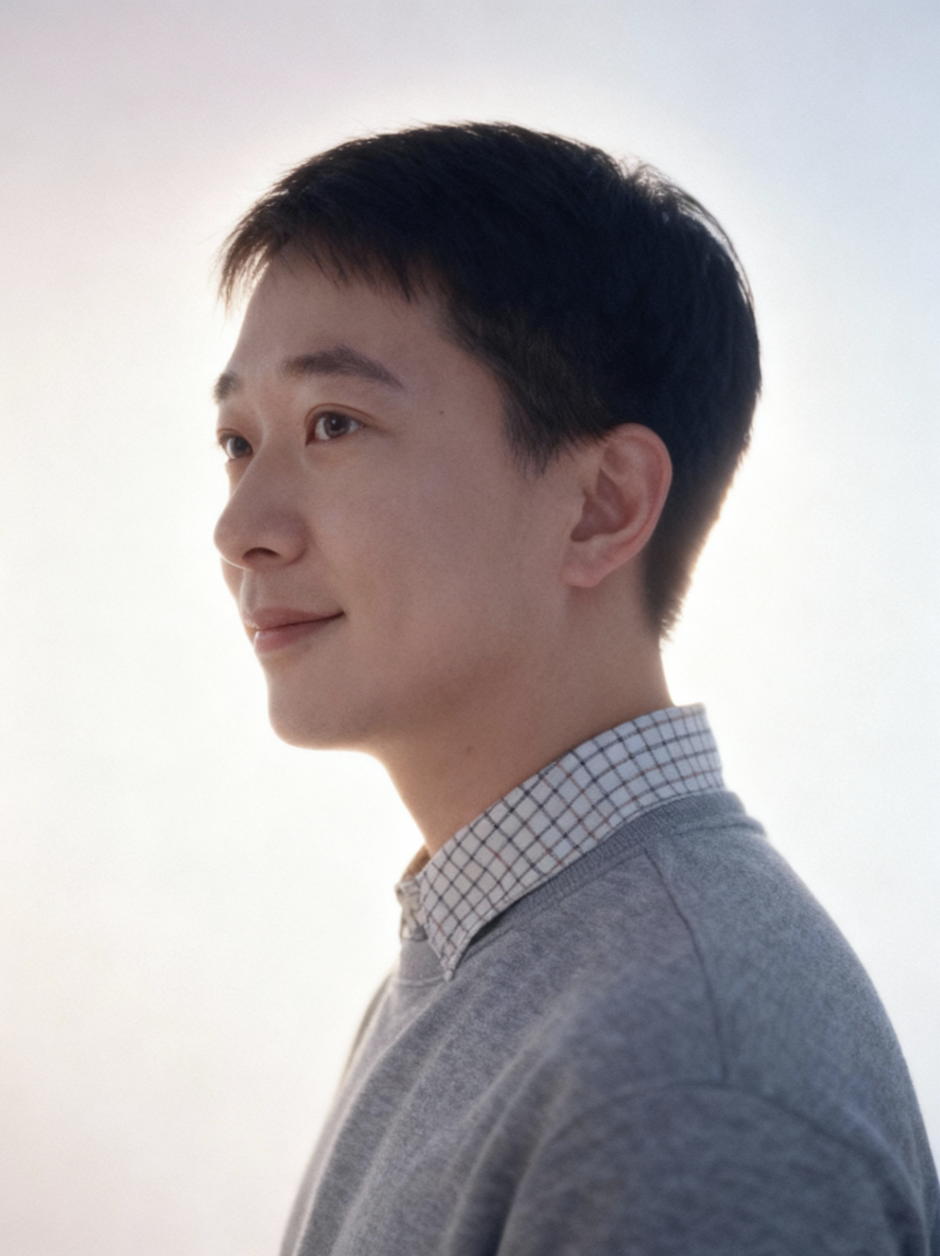
 Dong Zhang
· 3 previous affiliations
- Full Professor · Since 2025
- PhD student · 2017–2021
- Assistant Professor · 2023–2025
- Postdoc · 2022–2023
- Nanyang Technological University2018–2020
- Intern · 2018–2020
6 other authors named Dong Zhang: Dong Zhang (20 papers), Dong Zhang (14 papers), Dong Zhang (6 papers), Dong Zhang (University of Akron · 4 papers), Dong Zhang (3 papers), and 1 more
Research Overview
Dong Zhang focuses on computer vision, dense image prediction, and medical image analysis, with a particular emphasis on efficient neural architectures and weakly-supervised learning. His trajectory spans from foundational work on feature pyramids and semantic segmentation to the development of hybrid CNN-Transformer models for complex visual tasks. Currently, he investigates memory-efficient adapters, deepfake detection, and algorithm-hardware co-design for high-resolution vision.
Research Trajectory
Dong Zhang's early research included applied prediction models, such as his work on Robust learning-based prediction for timber-volume of living trees in 2017, before transitioning to core computer vision challenges. In 2020, he addressed weakly-supervised semantic segmentation by introducing a causal inference framework to mitigate confounding context in Causal Intervention for Weakly-Supervised Semantic Segmentation. Concurrently, he developed the Feature Pyramid Transformer, which enabled active feature interactions across both spatial dimensions and scales to capture non-local contexts. He expanded on segmentation reliability in 2021 with Self-Regulation for Semantic Segmentation, proposing self-regulation losses that balance the use of detailed features and broader visual contexts without requiring additional supervision.
Moving into 2023 and 2024, his focus broadened to efficient architectures and the research direction of Backbone Agnostic Modular Enhancements for dense image predictions. During this period, he developed the Centralized Feature Pyramid for Object Detection and subsequently introduced CAE-GReaT: Convolutional-Auxiliary Efficient Graph Reasoning Transformer for Dense Image Predictions, aiming to improve the representational capacity of models handling complex visual scenes.
In 2025, his research expanded significantly into medical image analysis and specialized visual recognition tasks. He introduced PHNet in Boosting Convolution With Efficient MLP-Permutation for Volumetric Medical Image Segmentation, a hybrid network addressing data anisotropy and long-range dependencies in 3D medical scans. This work contributed to several intersecting areas, including the direction of Hybrid CNN-Transformer Architectures for Global-Local Vision, the area of Volumetric Neural Networks for Anisotropic Spatial Resolution, work in the area of Preserving Tiny Features Against Spatial Resolution Degradation, and the broader field of Fusing Local Textures and Global Context in Neural Networks. Alongside medical imaging, he tackled diverse visual challenges, developing a confluent triple-flow network in Divide-and-Conquer: Confluent Triple-Flow Network for RGB-T Salient Object Detection and addressing spatial precision in Eliminating Semantic Ambiguity in Human Pose Estimation via Stable Feature Upsampling. Further contributions to video and scene analysis included Mitigating Query Selection Bias in Referring Video Object Segmentation and CrossNet: Cross-Scene Background Subtraction Network via 3D Optical Flow.
Bridging algorithm design and hardware efficiency, he collaborated on A 28nm 0.22μJ/Token Memory-Compute-Intensity-Aware CNN-Transformer Accelerator with Hybrid-Attention-Based Layer-Fusion and Cascaded Pruning for Semantic-Segmentation, addressing the high memory and computation overheads of hybrid models. Complementing this hardware-aware approach, he introduced the META framework in Memory Efficient Transformer Adapter for Dense Predictions, designed to eliminate hidden bottlenecks like frequent tensor reshaping in Vision Transformers, advancing the research direction of Linear Complexity Attention via Dimensional Decomposition. Simultaneously, he explored visual security and robustness, proposing multi-exit architectures in Robustifying vision transformer for image forgery localization with multi-exit architectures and a novel detection approach in A recover-then-discriminate framework for robust anomaly detection. Extending this focus on visual integrity into 2026, his research includes ADNet: Delving into generalizable deepfake detection via adaptive expert selection and discrepancy learning, which aims to improve the generalization of deepfake detection models across diverse manipulations.
Current Directions
Recent work investigates the intersection of efficient neural architectures and robust visual security. A major ongoing theme is the optimization of Vision Transformers for dense prediction tasks, focusing on reducing memory consumption and inference latency through structural normalization and adapter design. Concurrently, his research addresses the growing challenge of image forgery and anomaly detection, developing generalizable frameworks capable of identifying deepfakes and localized manipulations across diverse and unseen datasets. He also continues to advance medical image analysis, particularly in handling anisotropic volumetric data through hybrid CNN-Transformer designs that balance local precision with global context.
Profile updated
Loading new papers…
Other researchers whose papers cluster into the same research directions — a proxy for overlapping technical interests and shared intellectual neighborhoods.
See something wrong? Report a mistake