

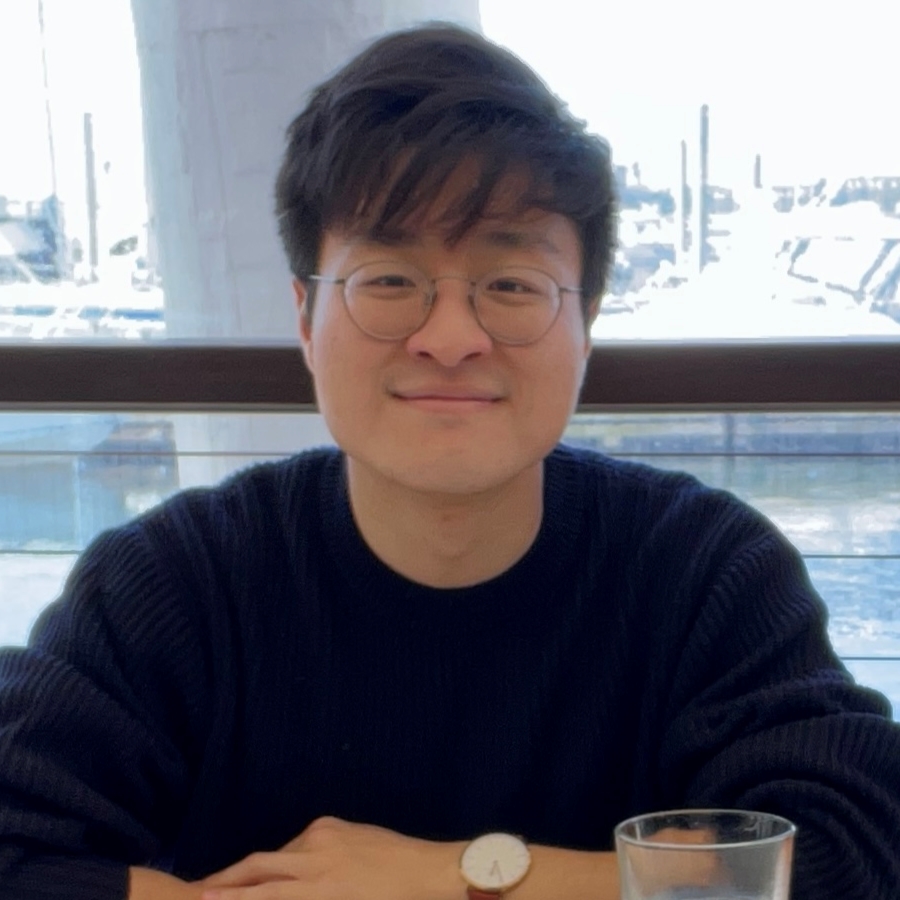
 Dong-Ki Kim
· 6 previous affiliations
- FieldAISince 2024
- Staff Research Scientist · Since 2024
- LG AI Research (South Korea)2023–2024
- Research Scientist · 2023–2024
- PhD student · 2020–2023
- MS student · 2017–2020
- Carnegie Mellon University2016–2017
- Visiting Student · 2016–2017
- Visiting Student · 2016
- Cornell Tech2013–2016
- Undergrad student · 2013–2016
Research Overview
Dong-Ki Kim focuses on multiagent reinforcement learning, embodied artificial intelligence, and robot learning. His early work addressed non-stationarity and long-term behavior influence in multiagent systems, establishing theoretical foundations for cooperative learning. His current research investigates the integration of large language models with robotic control and web navigation, emphasizing robust sim-to-real transfer and latency-aware execution for dynamic physical tasks.
Research Trajectory
Kim’s early research trajectory includes foundational contributions to safe and cooperative multiagent systems. His work engaged with the area of Safe Reinforcement Learning via Constrained Markov Decision Processes and the broader research direction of Stabilizing Primal-Dual Dynamics in Constrained Reinforcement Learning. He also explored architectural constraints in neural networks, contributing to the area of The Global Workspace as a Neural Communication Bottleneck and Modular Recurrent Architectures for Latent Factorization. In the domain of multiagent coordination, his research addressed Safe Multi-Agent Reinforcement Learning with Coupled Constraints, laying the groundwork for his subsequent focus on non-stationarity in learning environments.
In 2022, Kim extensively investigated how individual agents can anticipate and shape the learning processes of others in shared environments. He introduced a novel game-theoretic solution concept in Game-Theoretical Perspectives on Active Equilibria: A Preferred Solution Concept over Nash Equilibria, demonstrating that "Active Equilibria" enable more cooperative and efficient outcomes than traditional stationary concepts like Nash Equilibria. This theoretical framework was further detailed in a related preprint, Game-Theoretical Perspectives on Active Equilibria: A Preferred Solution Concept over Nash Equilibria, which highlighted applications in classic scenarios such as the Prisoner's Dilemma. Concurrently, he addressed the moving target problem inherent in multiagent systems. In Influencing Long-Term Behavior in Multiagent Reinforcement Learning, published at ICLR, he developed an approach that allows agents to influence the evolution of interacting agents' future policies, overcoming the limitations of myopic evaluation. This methodology was also expanded upon in a parallel manuscript, Influencing Long-Term Behavior in Multiagent Reinforcement Learning, which further formalized the mechanisms for escaping suboptimal equilibria in non-stationary environments.
Transitioning toward the integration of generative foundation models and reinforcement learning, Kim explored cooperative prompt optimization. With collaborators, he developed MultiPrompter: Cooperative Prompt Optimization with Multi-Agent Reinforcement Learning, a framework that treats prompt generation as a cooperative game where multiple AI agents iteratively construct prompts, significantly improving upon single-agent methods for image generation. During his tenure as a Research Scientist at LG AI Research, his focus expanded to deploying large language models as autonomous agents for complex navigation tasks. He introduced Auto-Intent: Automated Intent Discovery and Self-Exploration for Large Language Model Web Agents, a system that injects domain-specific intents as natural language hints. By discovering compact subgoals from human demonstrations, Auto-Intent enables LLMs to perform "self-exploration" and reason through multiple paths, drastically improving success rates on real-world websites. Applying similar principles to physical domains, he developed SayComply: Grounding Field Robotic Tasks in Operational Compliance through Retrieval-Based Language Models. This hierarchical retrieval-augmented generation approach grounds robotic task planning in domain-specific operational manuals, ensuring that autonomous systems strictly adhere to safety protocols and site-specific procedures absent from general-purpose training data.
In his recent work, including his role as a Staff Research Scientist at FieldAI, Kim has concentrated heavily on robust robotic control, sim-to-real transfer, and embodied reasoning. He addressed the complexities of unified whole-body loco-manipulation in StageACT: Stage-Conditioned Imitation for Robust Humanoid Door Opening, augmenting a transformer-based policy with task-stage inputs to double the success rate of humanoid robots opening unseen doors. Recognizing the limitations of standard zero-delay assumptions in robot learning, he introduced Delay-Aware Diffusion Policy: Bridging the Observation-Execution Gap in Dynamic Tasks. This framework explicitly models inference latency by re-syncing training data and conditioning the policy on measured delays, proving highly effective for high-speed tasks like robotic ping-pong.
Expanding the temporal and spatial scope of robotic reasoning, Kim developed Enter the Mind Palace: Reasoning and Planning for Long-term Active Embodied Question Answering. This system organizes episodic memories into structured, hierarchical scene graphs, allowing robots to reason across months of past experiences while actively exploring their environments. He also contributed to the geometric grounding of generative models in GrndCtrl: Grounding World Models via Self-Supervised Reward Alignment, utilizing Group Relative Policy Optimization to transform visually plausible video generators into reliable, physics-constrained simulators for 3D navigation. Most recently, he advanced the research direction of Scaling General Purpose Robotics via Vision Language Action Models through his participation in Simulation Distillation: Pretraining World Models in Simulation for Rapid Real-World Adaptation. This 2026 ICLR publication introduces SimDist, a framework that distills structural knowledge from simulation to pretrain world models, enabling highly data-efficient and stable adaptation to real-world robotic tasks.
Current Directions
Recent work investigates the deployment of foundation models and diffusion policies for robust robotic control in dynamic, real-world environments. The most recent papers in the evidence address the critical gaps between simulation and physical execution, particularly focusing on latency-aware reinforcement learning and the geometric grounding of video generation models. This includes developing hierarchical memory structures for long-term embodied question answering and pretraining world models in simulation to enable rapid, data-efficient adaptation to physical tasks. A central theme across these recent contributions is the integration of physical constraints and operational compliance into generative architectures, ensuring that autonomous agents can safely and reliably execute complex, long-horizon loco-manipulation tasks.
Profile updated
| Paper | Venue | Year |
|---|---|---|
| TOD-Flow: Modeling the Structure of Task-Oriented DialoguesGitHubsrsohn/ | EMNLP | 2023 |
Loading new papers…
Other researchers whose papers cluster into the same research directions — a proxy for overlapping technical interests and shared intellectual neighborhoods.
See something wrong? Report a mistake