

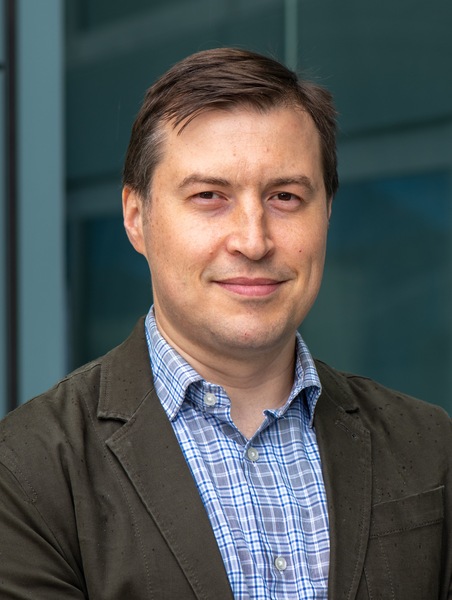
 Dmitriy Morozov
· 4 previous affiliations
- Lawrence Berkeley National LaboratorySince 2013
- Researcher · Since 2013
- Stanford University2008–2010
- Postdoc · 2008–2010
- Duke University2003–2008
- PhD student · 2003–2008
- North Carolina State University2001–2003
- Undergrad student · 2001–2003
Research Overview
Dmitriy Morozov focuses on computational topology, computational geometry, and their applications to data analysis. His trajectory spans the development of foundational algorithms for persistent homology to the integration of topological methods into machine learning and distributed systems. Recent work investigates scalable algorithms for topological data analysis and the application of topological priors to scientific machine learning and protein self-assembly.
Research Trajectory
Early work established core algorithmic foundations for topological data analysis (TDA). This included the development of dynamic algorithms for updating persistence in linear time, detailed in Vines and vineyards by updating persistence in linear time. He also explored methods for testing expansion and Inferring Local Homology from Sampled Stratified Spaces. Expanding the algebraic flexibility of TDA, he formalized Zigzag persistent homology and real-valued functions, allowing for simplex deletions alongside insertions, and introduced techniques to compute Persistent homology for kernels, images, and cokernels.
Building on these algebraic foundations, he applied persistent cohomology to nonlinear dimensionality reduction. In Persistent Cohomology and Circular Coordinates, he introduced an approach to automatically detect and extract cyclical structures by mapping data to a circle. This work contributed to the broader research area of Tracking Structural Features with Persistent Homology and the direction of Scaling Topological Data Analysis for Deep Learning.
As datasets grew in complexity, his focus expanded to high-performance computing (HPC) and distributed systems. He addressed the need for scalable deep learning training by exploring fault tolerance in Towards Low-Overhead Resilience for Data Parallel Deep Learning, proposing methods to recover data-parallel jobs without relying solely on traditional checkpoint-restart mechanisms. To accelerate topological computations across diverse hardware architectures, he developed a portable GPU-accelerated implementation of the triplet merge tree algorithm in Fast Merge Tree Computation via SYCL.
A major theme of his recent trajectory involves pushing the theoretical and practical boundaries of TDA algorithms. He bridged a long-standing gap in the field with Persistent (Co)Homology in Matrix Multiplication Time, demonstrating how to compute persistent homology as fast as theoretically possible while retaining the geometric cycles that define topological features. He also advanced the computation of compatible representative cycles for zigzag filtrations in A Fast Algorithm for Computing Zigzag Representatives, contributing to the area of Fast Persistent Homology through Cohomological Duality and Clearing. Further expanding the algebraic toolkit, he addressed the bottleneck of computing multigraded modules in large datasets with Computing Betti tables and minimal presentations of zero-dimensional persistent homology. To handle massive spatial datasets, he introduced Cadmus, a distributed algorithm detailed in Distributed Computation of Persistent Cohomology, which combines domain and range partitioning to achieve significant strong scaling improvements over prior state-of-the-art solvers.
Parallel to these algorithmic improvements, he has integrated topological methods directly into machine learning optimization pipelines. In Topological regularization via persistence-sensitive optimization, he proposed a method that avoids back-propagating gradients through a black-box persistence diagram, instead building on persistence-sensitive optimization to provide more expressive control over solution roughness. He further accelerated these processes in Topological Optimization with Big Steps, leveraging internal cycles and chains to update critical sets of simplices simultaneously, thereby reducing the required optimization steps by an order of magnitude.
Most recently, his work has applied these scalable algorithms and topological priors to complex scientific domains. In Topological potentials guiding protein self-assembly, he collaborated to develop a long-range guiding bias based on persistent homology, significantly increasing the success rates of protein assembly simulations. He also introduced scalable methods for general metric spaces in Distributed-Memory Parallel Algorithms for Fixed-Radius Near Neighbor Graph Construction, utilizing optimized cover trees to process million-point datasets. In the domain of scientific machine learning, he participated in investigating compute-optimal training regimes for foundation models in On Neural Scaling Laws for Weather Emulation through Continual Training.
Current Directions
The most recent papers in the evidence address the intersection of scalable distributed algorithms and scientific machine learning. Current work investigates the application of topological priors to complex biological simulations, such as using persistent homology to guide protein self-assembly. Additionally, recent efforts focus on distributed-memory parallel algorithms for constructing near-neighbor graphs in general metric spaces and characterizing neural scaling laws for weather emulation, highlighting a broader commitment to building efficient, foundation-scale models for scientific domains.
Profile updated
Loading new papers…
Other researchers whose papers cluster into the same research directions — a proxy for overlapping technical interests and shared intellectual neighborhoods.
See something wrong? Report a mistake