

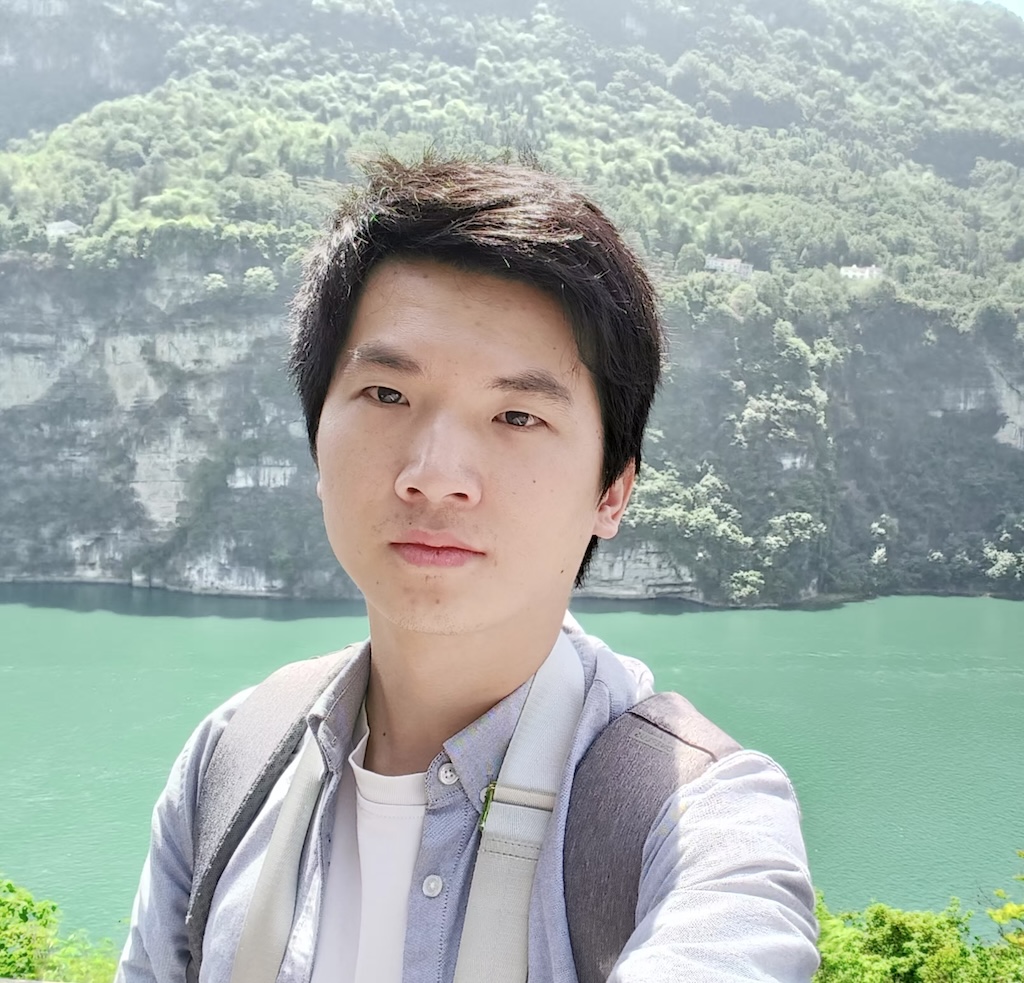
 Dingkang Liang
· 1 previous affiliation
- Assistant Professor · Since 2026
- PhD student · 2022–2025
- MS student · 2019–2022
Research Overview
Dingkang Liang focuses on embodied AI, 3D vision, world models, and dense object analysis. His work spans from scalable crowd counting and semi-supervised object detection to efficient point cloud processing and unified driving world models. Recently, he investigates multimodal reasoning and parallel task execution for embodied agents.
Research Trajectory
The early trajectory of this research focused on dense object analysis, particularly in the domain of crowd counting and localization. Addressing the challenge of extreme scale variations in dense scenes, he introduced AutoScale: Learning to Scale for Crowd Counting, which proposed a module to automatically identify and rescale dense regions to a uniform scale. This work aligns with the broader area of Scalable Object Counting via Limited Supervision. Advancing beyond simple counting, he developed An End-to-End Transformer Model for Crowd Localization (CLTR), which framed localization as a direct set prediction problem to eliminate complex post-processing steps.
By 2023, the focus expanded to object detection under limited supervision paradigms. He developed SOOD: Towards Semi-Supervised Oriented Object Detection, contributing to the research direction of Oriented Object Detection with Weak Supervision. This framework introduced rotation-aware adaptive weighting and global consistency losses to handle objects at arbitrary angles in aerial imagery, advancing the area of Learning Oriented Bounding Boxes for Arbitrary Object Detection. This line of inquiry was subsequently expanded in SOOD++: Leveraging Unlabeled Data to Boost Oriented Object Detection, which refined the sampling and consistency mechanisms for dense aerial distributions. Extending these limited-supervision principles to 3D environments, he introduced A Simple Vision Transformer for Weakly Semi-supervised 3D Object Detection (ViT-WSS3D). By treating single-point labels as tokens that interact globally with the 3D scene, this method significantly reduced annotation requirements, contributing to the broader area of Learning Object Localization from Image Level Labels.
In 2024, the research shifted toward computational efficiency in 3D vision and point cloud analysis. To address the high resource costs of fine-tuning large pre-trained models, he proposed Dynamic Adapter Meets Prompt Tuning: Parameter-Efficient Transfer Learning for Point Cloud Analysis. Tackling the quadratic complexity of standard attention mechanisms, he developed PointMamba: A Simple State Space Model for Point Cloud Analysis, which adapted state space models to achieve linear-complexity global modeling for 3D data. Further optimizing vision transformers, he introduced Make Your ViT-Based Multi-view 3D Detectors Faster via Token Compression (ToC3D). This work contributes to the area of Hierarchical Token Pruning for Efficient Transformers by utilizing historical object queries as priors to identify and prioritize important foreground patches, thereby skipping redundant background computation.
Moving into 2025, the scope of work broadened to encompass generative models, unified world models, and embodied AI. In the generative space, he introduced Less is Enough: Training-Free Video Diffusion Acceleration via Runtime-Adaptive Caching (EasyCache), a framework that dynamically reuses computed data during stable denoising periods to accelerate video diffusion models. He also explored synthetic data generation, contributing to research directions such as Modality-Agnostic Learning through Randomized Image Synthesis, with A Unified Image-Dense Annotation Generation Model for Underwater Scenes (TIDE). This text-to-image framework produces realistic underwater images alongside perfectly aligned depth maps and semantic masks to improve downstream perception tasks.
Concurrently, he made significant contributions to autonomous driving through the development of unified world models. He proposed HERMES: A Unified Self-Driving World Model for Simultaneous 3D Scene Understanding and Generation, which leverages large language models and bird's-eye view representations to jointly master reasoning and point cloud prediction. This was complemented by Seeing the Future, Perceiving the Future: A Unified Driving World Model for Future Generation and Perception (UniFuture), which utilizes a dual-latent sharing scheme to ensure coherent predictions of both future appearance and geometry. In the realm of embodied AI, he introduced Cook and Clean Together: Teaching Embodied Agents for Parallel Task Execution, presenting a new dataset and agent architecture designed to optimize complex schedules in 3D environments using operations research principles.
Most recently, in 2026, his research has addressed the reasoning capabilities of multimodal large language models. He developed ThinkOmni: Lifting Textual Reasoning to Omni-modal Scenarios via Guidance Decoding, a training-free framework that employs dynamic guidance decoding to transfer the advanced logic of text-based reasoning models into omni-modal contexts. Additionally, he participated in research on efficient reinforcement learning frameworks for multimodal models, contributing to Shuffle-R1: Efficient RL framework for Multimodal Large Language Models via Data-centric Dynamic Shuffle.
Current Directions
The most recent papers in the evidence address the intersection of multimodal reasoning, embodied decision-making, and generative world models. Recent work investigates how large language models can be adapted for omni-modal scenarios without extensive retraining, focusing on dynamic decoding strategies to elicit complex, "slow-thinking" reasoning from multimodal inputs. Concurrently, there is a strong emphasis on building unified world models for autonomous systems that can simultaneously perceive 3D geometry, understand complex scenes, and generate coherent future states. In the embodied AI space, current research explores parallel task execution, enabling agents to optimize complex schedules and improve efficiency in interactive 3D environments.
Profile updated
Loading new papers…
Other researchers whose papers cluster into the same research directions — a proxy for overlapping technical interests and shared intellectual neighborhoods.
See something wrong? Report a mistake