

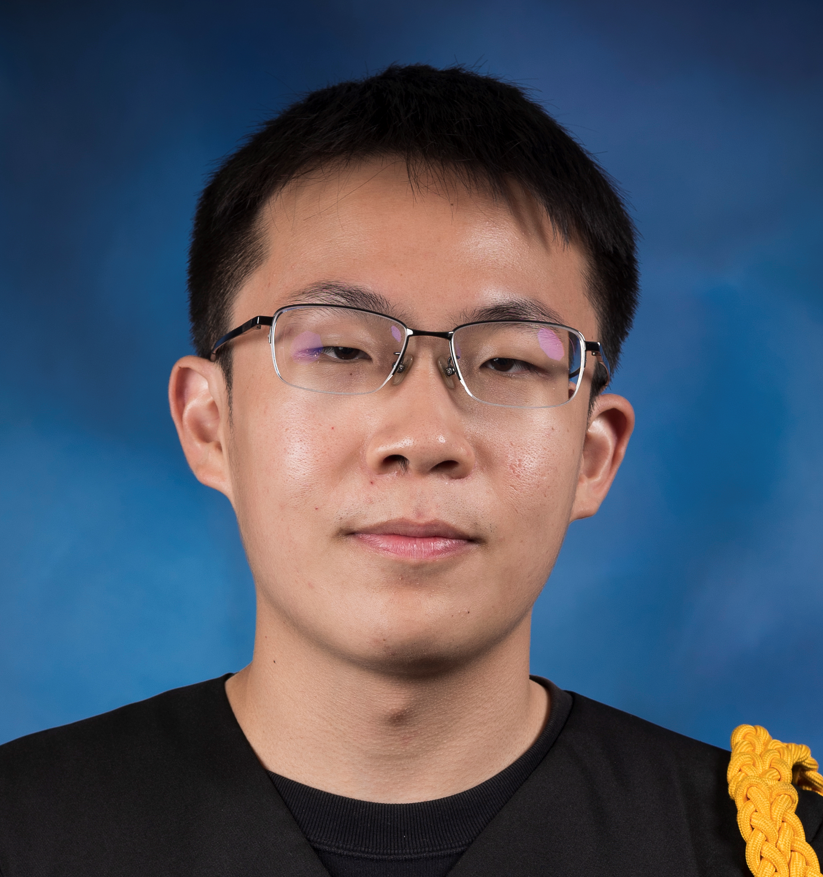
 Di Wu
· 2 previous affiliations
- University of California, Los AngelesSince 2022
- PhD student · 2022–2027
- Current
- Discover2018–2022
- Undergrad student · 2018–2022
26 other authors named Di Wu: Di Wu (Sun Yat-sen University · 258 papers), Di Wu (Elsevier BV (Netherlands) · Association for Computing Machinery · Institute of Electrical and Electronics Engineers · La Trobe University · Association for the Advancement of Artificial Intelligence · 191 papers), Di Wu (McGill University · Concordia University · 171 papers), Di Wu (Harbin Institute of Technology · 25 papers), Di Wu (Hunan University · 22 papers), and 21 more
Research Overview
Di Wu focuses on building trustworthy knowledge-augmented language models, information retrieval mechanisms, and long-term memory systems for artificial intelligence. His early work explored efficient keyphrase generation and adaptive retrieval, establishing methods for models to selectively access external context. More recently, his research addresses the evaluation and architectural design of persistent memory for interactive chat assistants and autonomous agents.
Research Trajectory
Wu's early trajectory heavily emphasized keyphrase generation (KPG) and the adaptation of pre-trained language models for specialized information extraction. In Pre-trained Language Models for Keyphrase Generation: A Thorough Empirical Study, he and his collaborators conducted a comprehensive evaluation of architectural choices, demonstrating that domain-specific pre-training and asymmetric encoder-decoder designs yield highly data-efficient performance. This foundational investigation was expanded in Rethinking Model Selection and Decoding for Keyphrase Generation with Pre-trained Sequence-to-Sequence Models, which examined how models distill documents into both explicitly present phrases and conceptually relevant absent keyphrases. He later investigated the efficacy of alternative architectures for these tasks in On Leveraging Encoder-only Pre-trained Language Models for Effective Keyphrase Generation, comparing in-domain encoder-only models against sequence-to-sequence alternatives across varied resource settings and noting specific advantages when paired with Conditional Random Fields.
Recognizing the limitations of rigid exact-match metrics in KPG, Wu introduced a multi-dimensional framework in KPEval: Towards Fine-grained Semantic-based Evaluation of Keyphrase Extraction and Generation Systems. This work incorporates semantic similarity, faithfulness, and diversity to better align with human judgment, advancing the research direction of Efficient Model-Based Evaluation for Generative AI and contributing to the area of Semantic Redundancy Penalization for Diverse Language Generation. Concurrently, he explored cross-task generalization in large language models. As a contributor to Active Instruction Tuning: Improving Cross-Task Generalization by Training on Prompt Sensitive Tasks, he helped develop a framework that selects informative training data based on "prompt uncertainty"—a measure of a model's sensitivity to phrasing changes. This approach achieves better zero-shot performance with fewer tasks, aligning with the broader field of Sample Selection Guided by Model Uncertainty.
Moving into 2024, Wu's focus shifted toward optimizing and securing Retrieval-Augmented Generation (RAG) systems. He led the development of a selective retrieval framework for code generation in Repoformer: Selective Retrieval for Repository-Level Code Completion. By training models to self-evaluate when external repository context is necessary, this approach significantly accelerates inference by skipping unnecessary retrievals, directly advancing the research direction of Reducing Computational Overhead in Retrieval-Augmented Systems. To address the reliability of RAG outputs, he introduced a real-time monitoring system in Synchronous Faithfulness Monitoring for Trustworthy Retrieval-Augmented Generation. This system, paired with a faithfulness-oriented decoding algorithm, detects and mitigates mid-sentence deviations from source material, contributing to the areas of Fine-Grained Hallucination Detection and Localization and Universal Internal Signatures of LLM Hallucinations. Returning to keyphrase extraction with a new paradigm, he also presented MetaKP: On-Demand Keyphrase Generation, which leverages self-consistency prompting to generate keyphrases tailored to specific user intents rather than relying on a one-size-fits-all approach.
In his most recent work, Wu has concentrated on the architecture and evaluation of long-term memory in interactive AI systems. He proposed a sophisticated source selection mechanism in Self-Routing RAG: Binding Selective Retrieval with Knowledge Verbalization, which allows LLMs to verbalize internal knowledge and use a kNN-augmented router to minimize expensive external queries. His research also extends to autonomous agents; he participated in the development of LLMs as Scalable, General-Purpose Simulators For Evolving Digital Agent Training, a framework that synthesizes diverse user interface states to train highly capable, smaller-parameter digital agents that rival much larger models. To rigorously measure these capabilities, Wu introduced LongMemEval: Benchmarking Chat Assistants on Long-Term Interactive Memory, revealing significant performance degradation in commercial systems when recalling information from lengthy interaction histories. He subsequently expanded this evaluation paradigm with LongMemEval-V2: Benchmarking Agent Memory for Experienced Colleagues, a massive benchmark testing whether AI agents can learn from past interactions in complex web environments, alongside a novel memory management system framed as a file-search task.
Current Directions
The most recent papers in the evidence address the integration of persistent memory into large language models and the training of autonomous digital agents. Recent work investigates how chat assistants and coding agents manage, retrieve, and reason over extensive interaction histories, framing memory management as an active search and retrieval problem rather than relying solely on expanded context windows. Additionally, current research explores the use of LLMs as scalable simulators to generate synthetic environments for agent training, as well as advanced routing mechanisms that allow models to dynamically choose between verbalizing internal knowledge and querying external databases to improve both efficiency and accuracy.
Profile updated
Loading new papers…
Other researchers whose papers cluster into the same research directions — a proxy for overlapping technical interests and shared intellectual neighborhoods.
See something wrong? Report a mistake