

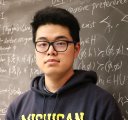
 Dengwang Tang
· 5 previous affiliations
- eBay IncSince 2024
- Researcher · Since 2024
- Current
- Postdoc · 2022–2024
- Postdoc · 2021–2022
- University of Michigan2014–2021
- PhD student · 2016–2021
- Undergrad student · 2014–2016
- Shanghai Jiao Tong University2012–2016
- Undergrad student · 2012–2016
Research Overview
Dengwang Tang focuses on randomized algorithms, dynamic games, and reinforcement learning. Early work explored load balancing and graph exploration using random walks, while subsequent research addressed asymmetric information in multi-agent systems. The most recent focus involves pure exploration and constrained optimization within multi-armed bandit frameworks.
Research Trajectory
Tang's early research addressed mechanism design and resource allocation, engaging with themes such as The EFX Existence Problem for Indivisible Items. In 2016, Tang co-authored Approximately Envy-Free Spectrum Allocation with Complementarities, which proposed a polynomial-time mechanism for combinatorial auctions where agents' valuations exhibit complementarities. By modifying an iterative rounding procedure from assignment problems, the work demonstrated how to construct lotteries for allocations and assess bundle prices efficiently.
Between 2018 and 2019, Tang's focus shifted toward randomized algorithms and queuing theory, specifically the "balls-in-bins" load balancing problem. This work contributed to the research direction of Non-Backtracking Random Walks for Efficient Graph Exploration and touched upon the broader area of Local Weak Convergence in Sparse Random Graphs. In Balanced Allocation on Graphs with Random Walk Based Sampling (2018), Tang investigated policies where sampled bins are determined by non-backtracking random walks on regular graphs, rather than uniform random sampling. This approach was further developed in Derandomized Load Balancing using Random Walks on Expander Graphs (2019), which analyzed a low-randomness variant of the power-of-$d$ choices algorithm. The research demonstrated that under certain graph assumptions, the queuing system's dynamics converge to a deterministic ordinary differential equation, offering a rigorous theoretical foundation for derandomized dispatching schemes in large computing centers.
By 2021, Tang began investigating stochastic dynamic games and multi-agent systems, addressing challenges related to the research area of Managing the Combinatorial Explosion in Multi-Agent Learning. A primary focus was how teams operate under asymmetric information and delayed communication. In Dynamic Games Among Teams with Delayed Intra-Team Information Sharing (published in 2023), Tang and collaborators characterized Nash equilibria in environments where team members share observations with a delay. The work identified subclasses of strategies where agents can make decisions based on compressed versions of their private information, mitigating the difficulties of an increasing domain of strategies over time.
During this period, Tang also participated in research bridging imitation learning and reinforcement learning, relating to the broader area of Inferring Environment Dynamics from Expert Actions. As a co-author on Bridging Imitation and Online Reinforcement Learning: An Optimistic Tale (2023), Tang contributed to the development of posterior sampling-based algorithms that leverage offline demonstration datasets from imperfect experts to bootstrap online learning performance in Markov Decision Processes.
Most recently, Tang's trajectory has expanded into multi-armed bandits and pure exploration problems. In 2025, Tang led the work Pure Exploration for Constrained Best Mixed Arm Identification with a Fixed Budget, which introduced a parameter-free algorithm for identifying the optimal probability distribution over a subset of arms that maximizes expected reward while satisfying multiple cost constraints.
Current Directions
The most recent papers in the evidence indicate a focus on constrained optimization within multi-armed bandit frameworks, specifically aligning with the research direction of Boundary Relative Pure Exploration. Current work investigates how to efficiently identify optimal mixed strategies under fixed sampling budgets when both rewards and multiple cost attributes are drawn from distributions with unknown means. This involves developing parameter-free algorithms that balance exploration and exploitation while strictly adhering to expected cost constraints, extending traditional pure exploration techniques into more complex, multi-attribute decision-making environments.
Profile updated
Loading new papers…
Other researchers whose papers cluster into the same research directions — a proxy for overlapping technical interests and shared intellectual neighborhoods.
See something wrong? Report a mistake