

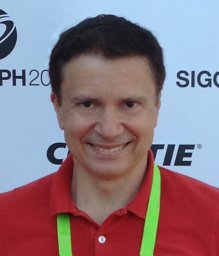
 Demetri Terzopoulos
· 7 previous affiliations
- DiscoverSince 2005
- Full Professor · Since 2005
- University of California, Los AngelesSince 2005
- Distinguished Professor and Chancellor's Professor of Computer Science · Since 2005
- VoxelCloudSince 2016
- Co-Founder and Chief Scientist · Since 2016
- University of Toronto1989–2005
- Full Professor · 1989–2005
- New York University2000–2005
- Full Professor · 2000–2005
- PhD student · 1980–1984
- Master of Engineering (MEng), Bachelor of Engineering (Honours BEng), EE
Research Overview
Demetri Terzopoulos focuses on computer vision, computer graphics, and physics-based modeling, particularly the intersection of artificial life and biomechanical simulation. His trajectory spans early work on deformable models and active contours to the development of autonomous virtual agents with biomimetic perception. Recently, his research addresses multi-agent reinforcement learning and the distillation of 3D motion from video priors.
Research Trajectory
In the 1980s, research in early vision reconstruction frequently encountered mathematically ill-posed inverse problems. To address the challenge of preserving spatial discontinuities during reconstruction, he introduced controlled-continuity stabilizers in Regularization of Inverse Visual Problems Involving Discontinuities. Building on energy-minimizing frameworks, his group subsequently developed Snakes: Active contour models. This work introduced splines guided by external constraints and image forces to accurately localize visual features such as edges, lines, and subjective contours.
Throughout the 1990s, this research on deformable models expanded into three dimensions and physical simulation. He explored parameterized geometries integrated with physical dynamics in Dynamic 3D Models with Local and Global Deformations: Deformable Superquadrics. These physics-based approaches naturally extended to biomechanical and behavioral modeling, leading to the development of Artificial Fishes, which simulated locomotion, perception, and behavior in virtual environments. Concurrently, he applied physical modeling to human features, detailing methods for synthesizing realistic expressions in Realistic modeling for facial animation.
The synthesis of artificial life and computer vision culminated in Animat Vision: Active Vision in Artificial Animals. This work positioned autonomous virtual robots in physics-based worlds, requiring them to actively control their gaze and bodies to navigate purposefully. This paradigm contributed to the research direction of Foveated Architectures for Efficient and Goal Directed Vision and the broader area of closing the sim-to-real gap in robotics. The core deformable model research also found significant application in healthcare, as synthesized in Deformable models in medical image analysis: a survey, which detailed how geometry and physics could segment and track anatomical structures, advancing automated segmentation for scalable radiomics.
In the early 2000s, his research incorporated multilinear algebra to disentangle complex visual factors. With collaborators, he developed Multilinear Analysis of Image Ensembles: TensorFaces, utilizing an N-mode singular value decomposition to separate facial geometry, expression, and illumination. Later work integrated deep learning and interactive systems into spatial and visual analysis. This included Automated Layout Synthesis and Visualization from Images of Interior or Exterior Spaces, which allowed users to automatically furnish scenes based on layout constraints. In facial recognition, his lab proposed AcFR: Active Face Recognition Using Convolutional Neural Networks, a system that mimics human observational behaviors—such as acquiring different viewpoints—to assess subjects. He also contributed to multimodal architectures, participating in the development of Attention-Based Natural Language Person Retrieval, which localized individuals in images based on textual descriptions using region proposal networks.
Returning to the intersection of biomechanics and active perception, he oversaw Learning Biomimetic Perception for Human Sensorimotor Control in 2018. This framework utilized deep neural networks to control a biomechanically accurate virtual human, teaching it to coordinate eye, head, and limb movements to intercept targets, further advancing end-to-end visuomotor control.
Most recently, his focus has expanded into multi-agent reinforcement learning (MARL) and generative animation. To address the "ad-hoc teaming" problem—where agents struggle to coordinate with unfamiliar teammates—his group introduced inverse attention mechanisms in Inverse Attention Agent in Multi-Agent System and the subsequent Inverse Attention Agents for Multi-Agent Systems. These models infer the goals of other actors, contributing heavily to the broader area of Robust Zero Shot Coordination with Unseen Partners. In parallel, he participated in research on distilling 3D motion from 2D video diffusion priors, as seen in AnimaMimic: Imitating 3D Animation from Video Priors, which combines automatic rigging with differentiable physics to animate static meshes.
Current Directions
The most recent papers in the evidence address the adaptability of autonomous agents and the generation of physically grounded 3D animations. In the domain of multi-agent reinforcement learning, current work investigates zero-shot coordination, specifically tackling the ad-hoc teaming problem where agents must dynamically adapt to unfamiliar teammates or adversarial actors in partially observable environments. Parallel research explores the intersection of generative AI and physics-based animation, focusing on methods to distill motion from 2D video diffusion models to automatically rig and animate 3D meshes while respecting physical laws and temporal coherence.
Profile updated
Loading new papers…
Other researchers whose papers cluster into the same research directions — a proxy for overlapping technical interests and shared intellectual neighborhoods.
See something wrong? Report a mistake