

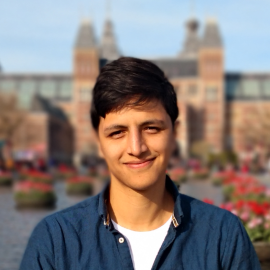
 David W. Romero
· 9 previous affiliations
- CartesiaSince 2025
- Research Scientist · Since 2025
- Cartesia AISince 2025
- Researcher · Since 2025
- Nvidia (United States)2023–2025
- Researcher · 2023–2025
- Vrije Universiteit Amsterdam2018–2024
- Doctor of Philosophy - PhD (cum laude), Efficient Deep Learning · 2018–2024
- Google (United States)2022–2023
- Student Researcher · 2022–2023
- Qualcomm (United States)2021–2022
- Intern · 2021–2022
- Research Consultant · 2021
- Technische Universität Berlin2016–2018
- Master of Science, Computational Engineering Sciences · 2016–2018
- Universidad Nacional de Colombia2010–2016
- Undergrad student · 2010–2016
Research Overview
David W. Romero focuses on improving the computational, parameter, and data efficiency of deep learning systems through continuous parameterizations and symmetry preservation. His trajectory spans foundational work on continuous convolutional kernels and equivariant neural networks to recent advancements in scalable generative modeling. Currently, he investigates high-fidelity visual generation and multi-hybrid architectures for large-scale sequence modeling.
Research Trajectory
The intellectual arc of Romero's work is comprehensively detailed in his dissertation, The Good, The Efficient and the Inductive Biases: Exploring Efficiency in Deep Learning Through the Use of Inductive Biases. This work articulates a core philosophy: leveraging continuous modeling and symmetry preservation to build highly efficient neural architectures.
Romero's early trajectory established foundational methods for integrating symmetries and continuous parameterizations into neural networks. He made significant contributions to the research direction of Continuous Kernel Parameterization, developing architectures that natively handle data at varying resolutions. His investigations during this period also advanced the area of Group Equivariant Self-Attention Mechanisms and the broader field of Stochastic Sampling for Continuous Group Equivariance. Recognizing that strict symmetries are often violated in real-world datasets, he expanded his focus to include the research direction of Soft and Adaptive Equivariance for Imperfect Symmetries and explored methods for Hierarchical Symmetry Relaxation in Deep Neural Networks. Additionally, his interest in expanding receptive fields efficiently led to contributions in the area of Global Context through Large Scale Convolutions.
Building on this foundation, he developed novel approaches to architecture search. In DNArch: Learning Convolutional Neural Architectures by Backpropagation, he introduced a framework that treats neural architectures as continuous entities. By utilizing differentiable masks, DNArch allows for the simultaneous learning of network weights and architectural parameters—such as depth, width, and kernel sizes—in a single training run, bypassing the need for predefined component lists or expensive retraining.
Expanding the application of equivariant networks, Wavelet Networks: Scale-Translation Equivariant Learning From Raw Time-Series addresses a gap in domains that traditionally focused on planar or volumetric data. By identifying scale and translation as core symmetries inherent to time-series, he constructed specialized equivariant neural networks that significantly improve data efficiency and generalization for 1D signals.
Transitioning to 3D data, he oversaw the development of Fast, Expressive SE(n) Equivariant Networks through Weight-Sharing in Position-Orientation Space. This architecture, known as PONITA, formalizes weight-sharing through optimal invariant attributes. It provides a highly expressive and computationally efficient alternative to existing methods for processing 3D point clouds, achieving state-of-the-art results across various geometric benchmarks.
In 2025, Romero's focus expanded significantly into generative AI and large-scale systems. Participating in collaborative efforts on 3D generation, he contributed to MFM-point: Multi-scale Flow Matching for Point Cloud Generation. This framework applies a coarse-to-fine strategy and distributional alignment to achieve high-fidelity point-based 3D modeling without the overhead of complex voxel or latent-based alternatives.
In the visual domain, he directed the research behind HMAR: Efficient Hierarchical Masked Auto-Regressive Image Generation. HMAR frames image generation as a Markovian process across resolution scales, incorporating multi-step masked refinement to significantly improve training speed and lower memory usage compared to prior autoregressive models.
Addressing the computational demands of large language models, he collaborated on Systems and Algorithms for Convolutional Multi-Hybrid Language Models at Scale. This work, centered on the StripedHyena 2 architecture, co-designs hardware-aware kernels that integrate specialized convolutional operators with attention mechanisms, breaking efficiency bottlenecks in standard Transformers at the 40-billion parameter scale.
Most recently, in 2026, he contributed to unsupervised symmetry discovery with RECON: Robust symmetry discovery via Explicit Canonical Orientation Normalization. RECON addresses the challenge of arbitrary orientations in class-pose machine learning by normalizing data to a natural pose, enabling rotation-invariant pre-trained models and robust out-of-distribution detection without requiring additional training.
Current Directions
The most recent papers in the evidence indicate a strong focus on scaling efficient generative models and hybrid architectures. Recent work investigates high-fidelity visual generation, framing image synthesis as a hierarchical, Markovian process to drastically reduce memory usage and training time. In parallel, research in 3D modeling explores multi-scale flow matching to generate unstructured point clouds efficiently. Beyond visual and spatial data, current efforts address the computational bottlenecks of large language models by co-designing hardware-aware kernels that hybridize specialized convolutions with attention mechanisms. Finally, ongoing investigations into unsupervised learning focus on robust symmetry discovery, developing normalization techniques that allow models to intrinsically align and process spatial data without relying on arbitrary orientation baselines.
Profile updated
Loading new papers…
Other researchers whose papers cluster into the same research directions — a proxy for overlapping technical interests and shared intellectual neighborhoods.
See something wrong? Report a mistake