

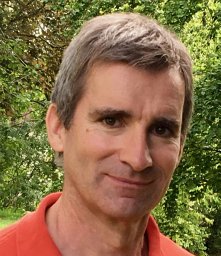
 David Rousseau
· 5 previous affiliations
- Researcher · Since 1999
- Current
- Directeur de recherche, physicien, spécialiste Intelligence Artificielle · Since 2009
- Chargé de recherche, physicien, spécialiste Higgs et développements logiciels · 1999–2009
- Chargé de recherche, physicien, spécialiste quark beau · 1992–1996
- Associé scientifique · 2010–2011
- Fellow · 1997–1999
- Habilitation à diriger des recherches (HDR), Physique des particules · 2007
- Université de la Méditerranée Aix-Marseille II1990–1992
- Doctorat, Physique des Hautes Energies · 1990–1992
Research Overview
David Rousseau focuses on the intersection of machine learning and high-energy particle physics, with a particular emphasis on handling systematic uncertainties in fundamental science. His trajectory spans the development of deep learning applications for collider experiments to the design of rigorous AI challenges and benchmarks. Recently, his work centers on robust scientific inference and uncertainty quantification for high-stakes physical measurements.
Research Trajectory
Rousseau’s early work in the provided corpus centers on the integration of machine learning into high-energy physics, particularly through the lens of community-wide data challenges. In 2016, he oversaw an analysis of the methods that successfully identified particle signatures, detailed in How machine learning won the Higgs boson challenge. This work highlighted the growing utility of advanced predictive models in collider experiments. He subsequently contributed to a comprehensive 2018 review, Machine learning at the energy and intensity frontiers of particle physics, which examined the expanding role of deep learning and other AI methods across experiments at facilities like the Large Hadron Collider.
As the adoption of AI in physics matured, Rousseau’s focus shifted toward the methodological rigor of these applications, specifically addressing how models handle systematic biases and physical uncertainties. In 2024, he introduced the FAIR Universe challenge in FAIR Universe – the challenge of handling uncertainties in fundamental science. This initiative uses simulated particle physics data with controlled biases to benchmark AI methods capable of reliably estimating physical parameters. This effort aligns with the broader research direction of Learning Beyond the Identically Distributed Assumption, pushing the community to develop models that remain robust when training and testing distributions diverge.
Alongside the design of specific scientific competitions, Rousseau has investigated the structural lifecycle of AI challenges to ensure their long-term utility. His 2024 paper, Towards impactful challenges: post-challenge paper, benchmarks and other dissemination actions, argues that the scientific value of a competition often fades without meticulous post-challenge curation. He provided a framework for transforming temporary competitions into enduring datasets, contributing to the area of Standardized Evaluation Protocols for Machine Learning Research.
Most recently, he collaborated on the launch of the FAIR Universe HiggsML Uncertainty Dataset and Competition (2025). This large-scale dataset bridges theoretical physics and practical AI by challenging participants to quantify systematic uncertainties in particle physics measurements, advancing work in the research direction of Distribution Free Uncertainty Quantification for High Stakes Prediction.
Current Directions
The most recent papers in the evidence indicate a sustained focus on uncertainty quantification and the creation of robust benchmarks for fundamental science. Rousseau is currently addressing the critical gap between theoretical physics simulations and practical AI deployment by developing frameworks that explicitly model systematic uncertainties. Rather than focusing solely on predictive accuracy, this recent work emphasizes the reliability of scientific inference when machine learning models encounter out-of-distribution data or experimental biases. Through the ongoing FAIR Universe initiatives, his efforts aim to establish standardized, enduring evaluation protocols that allow the physics and machine learning communities to rigorously test the limits of AI in high-stakes scientific discovery.
Profile updated
Loading new papers…
Other researchers whose papers cluster into the same research directions — a proxy for overlapping technical interests and shared intellectual neighborhoods.
See something wrong? Report a mistake