

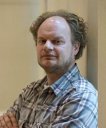
 David A. van Leeuwen
· 4 previous affiliations
- Radboud University NijmegenSince 2008
- Guest researcher · Since 2025
- Full Professor · 2008–2025
- Researcher · 1994–2011
- Leiden University1989–1993
- PhD student · 1989–1993
- Delft University of Technology1984–1989
- Undergrad student · 1984–1989
Research Overview
David A. van Leeuwen focuses on speech processing, speaker recognition, and biometric score calibration. His trajectory spans early large-scale multilingual speech evaluations to extensive collaborative efforts in noise-robust speaker verification and multimodal processing. The most recent work in his profile addresses large-scale speaker diarization and code-switching automatic speech recognition for bilingual broadcast archives.
Research Trajectory
David A. van Leeuwen’s research trajectory is characterized by a sustained engagement with speech processing, biometric evaluation, and large-scale collaborative system development. His early work involved participation in foundational European initiatives aimed at standardizing speech recognition evaluations. As a contributor to Multilingual large vocabulary speech recognition: the European SQALE project, he participated in adapting the ARPA evaluation paradigm for multilingual contexts, addressing cross-language performance, corpus design, and evaluation metrics.
In the early 2000s, van Leeuwen led research in information retrieval and feature extraction, serving as the senior author on TREC Feature Extraction by Active Learning. Throughout the following decade, his focus shifted heavily toward speaker recognition and verification, particularly in challenging acoustic environments. He became a frequent collaborator in major international evaluation campaigns, working alongside large consortiums to benchmark and improve verification systems. For instance, he contributed to The 2013 speaker recognition evaluation in mobile environment, which assessed state-of-the-art verification techniques—such as total variability modeling and system fusion—using the MOBIO database to simulate realistic mobile conditions.
A recurring methodological interest in van Leeuwen's work is the calibration and fusion of biometric scores. While much of this work originated in speaker recognition, he has also directed research applying these principles to other modalities. As the principal investigator on Score calibration in face recognition, he explored how calibration techniques could be adapted to improve the reliability and interpretability of facial recognition systems.
By the late 2010s, his research consolidated around the processing of complex, real-world audio archives, specifically focusing on speaker diarization and code-switching. Leading the work on Large-Scale Speaker Diarization of Radio Broadcast Archives, van Leeuwen and his team developed a two-stage diarization and linking scheme to process thousands of hours of historical Frisian-Dutch radio broadcasts, utilizing known speaker models to relate pseudo-speakers across decades of audio tapes.
Current Directions
The most recent papers in the evidence, dating to 2019, investigate the challenges of processing bilingual and historical speech archives. A primary focus is the development of robust automatic speech recognition (ASR) and diarization systems for code-switched speech, specifically within Frisian-Dutch radio broadcasts. This includes collaborative work on Multi-Graph Decoding for Code-Switching ASR, which proposes decoding and rescoring strategies that utilize both bilingual and monolingual graphs alongside a unified acoustic model. These recent efforts highlight an ongoing interest in applying advanced speech technologies to preserve, transcribe, and index complex, mixed-language cultural heritage data.
Profile updated
Loading new papers…
Other researchers whose papers cluster into the same research directions — a proxy for overlapping technical interests and shared intellectual neighborhoods.
See something wrong? Report a mistake