

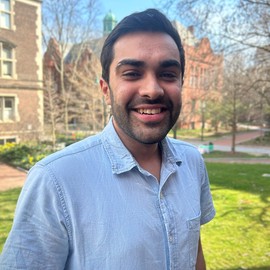
 Darshan Thaker
· 3 previous affiliations
- University of PennsylvaniaSince 2020
- PhD student · Since 2020
- Columbia University2018–2019
- MS student · 2018–2019
- The University of Texas at Austin2014–2018
- Undergrad student · 2014–2018
Research Overview
Darshan Thaker focuses on deep generative models, inverse problems, and adversarial robustness, with an emphasis on developing principled algorithms for inference-time steering. His trajectory spans early work in protein structure prediction and combinatorial optimization to foundational approaches for reverse-engineering adversarial attacks. Currently, his research addresses diffusion-based image restoration and the alignment and safety of large language models.
Research Trajectory
Thaker’s early research applied deep learning architectures to complex structural and combinatorial challenges. In 2019, he developed a deep learning-based pipeline for 3D protein structure prediction directly from amino acid sequences. This work, detailed in Accurate Protein Structure Prediction by Embeddings and Deep Learning Representations, utilized embeddings and encoder-decoder architectures to predict intermediate distance matrices and torsion angles. This contribution advanced several biological modeling areas, including the research directions of Decoding Protein Folds from Evolutionary Sequence Variation, Modeling Multi-Protein Assemblies and Quaternary Structures, and Protein Modeling with Shallow Multiple Sequence Alignments. During the same period, he participated in the development of Graph Pointer Networks for the Traveling Salesman Problem in Combinatorial Optimization by Graph Pointer Networks and Hierarchical Reinforcement Learning, contributing to the broader field of Scaling Neural Combinatorial Optimization to Real World Instances.
Transitioning toward trustworthy machine learning and inverse problems, Thaker began investigating the theoretical foundations of adversarial robustness. Rather than solely focusing on defensive mechanisms, his work explored how to mathematically unmask attackers. He introduced a block-sparse optimization framework in Reverse Engineering ℓp attacks: A block-sparse optimization approach with recovery guarantees, which demonstrated how to simultaneously identify the type of adversarial attack and recover the original clean signal with theoretical guarantees. This research intersects with the broader area of Efficient Sparse Coding via Neural Network Approximations. Building on this paradigm of reverse-engineering deceptions, he subsequently developed A Linearly Convergent GAN Inversion-based Algorithm for Reverse Engineering of Deceptions, further formalizing methods to deduce how adversarial perturbations are constructed.
In the domain of computer vision, Thaker has focused on steering deep generative models at inference time to solve inverse problems. He proposed a novel approach to diffusion-based image restoration in Frequency-Guided Posterior Sampling for Diffusion-Based Image Restoration. By progressively unveiling higher frequencies of degraded measurements during the sampling process, this method aligns restoration guidance with the natural coarse-to-fine generation order of diffusion models, reducing approximation errors in tasks like motion deblurring and dehazing.
Concurrently, Thaker’s research expanded into the safety and alignment of large language models (LLMs). He collaborated on PaCE: Parsimonious Concept Engineering for Large Language Models, which addresses the computational costs and reasoning trade-offs of standard alignment techniques, contributing to the research direction of Mitigating the Alignment Tax in Large Language Models. To systematically evaluate and improve LLM robustness, he has co-developed several automated red-teaming frameworks. This includes KDA: A Knowledge-Distilled Attacker for Generating Diverse Prompts to Jailbreak LLMs, an open-source model that distills multiple jailbreak strategies to efficiently bypass safety guardrails. He also contributed to methods for eliciting model hallucinations through semantically preserved prompts, as seen in SECA: Semantically Equivalent and Coherent Attacks for Eliciting LLM Hallucinations and REALISTA: Realistic Latent Adversarial Attacks that Elicit LLM Hallucinations.
Returning to defensive strategies in vision, Thaker recently collaborated on SSCD: Sparse Semantic Concept Defense Against Semantic Adversarial Attacks to Image Classifiers. This work leverages large language models to construct a dictionary of task-relevant visual concepts, using sparse coding to filter out attack-induced semantic changes while preserving interpretability.
Current Directions
The most recent papers in the evidence indicate a strong focus on the safety, alignment, and adversarial evaluation of large language models. Recent work investigates automated red-teaming methodologies, developing knowledge-distilled attackers and latent-space optimization techniques to systematically elicit hallucinations and bypass safety guardrails. Alongside this focus on generative model vulnerabilities, current research also addresses semantic adversarial defenses in computer vision, utilizing sparse coding and concept dictionaries to filter out sophisticated, non-pixel-based perturbations.
Profile updated
Loading new papers…
Other researchers whose papers cluster into the same research directions — a proxy for overlapping technical interests and shared intellectual neighborhoods.
See something wrong? Report a mistake