

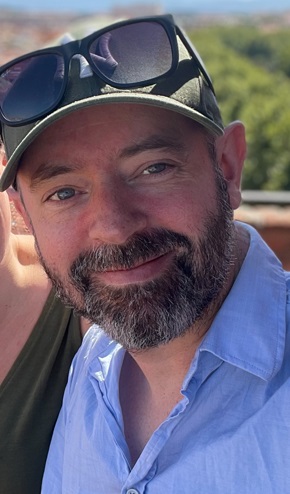
 Darren Cosker
· 6 previous affiliations
- Microsoft (United States)Since 2021
- Principal Scientist Manager - Microsoft Teams · Since 2024
- Principal Scientist Manager - Microsoft Mesh (Mixed Reality and AI) · 2022–2024
- Principal Researcher · 2021–2022
- University of Bath2006–2020
- Full Professor · 2006–2020
- Professor (Full) · 2012–2017
- Royal Academy of Engineering/EPSRC Research Fellow · 2007–2012
- DNEG (United Kingdom)2010–2016
- Royal Society Industry Fellow · 2012–2016
- Research Development Software Engineer · 2010–2011
- University of Surrey2007–2012
- Senior Visiting Research Fellow · 2007–2012
- Cardiff University1998–2006
- Ph.D, Computer Science · 1998–2006
- St Josephs Comprehensive, Port Talbot
Research Overview
Darren Cosker focuses on 3D facial modeling, computer vision, and machine learning. His early work established foundational datasets and methods for dynamic facial animation and non-rigid optical flow. More recently, his research has expanded into unsupervised image translation, multi-task learning, and speech-driven 3D facial synthesis, addressing the challenges of realistic, controllable animation and heterogeneous model integration.
Research Trajectory
Cosker’s early research established tools for analyzing and synthesizing facial expressions. In 2011, he introduced A FACS valid 3D dynamic action unit database with applications to 3D dynamic morphable facial modeling, providing a dynamic 3D Facial Action Coding System (FACS) dataset. To utilize this corpus, he developed a framework for dynamic 3D morphable models, utilizing an Active Appearance Model (AAM) for 3D facial registration and mesh correspondence.
Building on this interest in non-rigid deformation and mesh tracking, his work expanded into broader computer vision challenges. With collaborators, he developed Optical Flow Estimation Using Laplacian Mesh Energy (2013), a non-rigid optical flow algorithm designed for dense image correspondence. By incorporating a Laplacian Mesh Energy term directly into the optical flow optimization, the approach encouraged local smoothness while preserving non-rigid deformations. This contribution intersected with the area of Curvature Adaptive Mesh Refinement and the research direction Local Rigidity Priors for Dynamic 3D Scenes.
By 2018, Cosker's research incorporated advanced machine learning techniques, particularly in generative modeling and multi-task learning. He participated in the development of Unsupervised Attention-guided Image-to-Image Translation, which addressed the tendency of unsupervised translation models to alter backgrounds or disrupt object interactions. By jointly training attention mechanisms with generators and discriminators, the method allowed models to focus on relevant image regions without additional supervision. This work advanced the broader area of Weakly Supervised Part Discovery and Localization and the research direction Localized Adversarial Training for Targeted Image Synthesis. Concurrently, he explored model optimization across diverse domains in Multi-Task Learning by Maximizing Statistical Dependence. This approach allowed for the integration of heterogeneous task estimators—such as combining deep neural networks with Gaussian processes—by treating task-specific estimators as random variables and measuring their statistical dependence. This methodology contributed to the area of Mitigating Negative Transfer through Latent Task Grouping and the research direction Linear Scaling for Multi Task Interaction.
Returning to the domain of facial synthesis, his recent work has tackled the complexities of generating and editing realistic human avatars. In 3DiFACE: Synthesizing and Editing Holistic 3D Facial Animation (2025), he and his co-authors presented a holistic approach to speech-driven 3D facial animation. The method addresses the challenge of editing synthesized animations and accounts for the one-to-many mapping of audio to plausible lip and head movements, enabling diverse and controllable personalized 3D animations.
Current Directions
The most recent work in the evidence investigates the synthesis and control of holistic 3D facial animations. A primary focus is on speech-driven animation systems that allow for precise editing and the generation of realistic, diverse head and lip movements from audio inputs. This involves addressing the inherent ambiguity in audio-to-visual mappings—where a single audio input can correspond to multiple plausible facial motions—and developing frameworks that provide animators with granular control over personalized 3D avatars without requiring extensive manual intervention.
Profile updated
Loading new papers…
Other researchers whose papers cluster into the same research directions — a proxy for overlapping technical interests and shared intellectual neighborhoods.
See something wrong? Report a mistake