

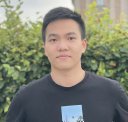
 Daolang Huang
· 6 previous affiliations
- Meta (United States)Since 2026
- Research Scientist Intern · Since 2026
- ELLIS Institute FinlandSince 2023
- Doctoral Researcher · Since 2023
- Doctoral Researcher · Since 2023
- Visiting PhD Student · 2026
- Aalto University2020–2023
- PhD student · 2023
- Research Assistant · 2021–2022
- MS student · 2020–2022
- Jinan University2016–2020
- Undergrad student · 2016–2020
Research Overview
Daolang Huang focuses on amortized inference, simulation-based inference, and Bayesian optimization. His work develops computational methods that accelerate complex probabilistic modeling tasks, particularly in experimental design and decision-making under uncertainty. Recently, he has investigated transformer-based architectures for joint inference and active data acquisition.
Research Trajectory
Huang’s early research explored architectural improvements in deep learning for computer vision tasks. In 2020, he participated in the development of Sequential Convolution and Runge-Kutta Residual Architecture for Image Compressed Sensing. This work addressed challenges in data sampling and image reconstruction quality by applying sequential convolutional modules to compact measurements. This contribution intersected with several methodological areas, including the area of Higher Order Numerical Schemes for Deep Architectures, the broader field of Collapsing Multi-Branch Networks for Efficient Inference, and research concerning Signal Propagation and Stability in Deep Architectures.
By 2022, his focus shifted toward accelerating optimization processes and incorporating human expertise into probabilistic models. He introduced a multi-task learning architecture in Bayesian Optimization Augmented with Actively Elicited Expert Knowledge, which utilized Siamese neural networks to elicit expert knowledge from pairwise queries and transfer it to the optimization task. He expanded on this approach in Augmenting Bayesian Optimization with Preference-based Expert Feedback, demonstrating how preference-based neural networks could significantly accelerate Bayesian optimization by learning from expert feedback.
Concurrently, Huang advanced meta-learning techniques by embedding geometric symmetries directly into model architectures. In Practical Equivariances via Relational Conditional Neural Processes, he proposed replacing absolute coordinates with relational encodings. This adaptation allowed conditional neural processes to achieve translation and rotation equivariance, scaling effectively to high-dimensional tasks where traditional convolutional approaches often struggle.
In 2023 and 2024, Huang’s research increasingly addressed the reliability and applicability of simulation-based inference (SBI) and Bayesian experimental design (BED). Recognizing that simulators rarely replicate real-world data perfectly, he developed a framework in Learning Robust Statistics for Simulation-based Inference under Model Misspecification. This method regularizes summary statistics by penalizing those that the model struggles to simulate, yielding more reliable posterior estimates. In the realm of experimental design, he authored Amortized Decision-Aware Bayesian Experimental Design. This work highlighted that traditional BED often optimizes for parameter estimation rather than downstream utility, proposing an amortized policy network that designs experiments explicitly tailored for subsequent decision-making tasks.
Moving into 2025, Huang explored the integration of transformer architectures and reinforcement learning to further amortize computational costs. With collaborators, he developed PABBO: Preferential Amortized Black-Box Optimization, a framework that pre-computes the complex operations typically handled by Gaussian Processes, resulting in substantial speedups for human-in-the-loop optimization. He also contributed to Cost-aware simulation-based inference, which combined rejection and self-normalized importance sampling to reduce the number of expensive simulations required for parameter estimation. This work advanced the research direction of Overcoming Weight Collapse in High Dimensional Importance Sampling. Further unifying these themes, he introduced ALINE: Joint Amortization for Bayesian Inference and Active Data Acquisition. ALINE leverages a transformer-based engine to simultaneously perform inference and strategic data acquisition, allowing experimental goals to shift dynamically. This contribution aligns with the broader area of Prior-Amortized Bayesian Inference.
In 2026, Huang’s collaborative work continued to push the boundaries of efficiency and real-world applicability in probabilistic modeling. He co-developed Constrained Bayesian Experimental Design via Online Planning, a framework that incorporates multi-step lookahead planning to respect physical and budgetary constraints during sequential experiments. Additionally, he participated in research optimizing transformer models for probabilistic tasks. This included Efficient Autoregressive Inference for Transformer Probabilistic Models, which decoupled static context encoding from sequential target prediction to accelerate joint distribution generation, and In-Context Multi-Objective Optimization, which introduced a pretrained foundation model capable of proposing high-quality designs in a single forward pass without per-task surrogate fitting.
Current Directions
The most recent papers in the evidence indicate a strong focus on scaling probabilistic inference and optimization through large-scale, pretrained architectures. Recent work investigates the use of transformer-based foundation models to perform in-context, multi-objective optimization, effectively bypassing the need for iterative surrogate model fitting. Additionally, there is an ongoing emphasis on making Bayesian experimental design more applicable to real-world scenarios by integrating online planning mechanisms that account for heterogeneous costs and physical constraints. Another active area involves improving the computational and memory efficiency of autoregressive inference in probabilistic transformers, enabling faster generation of joint distributions for complex physical and scientific simulations.
Profile updated
Loading new papers…
Other researchers whose papers cluster into the same research directions — a proxy for overlapping technical interests and shared intellectual neighborhoods.
See something wrong? Report a mistake