

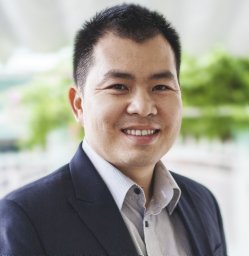
 Danh Le-Phuoc
· 9 previous affiliations
- Technische Universität BerlinSince 2016
- Technical Coordinator of Horizon Europe Project SmartEdge · Since 2023
- Principal Researcher · Since 2016
- Principle Investigator of the DFG Individual Research project COSMO · 2020–2025
- Senior Researcher · Since 2020
- Fraunhofer FIRSTSince 2021
- Researcher · Since 2021
- VinUniversitySince 2025
- Visiting Associate Professor · Since 2025
- HiveIntel GmbHSince 2025
- Co-Founder · Since 2025
- TU WienSince 2025
- Guest Professor · Since 2025
- Principal Researcher · 2013–2016
- PhD student · 2007–2012
- Doctor of Philosophy (PhD), Computer Science · 2007–2012
- Hue College of Science2005–2007
- MSc, Computer Science · 2005–2007
Research Overview
Danh Le-Phuoc focuses on semantic stream reasoning, neural-symbolic integration, and federated learning systems. His trajectory spans the development of evaluation frameworks for linked stream data to the design of hybrid architectures that fuse deep neural networks with probabilistic logic rules. Recently, his work addresses privacy-preserving federated domain generalization and attention mechanisms for multi-horizon time series forecasting.
Research Trajectory
Early work focused on the infrastructure and evaluation of semantic stream processing. In 2012, he introduced a customizable evaluation framework and methodology for testing systems that process linked stream data, such as RDF models extended for sensor and social network streams, in Linked Stream Data Processing Engines: Facts and Figures. This research provided a systematic environment for realistic data generation, system testing, and result analysis in the emerging field of stream data processing.
As deep learning became ubiquitous in sensor data processing, his focus shifted toward bridging the gap between neural networks and symbolic logic. This led to contributions in the research direction of Incremental Reasoning over Sliding Data Streams and the broader area of Reasoning with Weighted Logical Constraints. He developed An Adaptive Semantic Stream Reasoning Framework for Deep Neural Networks, which laid the groundwork for integrating neural models with semantic reasoning. Building on this foundation, he proposed A Scalable Reasoning and Learning Approach for Neural-Symbolic Stream Fusion, which addressed the rigidity of traditional deep neural network pipelines in autonomous systems. By specifying data fusion pipelines through logic rules with learnable probabilistic weights, this approach allowed for more flexible integration of vision sensors like stereo cameras and LiDARs without hard-wiring engineered models to a fixed processing logic.
This line of research culminated in the development of a platform-agnostic federated execution framework, detailed in CQELS 2.0: Towards A Unified Framework for Semantic Stream Fusion. This system incorporated a neural-symbolic stream reasoning component capable of running across diverse hardware architectures, from embedded devices to cloud infrastructures, while enabling adaptive federation across network nodes.
Concurrently, he expanded his research into explainable deep learning architectures for temporal data, contributing to areas such as Scaling Transformers via Information Preserving Sparse Attention and the research direction of Dynamic Weighting of Historical Sequences via Temporal Attention. With collaborators, he investigated long multi-horizon time series forecasting in Put Attention to Temporal Saliency Patterns of Multi-Horizon Time Series, introducing an attention-based approach called Temporal Saliency Detection to automatically encode saliency-related patterns and improve the explainability of transformer-based forecasting models.
Most recently, his trajectory has encompassed privacy-preserving distributed machine learning, specifically addressing domain shift across collaborative clients. In Efficiently Assemble Normalization Layers and Regularization for Federated Domain Generalization, he participated in designing an architectural method to mitigate performance degradation on unseen domains without incurring the high communication costs or data leakage risks typical of federated systems. This work intersects with the research direction of Learning Invariant Representations for Domain Generalization and the broader area of Gradient Inversion and Privacy Leakage in Federated Learning.
Current Directions
The most recent work in the evidence points toward a dual focus on robust federated learning and advanced temporal modeling. A primary current direction involves federated domain generalization, where the objective is to train global models across distributed, privacy-sensitive clients that can maintain high performance when encountering unseen domains. This involves exploring novel architectural assemblies, such as specialized normalization layers and regularization techniques, to balance model robustness with communication efficiency and privacy guarantees. Additionally, ongoing themes in his research include improving the explainability and accuracy of multi-horizon time series forecasting through specialized attention mechanisms designed to capture and encode temporal saliency patterns.
Profile updated
Loading new papers…
Other researchers whose papers cluster into the same research directions — a proxy for overlapping technical interests and shared intellectual neighborhoods.
See something wrong? Report a mistake