

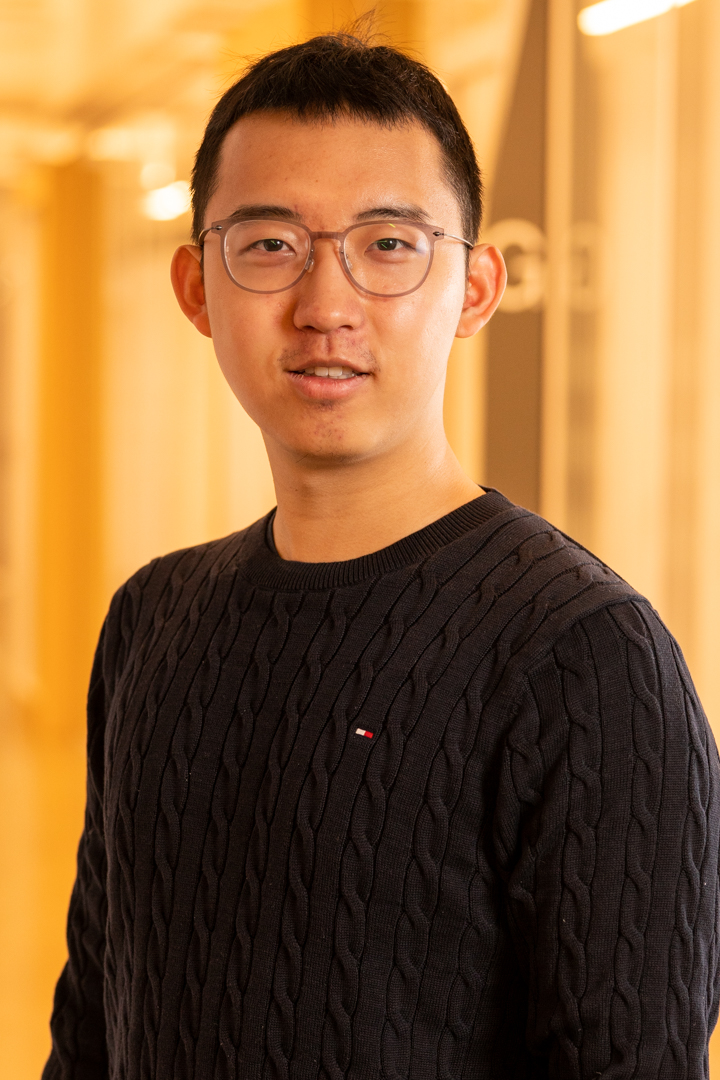
 Chuanrui Wang
4 previous affiliations
- Mayun University2024–2026
- Intern · 2024–2026
- MS student · 2022
- École Centrale de Lille2019–2022
- Engineer's degree, Ingénieur généraliste · 2019–2022
- Beihang University2019–2022
- MS student · 2019–2022
Research Overview
Chuanrui Wang focuses on generative models and scientific discovery, with a particular emphasis on complex structured data such as proteins and single-cell transcriptomics. His trajectory spans from large-scale distributed deep learning systems to knowledge-aware retrieval, before concentrating heavily on computational biology. His most recent work investigates non-Euclidean geometric deep learning and generative frameworks for modeling biological trajectories and cellular perturbations.
Research Trajectory
Early in his career, Wang contributed to the development of large-scale distributed deep learning systems. He was part of the team that built Colossal-AI: A Unified Deep Learning System For Large-Scale Parallel Training in 2021, an open-source framework designed to accelerate the training of massive models with billions of parameters. By integrating multi-dimensional tensor parallelism, sequence parallelism, and heterogeneous memory management, the system significantly improved training efficiency. This work intersected with the research direction of Automated Strategy Search for Distributed Model Training and the broader area of 3D Partitioning for Communication Avoiding Parallel Algorithms. The following year, his focus included natural language processing and information retrieval, leading the development of KnowReQA: A Knowledge-aware Retrieval Question Answering System.
By 2023, Wang's research shifted toward the intersection of generative AI and structural biology. He introduced PDB-Struct: A Comprehensive Benchmark for Structure-based Protein Design, which established a rigorous evaluation framework for protein engineering. By utilizing high-accuracy structure prediction models like AlphaFold2 as a proxy for laboratory experiments, and correlating these predictions with large-scale experimental stability datasets, this work demonstrated that high sequence recovery does not inherently guarantee successful protein folding. This contribution advanced the area of Standardized Benchmarks for Generative Biological Design and touched upon the research direction of Self-Consistency for Generative Protein Design. Concurrently, he collaborated on Protein Sequence and Structure Co-Design with Equivariant Translation, addressing the interdependent nature of amino acid sequences and 3D molecular shapes by modeling them simultaneously rather than treating them as isolated optimization problems.
More recently, Wang has explored advanced geometric and generative methods for complex biological and hierarchical data. With collaborators, he developed GGBall: Graph Generative Model on Poincaré Ball, a framework that replaces traditional Euclidean latent spaces with hyperbolic geometry. By combining a hyperbolic vector-quantized autoencoder with Riemannian flow matching, the model better captures exponentially expanding structures like molecules and social networks. This research contributes to the broader area of Numerical Stability in Non-Euclidean Deep Learning and intersects with work in Hyperbolic Attention Mechanisms for Hierarchical Data.
Expanding his focus to cellular biology, he co-developed PACE: Geometry-Aware Bridge Transport for Single-Cell Trajectory Inference, which utilizes a Riemannian metric to reconstruct continuous developmental trajectories from destructive single-cell snapshots by penalizing motion off the cellular manifold. He also contributed to scDFM: Distributional Flow Matching Model for Robust Single-Cell Perturbation Prediction, a generative framework that predicts population-level cellular responses to drugs and genetic edits. By combining conditional flow matching with a biologically-aware transformer architecture, the model captures full distributional dynamics rather than relying on single-cell averages.
Current Directions
The most recent papers in the evidence address the application of advanced generative modeling and non-Euclidean geometry to complex biological systems. Recent work investigates how hyperbolic spaces and Riemannian manifolds can improve the representation of hierarchical data and continuous biological processes, such as single-cell trajectory inference. Additionally, Wang is exploring distributional modeling techniques, specifically flow matching, to predict how cellular populations respond to genetic and chemical perturbations. This represents a shift toward modeling full population dynamics and complex combinatorial settings in computational biology, moving beyond traditional sequence-to-structure paradigms.
Profile updated
Loading new papers…
Other researchers whose papers cluster into the same research directions — a proxy for overlapping technical interests and shared intellectual neighborhoods.
See something wrong? Report a mistake