

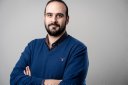
 Christos Chatzichristos
Research Overview
Christos Chatzichristos focuses on multimodal data fusion, tensor decompositions, and robust machine learning for clinical time series. His trajectory spans from developing flexible tensor models for neuroimaging to designing transformer-based architectures capable of handling noisy or incomplete physiological signals. His current work emphasizes foundation models and game-theoretic regularization to improve the reliability of automated diagnostics.
Research Trajectory
The early research of Christos Chatzichristos extensively explored tensor-based analysis to model the inherently multidimensional nature of brain imaging data. In 2017, he investigated flexible representations of functional Magnetic Resonance Imaging (fMRI) data in the temporal domain, introducing PARAFAC2 and its block term decomposition analog for blind fMRI source unmixing. This work relaxed the strict trilinear assumptions typically applied to fMRI, better accommodating the natural variability of the hemodynamic response function across subjects. He expanded on these higher-order methods to handle complex spatial structures in Higher-Order Block Term Decomposition for Spatially Folded fMRI Data.
Recognizing the complementary strengths of different neuroimaging modalities—specifically the high temporal resolution of electroencephalography (EEG) and the high spatial resolution of fMRI—he developed methods to jointly analyze these datasets. He proposed Fusion of EEG and fMRI via Soft Coupled Tensor Decompositions, which avoided the rigid assumptions of hard coupling that force identical responses across modalities. This approach culminated in Early soft and flexible fusion of EEG and fMRI via tensor decompositions, demonstrating how accommodating biological variability through flexible tensor representations leads to more accurate spatiotemporal mapping of brain activity. During this period, he also contributed to methodological improvements in fMRI analysis, such as the Enhanced design matrix for task-related fMRI data analysis. While primarily focused on neuroimaging, his expertise in clinical data modeling also extended to oncology, where he explored A non-conformity approach towards post-prostatectomy metastasis estimation using a multicentre prostate cancer database.
As deep learning architectures became more prevalent in clinical signal processing, his focus shifted toward building robust models capable of handling the noise and missing modalities inherent in real-world healthcare settings. He engaged deeply with the challenge of automated seizure detection, organizing the Epilepsy Detection Grand Challenge in 2023. This interest in epilepsy continued with collaborative work on Detecting Epileptic Seizures Using Hand-Crafted and Automatically Constructed EEG Features and Learning Robust Representations of Tonic-Clonic Seizures With Cyclic Transformer, which leveraged cyclic transformers to improve the reliability of seizure representations.
A major theme of this period was addressing the fragility of multimodal systems when faced with imperfect data. He helped develop CoRe-Sleep: A Multimodal Fusion Framework for Time Series Robust to Imperfect Modalities, a transformer-based architecture for automated sleep staging. By utilizing a coordinated representation approach and multi-task learning, the framework maintained high performance even when sensor data was noisy or missing. This work advanced several critical research areas, including the direction of Learning from Imperfect Real-World Clinical Data and the broader area of Robust Multimodal Learning for Incomplete Clinical Data. It also contributed to methodologies for Self-Supervised Learning via Audio-Visual Temporal Alignment and the related area of Robust Multimodal Learning with Incomplete Clinical Data.
Most recently, his research has advanced the design of foundation models for physiological signals and tackled fundamental optimization challenges in multimodal learning. He contributed to Exploiting a Mixture-of-Layers in an Electrocardiography Foundation Model, which introduced "ECG-Soup." This architecture dynamically fuses representations from multiple internal transformer layers rather than relying solely on the final layer, achieving strong performance in arrhythmia detection. This approach intersects with the research direction of extracting Semantic Embeddings from Intermediate Transformer Layers and the area of Masked Signal Reconstruction for Neural Foundation Models.
To address the phenomenon where one dominant data modality suppresses the learning of others during training, he co-authored Balancing Multimodal Training Through Game-Theoretic Regularization. This paper introduced the Multimodal Competition Regularizer (MCR), combining game-theoretic gradient balancing with mutual information decomposition to improve performance across diverse datasets. Additionally, he has explored generative adversarial networks for signal extraction, participating in the development of Noncontact capacitive coupling ECG-Derived respiratory signals using the conformer based time-frequency domain generative adversarial network.
Current Directions
The most recent papers in the evidence indicate a strong focus on foundation models for physiological signals and the optimization of multimodal learning architectures. Current work investigates how to extract richer semantic representations from intermediate layers of transformers, moving beyond traditional last-layer conventions to build more effective electrocardiography models. Additionally, there is a continued emphasis on resolving modality competition in multimodal training through game-theoretic gradient balancing, ensuring that models learn effectively from diverse, real-world clinical data sources without being dominated by a single modality.
Profile updated
Loading new papers…
Other researchers whose papers cluster into the same research directions — a proxy for overlapping technical interests and shared intellectual neighborhoods.
See something wrong? Report a mistake