

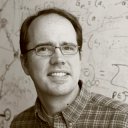
 Christopher Meek
· 2 previous affiliations
- University of WashingtonCurrent
- Affiliate Professor · Current
- Microsoft (United States)1996–2021
- Principal Researcher and Research Manager · 1996–2021
Research Overview
Christopher Meek focuses on probabilistic modeling, semantic representation, and natural language understanding. His trajectory spans early work in Bayesian networks and tensor decomposition to recent advancements in semantic parsing and question answering. Currently, his research investigates the reliability and reasoning capabilities of large language models for code generation and mathematical problem-solving.
Research Trajectory
Christopher Meek's early research established a foundation in probabilistic modeling and search algorithms. In 1995, he co-authored Learning Bayesian Networks with Discrete Variables from Data, which introduced a greedy Bayesian search algorithm and a combined approach for learning Bayesian networks. A decade later, he collaborated on applying probabilistic models to genetics in Using epitomes to model genetic diversity: Rational design of HIV vaccines (2005). This work utilized epitomes—compact representations of probability distributions—to model HIV diversity, contributing to the broader research direction of Bridging the Humoral and Cellular Immunity Assessment Gap.
Transitioning toward natural language processing and semantic representation, he co-developed a Web-relevance similarity measure in Improving Similarity Measures for Short Segments of Text (2007). By leveraging machine learning and relevance-weighted inner products rather than standard TF-IDF, this work advanced the area of Multi-Perspective Similarity Modeling for Robust Representation Learning. Returning to core probabilistic inference, he guided research on Exact inference and learning for cumulative distribution functions on loopy graphs (2010). This paper addressed the challenge of modeling heavy-tailed statistics in domains like climatology and epidemiology using cumulative distribution networks, aligning with broader efforts in the area of Tractable Probabilistic Circuits for Exact Inference.
Between 2013 and 2015, Meek's research heavily emphasized tensor decomposition, semantic parsing, and question answering. He oversaw the development of Multi-Relational Latent Semantic Analysis (2013), which generalized Latent Semantic Analysis by constructing a 3-way tensor to capture multiple relations between words in a latent semantic space. This tensor-based approach was subsequently extended to knowledge bases in Typed Tensor Decomposition of Knowledge Bases for Relation Extraction (2014), where relational domain knowledge about entity types was leveraged to accelerate learning and discover missing relations.
During this same period, he explored semantic similarity for open-domain question answering. In Semantic Parsing for Single-Relation Question Answering (2014), his team utilized convolutional neural networks to measure the similarity between question components and knowledge base entities and relations. To support the evaluation of such systems, he led the creation of WikiQA: A Challenge Dataset for Open-Domain Question Answering (2015), providing a large-scale, naturally constructed dataset that included unanswerable questions to facilitate research on answer triggering. Concurrently, he continued to innovate in probabilistic modeling, introducing an exponential family model capable of capturing hierarchical structure in Recursive Inversion Models for Permutations (2014).
In recent years, Meek's trajectory has shifted toward the capabilities, evaluation, and reliability of large pre-trained language models, particularly in the context of semantic parsing, code generation, and formal reasoning. In 2021, he contributed to Learning Web-based procedures by Reasoning over Explanations and Demonstrations in Context, which applied inverse semantics from program synthesis to learn web tasks from human teachers. He also participated in SCoRe: Pre-Training for Context Representation in Conversational Semantic Parsing (2021), addressing the challenge of representing multi-turn dialog dynamics when converting natural language to formal queries like SQL. Recognizing the evaluation gaps in modern NLP, he co-authored Few-Shot Learning Evaluation in Natural Language Understanding (2021), introducing the CLUES benchmark to standardize few-shot evaluation.
His focus on formal languages continued with Synchromesh: Reliable Code Generation from Pre-trained Language Models (2022). This framework improved the syntactic and semantic reliability of language models for code synthesis using Target Similarity Tuning, advancing research directions such as Reconciling Sub-word Tokenization with Structural Constraints and Enforcing Structural Constraints on Language Model Outputs. Most recently, he explored multi-step formal reasoning in Learning Math Reasoning from Self-Sampled Correct and Partially-Correct Solutions (2023), proposing a training method that leverages self-sampled reasoning paths to reduce bias and improve generalization on grade-school math problems.
Current Directions
The most recent papers in the evidence indicate a strong focus on improving the reliability, reasoning capabilities, and few-shot performance of large pre-trained language models. Recent work investigates how to adapt these models for formal and structured outputs, such as conversational semantic parsing and syntactically valid code generation. A major theme in this current research is mitigating the limitations of standard language modeling objectives when applied to multi-step logic and formal languages. This includes developing frameworks to enforce syntactic constraints during decoding, utilizing inverse semantics to reason over human demonstrations, and employing self-sampling techniques to diversify reasoning paths for complex mathematical problem-solving.
Profile updated
Loading new papers…
Other researchers whose papers cluster into the same research directions — a proxy for overlapping technical interests and shared intellectual neighborhoods.
See something wrong? Report a mistake