

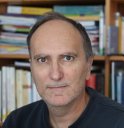
 Christophe Pallier
· 6 previous affiliations
- Senior Researcher (DR1) · Since 1998
- Universitat de Barcelona1994–2007
- Invited researcher · 2006–2007
- Post-doc · 1994–1995
- Invited scholar · 1997
- Rugters university1996
- Post-doc · 1996
- PhD student · 1991–1994
- Research Doctorate, Cognitive Science · 1990–1994
- École Polytechnique1987–1990
- Undergrad student · 1987–1990
Research Overview
Christophe Pallier focuses on the cognitive neuroscience of language, functional neuroimaging methodology, and the computational modeling of speech processing. His trajectory spans from identifying the neural correlates of syntactic parsing and semantic comprehension to developing large-scale, multilingual fMRI datasets. Recently, his work investigates the alignment between biological brain activity and artificial neural networks to decode natural language from non-invasive brain recordings.
Research Trajectory
Pallier's early research addressed methodological challenges in functional neuroimaging while simultaneously investigating the neural basis of reading and language comprehension. In 2012, he contributed to a transfer learning framework for functional MRI (fMRI) that leveraged large databases of full-brain images to automatically define relevant regions of interest. This work, detailed in Improving Accuracy and Power with Transfer Learning Using a Meta-analytic Database, improved the statistical power of studies with small sample sizes and advanced the research direction of Data-Driven Discovery Beyond Predefined Brain Regions of Interest. During the same period, he explored the extraction of visual information from brain activity in Decoding Visual Percepts Induced by Word Reading with fMRI. Building on these neuroimaging foundations, his research subsequently focused on the neural mechanisms of syntactic parsing. In Entropy Reduction correlates with temporal lobe activity (2017), his team demonstrated that activity in specific regions of the temporal lobe increases in tandem with grammatical uncertainty, providing neural evidence for computational models of sentence comprehension.
As the field of cognitive neuroscience increasingly embraced naturalistic stimuli, Pallier's work shifted toward ecologically valid paradigms and multilingual datasets. He participated in the development of the Le Petit Prince multilingual naturalistic fMRI corpus (2023), a resource capturing brain activity from English, Chinese, and French speakers listening to an audiobook. This corpus enabled several targeted investigations into natural language processing. In Localising memory retrieval and syntactic composition: an fMRI study of naturalistic language comprehension, he and his collaborators used computational linguistics to separate the neural signatures of retrieving stored multi-word expressions from the bottom-up parsing required for syntactic composition. Utilizing the same multilingual data, he also contributed to Neural correlates of semantic number: a cross-linguistic investigation, which identified cortical regions involved in distinguishing plural from singular nouns across different languages. To synthesize these methodological and empirical advances, he co-authored Neurocomputational Models of Language Processing, reviewing how rigorously defined computational models can bridge the gap between abstract linguistic features and observable neural signals.
In parallel with his work on naturalistic fMRI, Pallier has extensively investigated the alignment between biological brains and artificial neural networks. In Toward a realistic model of speech processing in the brain with self-supervised learning (2022), he collaborated on evaluating self-supervised algorithms trained on raw waveforms, seeking models that can account for both behavioral and brain responses without relying on biologically implausible amounts of labeled text. This research contributes to the broader area of Aligning Deep Network Layers with Biological Sensory Hierarchies and intersects with work in Recurrent Feedback Mechanisms in Deep Visual Networks. He further explored the predictive power of artificial models in fMRI predictors based on language models of increasing complexity recover brain left lateralization (2024), demonstrating that modern language models can successfully capture the left-hemisphere dominance characteristic of human language processing.
Most recently, Pallier's research has focused on decoding natural language directly from brain recordings. In 2025, he contributed to Optimizing fMRI Data Acquisition for Decoding Natural Speech with Limited Participants, which showed that deep neural networks trained with a contrastive objective can effectively decode unseen speech from fMRI activity, provided sufficient data is collected per individual. Expanding beyond fMRI, he also participated in Towards decoding individual words from non-invasive brain recordings, developing a deep learning pipeline to decode words from EEG and MEG data. This work demonstrated robust performance across participants and devices, significantly advancing the research direction of Decoding Noisy Neural Signals via Latent Generative Priors.
Current Directions
The most recent papers in the evidence indicate a strong focus on neural decoding and the representational alignment between artificial intelligence and the human brain. Recent work investigates how deep learning pipelines can be optimized to decode natural speech and individual words from non-invasive neuroimaging modalities, including fMRI, EEG, and MEG. A central theme in this current research is overcoming the limitations of small participant cohorts by maximizing the yield of individual-level data and employing contrastive learning objectives. Additionally, ongoing efforts continue to explore how increasingly complex language models can serve as accurate predictors of cortical activity, bridging computational linguistics and clinical neurology to build more robust and accessible brain-computer interfaces.
Profile updated
Loading new papers…
Other researchers whose papers cluster into the same research directions — a proxy for overlapping technical interests and shared intellectual neighborhoods.
See something wrong? Report a mistake