

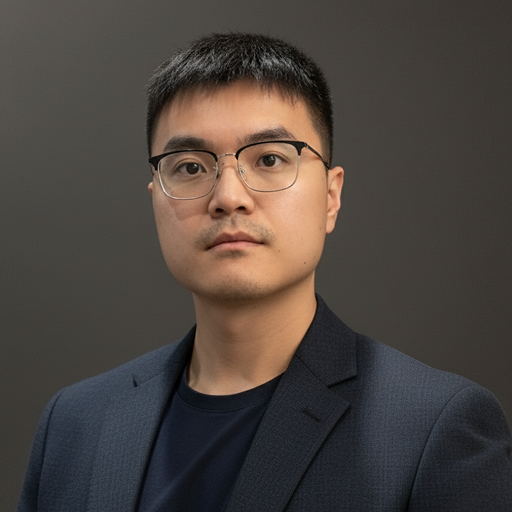
 Ching Chang
· 6 previous affiliations
- PravāhSince 2026
- Staff Machine Learning Research Scientist · Since 2026
- Current
- Visiting Graduate Researcher, Computer Science · 2025–2026
- Doctor of Philosophy - PhD, Computer Science · 2021–2026
- MS student · 2016–2018
- Research Consultant · 2025–2026
- Research Scientist · 2022–2025
- Machine Learning Engineer · 2019–2020
- Discover2025–2026
- Visiting Graduate Researcher · 2025–2026
- GoEdge.ai (優智能股份有限公司)2021–2025
- Research Scientist · 2021–2025
Research Overview
Ching Chang focuses on multivariate time series analysis, causal discovery, and the adaptation of large language models for temporal forecasting. His early work addresses anomaly detection and root cause analysis in complex industrial systems through causal graphs. More recently, his research investigates self-supervised representation learning and multimodal time series reasoning, integrating textual narratives with irregular numerical data to build more interpretable forecasting systems.
Research Trajectory
Ching Chang’s research initially centered on improving reliability and fault diagnosis in complex industrial environments. In 2023, he introduced a framework for Detecting and Ranking Causal Anomalies in End-to-End Complex System, which explicitly accounts for diverse operational states and time-lagged correlations to improve the accuracy of root cause identification. Building on this foundation, he collaborated on Root Cause Analysis in Microservice Using Neural Granger Causal Discovery, addressing the challenges site reliability engineers face when diagnosing system malfunctions. By incorporating the temporal order of time series data rather than relying solely on structural learning, this work advanced the research direction of Localizing System Faults through Causal Discovery and contributed to broader efforts in the area of Scaling Causal Graph Discovery to High Dimensions.
In 2024, Chang’s focus expanded to self-supervised representation learning for high-dimensional temporal data. He developed TimeDRL, a generic framework detailed in TimeDRL: Disentangled Representation Learning for Multivariate Time-Series and further refined in Self-Supervised Learning of Disentangled Representations for Multivariate Time-Series. This approach learns disentangled timestamp-level and instance-level embeddings without relying on traditional data augmentation, thereby mitigating inductive biases such as transformation-invariance and improving downstream forecasting and classification performance.
Concurrently, Chang began exploring the intersection of natural language processing and time series analysis. He participated in the development of Text2Freq: Learning Series Patterns from Text via Frequency Domain, a method that aligns textual narratives to the low-frequency components of time series to incorporate external insights into forecasting models. He also led the design of LLM4TS, presented in Align and Fine-Tune: Enhancing LLMs for Time-Series Forecasting. This framework adapts large language models for temporal forecasting through a two-stage fine-tuning process and multi-scale temporal data aggregation, contributing to the emerging area of Temporal Patching for Time Series Transformers and demonstrating particular efficacy in few-shot learning scenarios.
Continuing this trajectory into 2025, Chang addressed the gap between idealized benchmarks and messy real-world data by introducing Time-IMM: A Dataset and Benchmark for Irregular Multimodal Multivariate Time Series. This work captures distinct types of time series irregularity and enables the asynchronous integration of numerical and textual data. To synthesize the rapid developments in this domain, he also authored A Survey of Reasoning and Agentic Systems in Time Series with Large Language Models, providing a comprehensive taxonomy of time series reasoning systems categorized by their reasoning topology and primary objectives.
Current Directions
The most recent papers in the evidence indicate a strong focus on multimodal integration and the application of large language models as reasoning engines for temporal data. Recent work investigates how to handle irregular, asynchronous time series by fusing numerical trends with textual narratives, moving beyond idealized, uniformly sampled datasets. Furthermore, Chang is exploring the design of agentic systems that leverage large language models not just for numerical prediction, but to understand, explain, and act upon dynamic temporal environments. This involves developing structured reasoning topologies—such as direct, linear chain, and branch-structured approaches—to build more reliable and interpretable artificial intelligence systems for complex, real-world time series applications.
Profile updated
Loading new papers…
Other researchers whose papers cluster into the same research directions — a proxy for overlapping technical interests and shared intellectual neighborhoods.
See something wrong? Report a mistake