

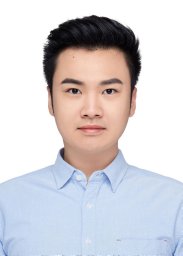
 Chaoyi Zhou
· 6 previous affiliations
- Clemson UniversitySince 2024
- Graduate Research Assistant · Since 2024
- PhD student · 2024
- United Imaging Intelligence (China)Since 2026
- Research Intern · Since 2026
- Research Intern · 2025
- Graduate Research Associate · 2023
- Computer Vision Research Engineer · 2023
- Researcher · 2022–2023
- Student Researcher · 2022
- University of Southern California2021–2022
- Master of Science - MS, Computer Science · 2021–2022
Research Overview
Chaoyi Zhou focuses on computer vision and generative modeling, with a particular emphasis on 3D implicit representations and content generation. His trajectory spans from enhancing 3D Gaussian splatting for unbounded scenes to developing novel differentiable rendering techniques. Currently, his work addresses the intersection of latent space representations and high-fidelity vector graphics optimization.
Research Trajectory
Zhou’s published research initially addressed the challenges of novel view synthesis, particularly the structural artifacts that arise when modeling environments from limited data. In 2024, he and his collaborators investigated the degradation of 3D Gaussian Splatting (3DGS) in sparse input scenarios, which often results in "floater" and "hollow" artifacts. To resolve this, he contributed to the development of 3DGS-Enhancer: Enhancing Unbounded 3D Gaussian Splatting with View-consistent 2D Diffusion Priors. This framework reformulates 3D view consistency as a temporal consistency problem, leveraging 2D video diffusion priors to restore view-consistent latent features. By integrating these features through a spatial-temporal decoder, the method refines the initial 3DGS model and achieves robust rendering performance on challenging, unbounded outdoor scenes. This work advances the broader research direction of Video Diffusion Models as Priors for 3D Consistency.
Moving into 2025, Zhou expanded his focus toward the efficiency and scalability of visual representations. He participated in the design of Fast 2DGS: Efficient Image Representation with Deep Gaussian Prior, a lightweight neural framework that predicts the optimal placement and attributes of 2D Gaussian primitives. By utilizing a deep Gaussian prior, the method achieves high-fidelity image reconstruction rapidly while maintaining a significantly smaller memory footprint and faster fine-tuning time compared to prior neural initialization techniques. This contribution intersects with areas such as Neural Warm-Starting for High-Precision Numerical Optimization and the broader field of Memory Efficient Architectures for Ultra High Resolution Vision.
Building on these foundations in implicit representations, Zhou subsequently introduced a novel framework for performing 3D reconstruction entirely within a compressed latent space. In Latent Radiance Fields with 3D-aware 2D Representations, he developed a method to inject 3D awareness directly into the 2D latent space of a Variational Autoencoder (VAE). By enforcing geometric consistency during the encoding phase and aligning the decoder with rendered features, the approach enables photorealistic novel view synthesis without relying on traditional, computationally heavy image-space rendering. This work represents a significant step forward in the research direction of Volumetric Rendering in Compressed Latent Spaces.
Most recently, Zhou has applied splatting techniques to the domain of scalable graphics. With collaborators, he developed Bézier Splatting for Fast and Differentiable Vector Graphics Rendering, which adapts the efficiency of 2D Gaussian Splatting to vector graphics. By sampling Gaussians along Bézier curves, the method provides natural positional gradients at object boundaries. This enables a differentiable renderer that accelerates image vectorization while maintaining strict compatibility with standard SVG formats. This research contributes to ongoing work in the area of Adaptive Density Control for 3D Gaussian Splatting and the broader area of Differentiable Rendering for Inverse Graphics and Scene Understanding.
Current Directions
The most recent papers in the evidence indicate a sustained focus on optimizing the efficiency, flexibility, and geometric fidelity of neural rendering pipelines. Current work investigates how compressed latent spaces can be leveraged to bypass the computational bottlenecks of traditional image-space 3D reconstruction. By embedding geometric awareness directly into 2D latent representations, this approach seeks to unify high-fidelity view synthesis with the memory efficiency required for scalable deployment in unbounded environments.
Additionally, recent efforts address the optimization of differentiable rasterization, exploring how parameterized geometric primitives—such as Bézier curves and 2D Gaussians—can accelerate inverse graphics tasks. Together, these themes point toward a broader research agenda aimed at creating fast, differentiable, and memory-efficient architectures that bridge the gap between 3D scene understanding and 2D vector graphics generation.
Profile updated
Loading new papers…
Other researchers whose papers cluster into the same research directions — a proxy for overlapping technical interests and shared intellectual neighborhoods.
See something wrong? Report a mistake