

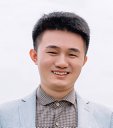
 Chaowei Fang
· 3 previous affiliations
- Xi'an Jiaotong UniversitySince 2026
- Associate Professor · Since 2026
- MS student · 2013–2015
- Undergrad student · 2009–2013
- Xidian UniversityCurrent
- Current
- Associate Professor · 2020–2026
- University of Hong Kong2015–2019
- PhD student · 2015–2019
Research Overview
Chaowei Fang focuses on multimodal information processing, low-level image restoration, and label-efficient machine learning. His early work established robust embedding techniques for image segmentation and advanced facial video hallucination. More recently, his research investigates high-fidelity talking head synthesis, complex watermark removal, and strategies for mitigating semantic drift in continual learning environments.
Research Trajectory
The trajectory begins with foundational work in dense visual tasks and image segmentation. In 2015, he participated in developing Piecewise Flat Embedding for Image Segmentation, a nonlinear embedding technique based on sparse signal recovery. This approach was designed to identify segment boundaries while significantly suppressing variations within segments, utilizing an L1-regularized energy term and a two-stage numerical algorithm based on Bregman iterations. He subsequently expanded this framework in a 2019 journal extension, Piecewise Flat Embedding for Image Segmentation., which introduced L1,p regularization to create representations with sharp boundaries and flat regions, improving performance in both clustering-based and contour-driven segmentation tasks.
Building on these dense visual tasks, his focus expanded to domain-specific super-resolution and image enhancement. To address the lack of temporal alignment in video processing, he proposed the Self-Enhanced Convolutional Network for Facial Video Hallucination in 2020, which leveraged high inter-frame dependency and a temporal window of adjacent low-resolution frames. He later applied advanced architectures to medical imaging, introducing the Cross-Modality High-Frequency Transformer for MR Image Super-Resolution to capture detailed content while managing signal-to-noise ratios through careful exploration of domain priors. During this period, he also revisited top-down modeling in visual recognition, designing a densely nested framework for Densely nested top-down flows for salient object detection.
Concurrently, he investigated label-efficient and robust machine learning methodologies. He collaborated on Trash to Treasure: Harvesting OOD Data with Cross-Modal Matching for Open-Set Semi-Supervised Learning, which introduced a warm-up training mechanism to exploit out-of-distribution samples for enhanced feature learning rather than discarding them. Addressing the practical challenges of imbalanced data, he developed Combating Noisy Labels in Long-Tailed Image Classification, proposing a learning paradigm that matches inferences on weak and strong data augmentations to differentiate noisy samples from clean samples in tail classes.
In 2023, his research addressed both user-guided computer vision and generative modeling. He introduced Variance-insensitive and Target-preserving Mask Refinement for Interactive Image Segmentation, a method designed to reduce sensitivity to initial mask variance and improve segmentation quality with fewer user inputs. In the generative domain, he proposed a two-stage framework for Identity-Preserving Talking Face Generation with Landmark and Appearance Priors, utilizing a Transformer-based landmark generator to infer lip and jaw movements from audio while maintaining the speaker's identity.
His recent work has increasingly focused on complex image restoration and advanced synthesis. He developed a dual-path network for Removing Interference and Recovering Content Imaginatively for Visible Watermark Removal, separating the task into watermark exclusion and background restoration. This work contributes to the broader research direction of Global Context via Frequency Domain Learning. He continued to advance this domain with Bridging Knowledge Gap Between Image Inpainting and Large-Area Visible Watermark Removal, injecting residual background information into pre-trained inpainting models using coarse masks to handle massive, semi-transparent watermarks. His broader perspective on these multimedia challenges was synthesized in the editorial overview Human-centric Multimedia Analysis.
In the realm of audio-driven synthesis, he participated in developing Hierarchically Controlled Deformable 3D Gaussians for Talking Head Synthesis, bridging sparse audio features and dense 3D Gaussian point clouds via 3D Morphable Models and fine-grained facial landmarks. Additionally, he contributed to the area of Prototype Alignment for Evolving Feature Spaces through his collaborative work on Navigating Semantic Drift in Task-Agnostic Class-Incremental Learning, which mitigates catastrophic forgetting by compensating for mean shifts and calibrating covariance. Most recently, he has continued his research in medical image enhancement with the High-frequency structure transformer for magnetic resonance image super-resolution. In 2026, Fang co-developed TriPrompt: Progressive Local Prompting for Few-shot Out-of-Distribution Detection, which introduces a progressive local prompting framework that decomposes patch-level evidence into Core-ID, Far-ID, and OOD cues to mitigate overconfident predictions on challenging out-of-distribution instances. They also contributed to Isolating Interference Factors for Robust Cloth-Changing Person Re-Identification and collaborated on EduMARS: Can Vision-Language Models Grade Like Teachers? Benchmarking Multimodal, Rubric-Based Assessment on Chinese K-12 Answers, evaluating vision-language models on rubric-based assessment tasks.
Current Directions
The most recent papers in the evidence indicate a dual focus on high-fidelity generative synthesis and complex image restoration. In generative modeling, current work investigates audio-driven talking head synthesis, specifically leveraging deformable 3D Gaussians and hierarchical control strategies to map sparse audio features to dense point clouds efficiently. In image restoration, recent efforts address the removal of large-area visible watermarks by bridging the gap between traditional watermark removal and deep image inpainting, utilizing coarse masks to improve robustness to real-world segmentation errors.
Additionally, ongoing research explores task-agnostic class-incremental learning, focusing on methods to calibrate covariance and correct semantic drift in evolving feature spaces. This is complemented by continued refinements in medical imaging, where recent architectures utilize high-frequency structure transformers to improve magnetic resonance image super-resolution.
Profile updated
Loading new papers…
Other researchers whose papers cluster into the same research directions — a proxy for overlapping technical interests and shared intellectual neighborhoods.
See something wrong? Report a mistake