

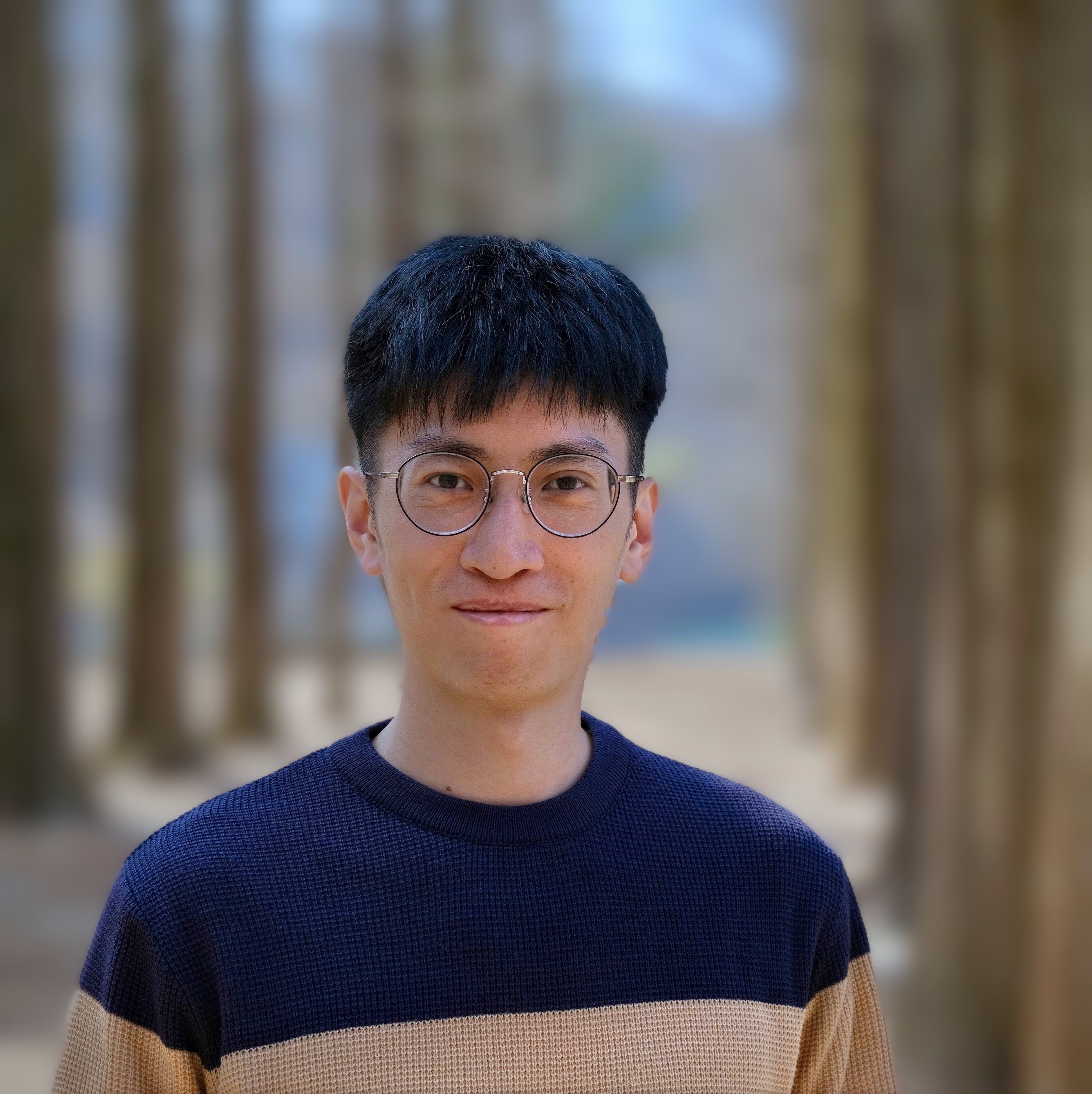
 Chao-Wei Huang
· 3 previous affiliations
- Meta (United States)Current
- Current
- Intern · 2023
- Intern · 2022
- National Taiwan UniversitySince 2014
- PhD student · Since 2020
- MS student · 2018–2020
- Undergrad student · 2014–2018
- Intern · 2020
Research Overview
Chao-Wei Huang focuses on spoken language understanding, conversational AI, and the adaptation of large language models to multimodal inputs. Early research emphasized improving the robustness of natural language processing systems against speech recognition errors using lattice representations. More recently, this work has evolved to address few-shot conversational search and direct speech-to-text translation using decoder-only architectures.
Research Trajectory
Huang’s early research primarily addressed the intersection of automatic speech recognition (ASR) and natural language understanding, focusing on the brittleness of text-based models when confronted with noisy, transcribed speech. In 2019, Huang led the development of Learning ASR-Robust Contextualized Embeddings for Spoken Language Understanding. This work introduced a confusion-aware fine-tuning method that utilized word confusion networks to force pre-trained language models to produce similar representations for acoustically confusable words, thereby mitigating the downstream impact of ASR errors.
Continuing this focus on speech-specific representations, Huang explored the use of recognition lattices—compact structures that encode multiple transcription hypotheses—rather than relying solely on 1-best ASR outputs. This led to Adapting Pretrained Transformer to Lattices for Spoken Language Understanding in 2020, which successfully modified transformer architectures to process lattice inputs directly, improving intent detection and dialogue act recognition.
Between 2020 and 2022, Huang’s work expanded into broader conversational modeling and domain-specific applications of pre-trained language models. As a contributing researcher, Huang participated in community-wide evaluations, including the Ninth Dialog System Technology Challenge (DSTC9), where efforts focused on task-oriented dialogue modeling and unstructured knowledge access. During this period, Huang also contributed to the broader research direction of Cascading Error Propagation in Multi-Turn Interactions and the area of Overcoming Shortcut History Dependency during Conversational Topic Shifts, investigating how conversational agents track state and manage topic shifts over extended interactions. Concurrently, Huang led research applying language models to clinical informatics, detailing why standard fine-tuning regimes struggled with electronic health records in PLM-ICD: Automatic ICD Coding with Pretrained Language Models.
By 2023, Huang’s focus shifted toward conversational search and the data-scarcity challenges inherent in training dense retrievers for dialogue. Leading the project CONVERSER: Few-Shot Conversational Dense Retrieval with Synthetic Data Generation, Huang proposed a framework that leveraged the in-context learning capabilities of large language models (LLMs) to generate synthetic conversational queries from retrieval passages. This approach allowed for the training of conversational dense retrievers using minimal in-domain examples, advancing the theme of Contextual Query Resolution for Conversational Search.
Most recently, Huang has returned to the speech modality, investigating how modern LLMs can be adapted for cross-modal tasks. In 2024, Huang led Investigating Decoder-only Large Language Models for Speech-to-text Translation. This research demonstrated that decoder-only architectures can be trained to directly consume encoded speech representations and generate text translations, bypassing traditional cascaded systems and achieving highly competitive performance using parameter-efficient fine-tuning techniques.
Current Directions
Huang’s most recent work centers on the direct integration of continuous audio representations into decoder-only large language models, optimizing them for complex multimodal tasks like speech-to-text translation. This involves exploring parameter-efficient fine-tuning strategies that allow massive text-based reasoning engines to process speech without relying on intermediate text transcriptions.
Alongside multimodal integration, recent themes in Huang’s research environment suggest an ongoing interest in the reliability and efficiency of LLMs. This includes work in the area of Fact-Grounded Verification via Atomic Claim Decomposition, which seeks to reduce hallucinations in long-form generation, as well as the research direction of The Reasoning Ceiling in Language Model Distillation, focusing on how the complex reasoning processes of large models can be effectively transferred to smaller, more deployable architectures.
Profile updated
Loading new papers…
Other researchers whose papers cluster into the same research directions — a proxy for overlapping technical interests and shared intellectual neighborhoods.
See something wrong? Report a mistake