

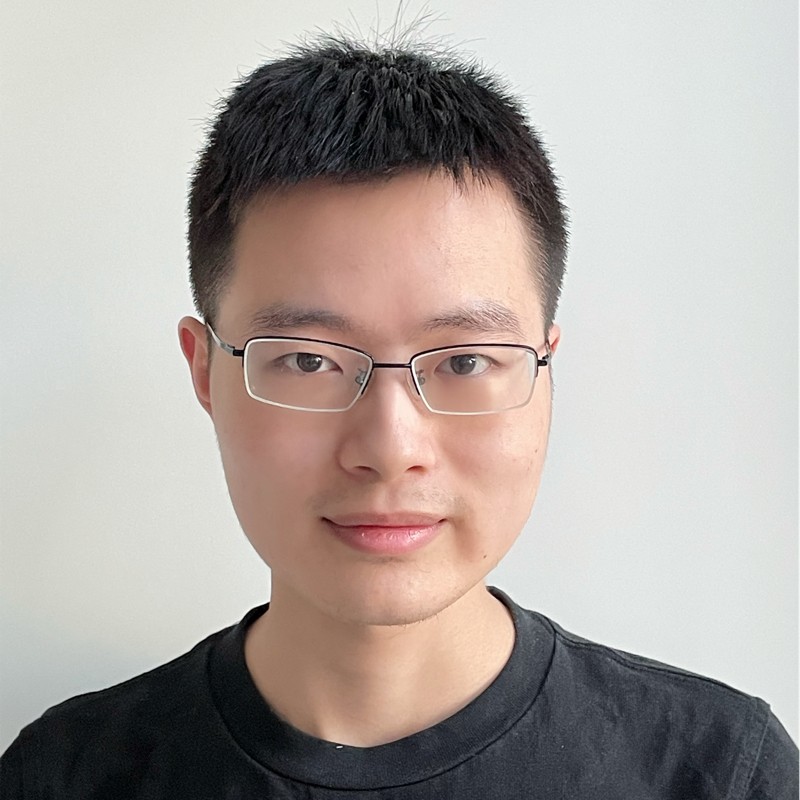
 Changyu Gao
· 2 previous affiliations
- Amazon (United States)Since 2025
- Researcher · Since 2025
- University of Wisconsin–Madison2019–2025
- PhD student · 2019–2025
Research Overview
Changyu Gao focuses on the design and analysis of optimization algorithms for machine learning, particularly in the contexts of differential privacy, robust optimization, and neural-symbolic systems. His trajectory spans from non-convex empirical risk minimization to federated learning and robust stochastic optimization. Most recently, his work addresses the theoretical foundations of neural-symbolic integration and optimal convergence rates for learning under adversarial data corruption.
Research Trajectory
Changyu Gao's research trajectory is anchored in the mathematical foundations of machine learning, with a sustained focus on optimization algorithms that guarantee privacy, robustness, and logical consistency. His early work addressed the challenges of optimizing complex, non-convex objectives under strict privacy constraints. In 2023, he introduced Differentially Private Algorithms for Smooth Nonconvex ERM, developing methods that utilize expected descent directions to find approximate second-order necessary solutions for empirical risk minimization. By integrating line search mechanisms, mini-batching, and a two-phase optimization strategy, this work improved the practical deployment speed of privacy-preserving algorithms, contributing to the broader area of Stochastic Noise Injection for Escaping Saddle Points.
Building on these foundations in privacy-preserving machine learning, Gao expanded his focus to distributed environments. He developed Private Heterogeneous Federated Learning Without a Trusted Server Revisited: Error-Optimal and Communication-Efficient Algorithms for Convex Losses, which established optimal error bounds and improved communication efficiency for federated learning systems operating without a central trusted authority. The resulting algorithms provided rigorous guarantees for convex loss functions, ensuring that decentralized training could remain both communication-efficient and mathematically optimal in its error rates.
Concurrently in 2024, Gao engaged deeply with the intersection of deep learning and symbolic logic, applying his optimization expertise to neural-symbolic (NeSy) systems. Participating in a large collaborative effort, he helped formalize this emerging domain in A Mathematical Framework, a Taxonomy of Modeling Paradigms, and a Suite of Learning Techniques for Neural-Symbolic Systems. This research introduced Neural-Symbolic Energy-Based Models (NeSy-EBMs) as a unifying mathematical framework to bridge probabilistic and non-probabilistic approaches. By establishing a comprehensive taxonomy of modeling paradigms focused on the interface between neural perception and symbolic reasoning, this work advanced the research direction of Formal Foundations for Hybrid Neuro-Symbolic Systems. The framework also provided structural clarity to work in the area of Logical Inference as Energy Minimization and the broader field of Logical Constraints for Neurosymbolic Reasoning.
To address the computational bottlenecks inherent in these hybrid models, Gao and collaborators subsequently developed Convex and Bilevel Optimization for Neural-Symbolic Inference and Learning. By framing parameter learning as an outer optimization loop and symbolic inference as an inner loop, they introduced a dual block coordinate descent algorithm. This approach relied on smoothing the inference objective, which yielded substantial training speedups and accuracy improvements over existing methods. This methodological advance provided practical solutions for the area of Accelerating Symbolic Reasoning with Tensor Operations and helped navigate the research area of Balancing Logical Expressivity and Computational Tractability.
Most recently, his optimization research has expanded to address adversarial data corruption. In 2025, he presented Optimal Rates for Robust Stochastic Convex Optimization, establishing definitive theoretical limits and optimal convergence rates for stochastic convex optimization when a fraction of the training data has been maliciously tampered with. This provided a rigorous mathematical answer to fundamental questions regarding the resilience of convex functions under adversarial conditions.
Current Directions
The most recent papers in the evidence indicate a dual focus on robust optimization and the computational foundations of hybrid AI systems. One primary direction investigates the theoretical limits of machine learning in adversarial settings, specifically determining optimal convergence rates for stochastic convex optimization when training data is subject to malicious corruption. A parallel line of current work addresses the scalability of neural-symbolic integration. By applying advanced optimization techniques—such as bilevel programming and dual block coordinate descent—this research seeks to resolve the computational bottlenecks that arise when combining neural perception with formal logical inference, enabling more efficient and verifiable reasoning systems.
Profile updated
Loading new papers…
Other researchers whose papers cluster into the same research directions — a proxy for overlapping technical interests and shared intellectual neighborhoods.
See something wrong? Report a mistake