

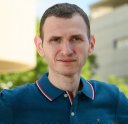
 Chaim Baskin
· 6 previous affiliations
- Ben-Gurion University of the NegevSince 2024
- Assistant Professor (Senior Lecturer) · Since 2024
- INSIGHT LabSince 2024
- Principal Investigator · Since 2024
- DecartSince 2026
- Head of Academic Research · Since 2026
- Visiting Assistant Professor · Since 2026
- Visiting Assistant Professor · 2026–2024
- Postdoc · 2021–2023
- Doctor of Philosophy - PhD, Computer Science Department · 2017–2021
- Master of Science (MSc), Electrical Engineering Department · 2015–2017
- Robert Bosch (Germany)2025–2026
- Scientific Advisor · 2025–2026
- Czech Technical University in Prague2022–2023
- Visiting Scholar · 2022–2023
Research Overview
Chaim Baskin focuses on resource-efficient learning, multimodal foundation models, and the robustness of deep networks. His research trajectory spans from ultra-low precision neural network quantization for edge hardware to analyzing the structural vulnerabilities of graph neural networks. Currently, his work addresses scalable video-language retrieval, adaptive computation, and task-aware model compression.
Research Trajectory
Baskin’s early research heavily emphasized neural network quantization and hardware-efficient deep learning. He introduced NICE: Noise Injection and Clamping Estimation for Neural Network Quantization, a training framework that enables ultra-low precision quantization (3 to 5-bit) by injecting uniform noise to simulate quantization error and learning optimal clamping thresholds. This work addressed the broader challenge of The Performance Cliff in Ultra Low Bit Quantization. Concurrently, he developed hardware-specific implementations, such as a scalable dataflow approach for FPGA platforms in Streaming Architecture for Large-Scale Quantized Neural Networks on an FPGA-Based Dataflow Platform. He expanded on these non-uniform quantization techniques with UNIQ: Uniform Noise Injection for Non-Uniform Quantization of Neural Networks, which emulates a k-quantile quantizer to adapt models for quantized weights and activations while introducing a novel complexity metric based on bit operations.
Moving into the early 2020s, Baskin’s focus broadened to include unsupervised learning representations and adversarial robustness. He explored the area of Improving Unsupervised Learning Through Redundant Cluster Allocation in Self-Supervised Learning for Large-Scale Unsupervised Image Clustering, proposing a benchmark that evaluates self-supervised models by performing K-means clustering on extracted features without labels. In parallel, he investigated network vulnerabilities, contributing to the direction of Mitigating Input Perturbation Sensitivity in Deep Networks. In Colored Noise Injection for Training Adversarially Robust Neural Networks, he demonstrated that injecting correlated, low-rank multivariate Gaussian noise during training significantly improves resilience against adversarial attacks, providing insights into the broader area of Understanding Gradient Masking in Adversarial Defenses. He also addressed memory bandwidth constraints with CAT: Compression-Aware Training for bandwidth reduction, training networks to produce low-entropy feature maps for more efficient inference compression. Additionally, he identified critical structural vulnerabilities in graph-based models, demonstrating in Single-Node Attack for Fooling Graph Neural Networks that an attacker can manipulate a target node's classification by perturbing a single, arbitrary node elsewhere in the graph.
As his trajectory progressed, Baskin and his collaborators developed more sophisticated frameworks for hardware-aware optimization and multimodal learning. In FBM: Fast-Bit Allocation for Mixed-Precision Quantization, his lab introduced a framework that treats bit-allocation as a Markov Decision Process, utilizing direct signals from hardware simulators to balance accuracy and latency. His research also expanded into multimodal architectures, modeling referring video object segmentation as a sequence prediction problem in End-to-End Referring Video Object Segmentation with Multimodal Transformers. Returning to graph neural networks, he investigated theoretical expressivity and the problem of Over-Squashing in Graph Neural Networks through Weisfeiler and Leman Go Infinite: Spectral and Combinatorial Pre-Colorings.
In recent years, Baskin’s work has increasingly focused on the efficiency and evaluation of large-scale foundation models, particularly in vision-language tasks and large language model (LLM) quantization. He addressed the computational costs of vision models in WAVECLIP: Wavelet Tokenization for Adaptive-Resolution CLIP, introducing a coarse-to-fine inference strategy that uses wavelet decomposition to allow early exiting on easier images. To better evaluate multimodal models, his group developed HERBench: A Benchmark for Multi-Evidence Integration in Video Question Answering, which exposes the limitations of current video-LLMs in integrating temporally separated visual cues. He also revisited quantization for modern architectures in You Had One Job: Per-Task Quantization Using LLMs' Hidden Representations, proposing a task-aware framework that protects critical layers based on hidden representations to maintain performance at smaller memory footprints.
His recent contributions to scalable retrieval include VEDJE: Video-Efficient Discriminative Joint Encoder for Scalable Video-Text Retrieval, which shifts heavy visual processing to an offline indexing stage to preserve motion cues in a minimal cache, and Efficient Discriminative Joint Encoders for Large Scale Vision-Language Reranking, which tackles the trade-off between the speed of embedding-based models and the accuracy of joint encoders. Furthermore, he has explored generative modeling in Structured Diffusion Bridges: Inductive Bias for Denoising Diffusion Bridges, injecting geometric inductive biases to reduce the reliance on perfectly paired data for cross-domain translation. Finally, in Revisting Node Affinity Prediction In Temporal Graphs, his team framed temporal graph heuristics as State Space Models to improve node affinity predictions over traditional temporal GNNs.
Current Directions
The most recent papers in the evidence indicate a strong focus on the efficiency, scalability, and rigorous evaluation of large-scale foundation models. Recent work investigates adaptive computation strategies for vision-language models, such as wavelet-based tokenization that enables early exiting during inference to balance speed and accuracy. In the domain of video-language understanding, Baskin and his collaborators are developing lightweight, cache-efficient joint encoders for scalable video-text retrieval, while also constructing new benchmarks to expose the reasoning bottlenecks in current video-LLMs. Additionally, his recent research addresses the compression of large language models through task-aware quantization techniques that selectively preserve precision in critical network layers, alongside ongoing work integrating state space models into temporal graph predictions.
Profile updated
Loading new papers…
Other researchers whose papers cluster into the same research directions — a proxy for overlapping technical interests and shared intellectual neighborhoods.
See something wrong? Report a mistake