

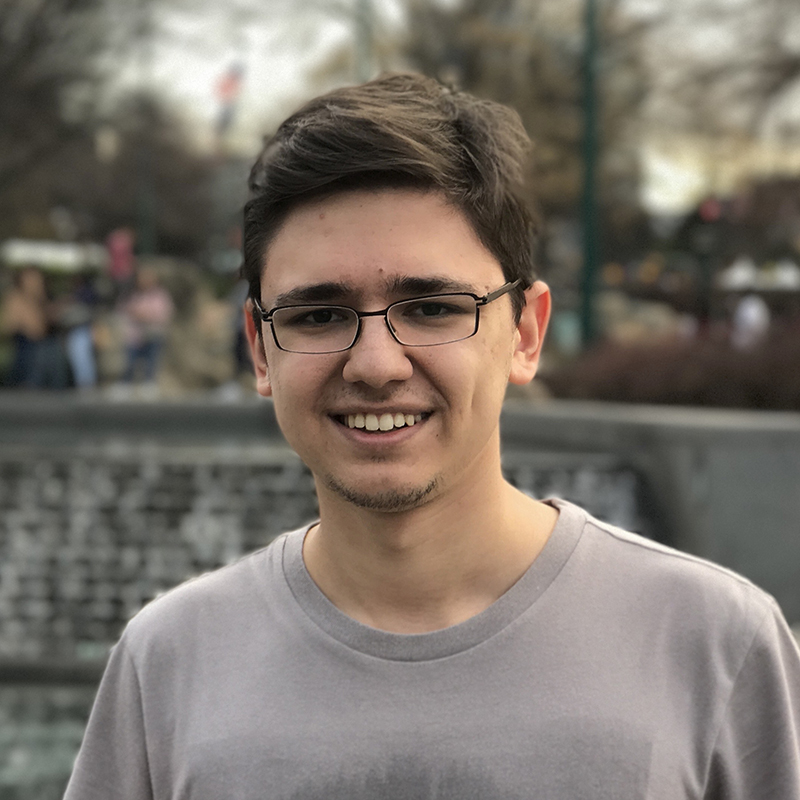
 Cem Gokmen
· 7 previous affiliations
- Google DeepMind (United Kingdom)Since 2026
- Senior Research Scientist · Since 2026
- Stanford University2020–2026
- Graduate Research Assistant · 2021–2026
- PhD student · 2022–2026
- Graduate Teaching Assistant · 2024
- MS student · 2020–2022
- Meta (United States)2025–2026
- Intern · 2025–2026
- Intern · 2023
- Intern · 2022
- Everyday Robots2022
- AI Resident | X, formerly Google [x] · 2022
- Georgia Institute of Technology2016–2018
- Undergrad student · 2016–2018
Research Overview
Cem Gokmen focuses on embodied artificial intelligence, robotic manipulation, and the development of high-fidelity simulation environments. His work spans the creation of large-scale benchmarks for everyday household activities to methods for failure prediction in imitation learning. Recently, he investigates whole-body loco-manipulation and the systematic evaluation of large language models for complex decision-making in robotics.
Research Trajectory
Early research involved distributed systems, participating in the analysis of A Local Stochastic Algorithm for Separation in Heterogeneous Self-Organizing Particle Systems (2019). This work demonstrated how simple computational particles with limited memory could collectively separate or integrate using strictly local stochastic rules.
Transitioning to robotics and embodied AI, he contributed to the research area of Generative Simulation for Scaling AI Agents through the development of iGibson 2.0: Object-Centric Simulation for Robot Learning of Everyday Household Tasks. This environment introduced object states like temperature, wetness, and cleanliness, enabling the simulation of a much broader range of household chores than previous physics-only simulators. Building on this need for realistic task evaluation, he participated in creating BEHAVIOR: Benchmark for Everyday Household Activities in Virtual, Interactive, and Ecological Environments, which formalized 100 everyday activities in simulation.
To ground these simulated tasks in human performance, he led the collection of Eye-BEHAVIOR: An Eye-Tracking Dataset for Everyday Household Activities in Virtual, Interactive, and Ecological Environments, capturing 3D human body and eye movements across interactive VR scenes. This ecosystem was subsequently expanded in BEHAVIOR-1K: A Benchmark for Embodied AI with 1,000 Everyday Activities and Realistic Simulation. This comprehensive benchmark advanced the broader area of Scaling Photorealistic Simulation for Embodied AI and provided a foundation for the research direction of Scaling Robotic Control to Long-Horizon Multi-Stage Tasks by grounding thousands of objects and activities in realistic physics and semantic properties.
Alongside simulation infrastructure, his research addresses the reliability of deployed robot policies. He developed a method for failure prediction in imitation learning, detailed in Asking for Help: Failure Prediction in Behavioral Cloning through Value Approximation. By approximating state values where none are natively available, this approach allows autonomous robots to detect impending failures and request human operator assistance, particularly during complex manipulation tasks.
As large language models became increasingly prevalent in robotics, he contributed to the area of Fine-Grained Diagnostic Evaluation of Autonomous Agents and the related direction of Formal Task Specification Using Temporal Logic through the Embodied Agent Interface: Benchmarking LLMs for Embodied Decision Making. This framework systematically assesses LLM capabilities and planning errors in embodied scenarios. Concurrently, he explored methods to bridge the simulation-to-reality gap, participating in the Automated Creation of Digital Cousins for Robust Policy Learning, which generates virtual assets that share key properties with real objects to improve policy transfer. He also helped develop the BEHAVIOR Vision Suite: Customizable Dataset Generation via Simulation, providing tools to generate highly customized synthetic data for evaluating computer vision models under controlled conditions.
Most recently, his focus has shifted toward complex physical execution, specifically within the research direction of Unified Whole-Body Loco-Manipulation. He contributed to the BEHAVIOR Robot Suite: Streamlining Real-World Whole-Body Manipulation for Everyday Household Activities, a framework integrating bimanual coordination and navigation for mobile manipulation robots. Continuing this trajectory, he participated in the development of MoMaGen: Generating Demonstrations under Soft and Hard Constraints for Multi-Step Bimanual Mobile Manipulation, a system that scales robot training data by transforming single human demonstrations into thousands of diverse, valid synthetic trajectories.
Current Directions
Recent work investigates the challenges of whole-body mobile manipulation in real-world household environments. The most recent papers in the evidence address the integration of bimanual coordination and stable navigation, seeking to streamline visuomotor policy learning for complex hardware. A major theme in this current research is scaling up robot training data by generating diverse, valid synthetic demonstrations from limited human input, ensuring that policies can transfer robustly to physical robots. Additionally, ongoing efforts focus on the systematic, fine-grained evaluation of large language models to better understand their planning capabilities and limitations when deployed as embodied agents.
Profile updated
Loading new papers…
Other researchers whose papers cluster into the same research directions — a proxy for overlapping technical interests and shared intellectual neighborhoods.
See something wrong? Report a mistake