

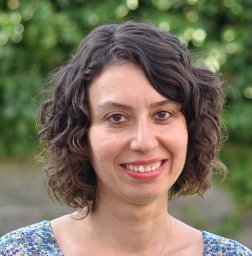
 Burcu Can
· 5 previous affiliations
- University of StirlingSince 2022
- Lecturer · Since 2022
- University of Wolverhampton2020–2022
- Reader in Computational Linguistics · 2020–2022
- Hacettepe University2005–2020
- Assistant Professor · 2015–2020
- Lecturer · 2012–2020
- MSc, Software Engineering · 2005–2007
- Visiting Researcher · 2019
- University of York2007–2014
- Visiting Researcher · 2013–2014
- PhD student · 2007–2011
Research Overview
Burcu Can focuses on natural language processing for morphologically rich and agglutinating languages, with an emphasis on unsupervised morphological segmentation and representation learning. Her trajectory spans from mitigating data sparsity in Turkish part-of-speech tagging to integrating semantic word embeddings into Bayesian and probabilistic models for morphological discovery. Recent work investigates the application of dense vector representations to low-resource morphological analysis.
Research Trajectory
Burcu Can’s early research addressed the fundamental challenges of processing agglutinating languages, where highly inflected word forms create severe data sparsity issues for standard natural language processing pipelines. In 2016, she led work on Turkish PoS Tagging by Reducing Sparsity with Morpheme Tags in Small Datasets, proposing a pipeline that learned inflectional and derivational morpheme tags using conditional random fields (CRFs). By integrating these tags into hidden Markov models (HMMs), the approach effectively alleviated sparsity in emission probabilities, outperforming baseline HMM models on small training datasets. This work contributed to the area of Mitigating Data Sparsity through Morphological Normalization, demonstrating that explicit morphological features are critical for robust tagging in highly inflected languages.
Concurrently, Can began exploring unsupervised methods for morphological analysis, shifting away from purely orthographic approaches toward models grounded in semantic similarity. As a co-author on Unsupervised Morphological Segmentation Using Neural Word Embeddings (2016), she helped develop a baseline segmentation model that utilized a two-level neural network to capture word meanings. By modeling morphotactics with a bigram language model based on maximum likelihood estimates, the research showed that semantic features significantly improve morphological segmentation in agglutinating languages.
Building on this semantic approach, Can served as the senior author on A Trie-structured Bayesian Model for Unsupervised Morphological Segmentation in 2017. This research introduced a Bayesian framework that synthesized multiple sources of prior information. The model leveraged neural word embeddings to identify semantically related words that were morphologically derived from one another, while simultaneously incorporating letter successor variety counts obtained from tries built on those embeddings. This synthesis of structural and semantic priors advanced the research direction of Unsupervised Morphological Segmentation, yielding strong performance on Turkish and other morphologically complex datasets.
As neural network architectures became increasingly central to natural language processing, Can’s focus expanded to the foundational question of how to best tokenize and represent text in languages where the word is not a simple atomic unit. As the principal investigator on Characters or Morphemes: How to Represent Words? (2018), she investigated the comparative advantages of different subword representation strategies, contributing to themes such as Overcoming Vocabulary Sparsity in Morphologically Rich Languages and the broader area of Beyond Linear Segmentation for Non-Concatenative Morphology.
Current Directions
The most recent papers in the evidence indicate a continued focus on refining unsupervised morphological segmentation, particularly for low-resource scenarios where annotated data is unavailable. In 2021, Can co-authored Incorporating word embeddings in unsupervised morphological segmentation, which formalized the integration of dense word vector representations into mathematical models using maximum likelihood estimates (MLE) and maximum a posteriori (MAP) estimates.
This recent work operates on the linguistic principle that morphologically derived words retain semantic relationships that can be captured in continuous vector space. By requiring only a small amount of raw text and pretrained embeddings, these models bypass the need for extensive manual annotation. This direction aligns with the broader area of The Diminishing Utility of Structural Priors at Scale, seeking to build robust, scalable NLP tools for languages that have historically been underserved by standard tokenization and segmentation techniques.
Profile updated
Loading new papers…
Other researchers whose papers cluster into the same research directions — a proxy for overlapping technical interests and shared intellectual neighborhoods.
See something wrong? Report a mistake