

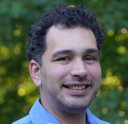
 Bruno Ribeiro
· 4 previous affiliations
- Purdue University West LafayetteSince 2015
- Associate Professor · Since 2023
- Assistant Professor · 2015–2023
- Stanford University2023–2024
- Visiting Associate Professor · 2023–2024
- Carnegie Mellon University2013–2015
- Postdoc · 2013–2015
- University of Massachusetts Amherst2004–2010
- PhD student · 2004–2010
Research Overview
Bruno Ribeiro focuses on graph neural networks, causal discovery, and out-of-distribution generalization in relational data. His trajectory spans early work in network measurement and sampling to foundational contributions in permutation-invariant architectures and graph representation learning. Currently, he investigates zero-shot generalization and causal structure learning to enable robust foundation models for complex, heterogeneous networks.
Research Trajectory
Ribeiro's early research focused on network measurement and the statistical properties of large-scale graphs. He introduced methods for estimating network traffic properties in Fisher information of sampled packets: an application to flow size estimation. Expanding on this foundation, he developed multidimensional random walk techniques, such as Frontier Sampling, to accurately evaluate complex network characteristics in Estimating and sampling graphs with multidimensional random walks. This interest in scalable graph analysis continued with collaborative work on Efficiently Estimating Motif Statistics of Large Networks, which proposed sampling algorithms to discover subgraph patterns in massive relational databases using minimal node queries, contributing to the area of Sublinear Graph Property Testing and Estimation.
By 2018, his focus shifted toward the design and expressivity of graph neural networks (GNNs). He participated in the development of architectures for dynamic heterogeneous networks in Subgraph Pattern Neural Networks for High-Order Graph Evolution Prediction, intersecting with the broader area of Higher Order Topological Deep Learning. Subsequently, his group made foundational contributions to the research direction of Permutation Invariance in Deep Graph Learning and Generation. This included Relational Pooling for Graph Representations., which generalized GNNs beyond the Weisfeiler-Lehman algorithm, and Janossy Pooling: Learning Deep Permutation-Invariant Functions for Variable-Size Inputs, which introduced a tractable stochastic optimization procedure for learning permutation-invariant functions. He further explored the theoretical underpinnings of graph representations in On the Equivalence between Positional Node Embeddings and Structural Graph Representations, advancing the broader area of Stochastic Symmetry Breaking in Graph Neural Networks.
In subsequent years, Ribeiro expanded his work to address out-of-distribution (OOD) generalization and the automated discovery of invariances. He introduced a framework for models to extrapolate from a single training environment by leveraging group theory in Neural Networks for Learning Counterfactual G-Invariances from Single Environments, advancing work in Causal Representation Learning for Out-of-Distribution Generalization. This focus on robustness extended to physical systems in MetaPhysiCa: Improving OOD Robustness in Physics-informed Machine Learning. Concurrently, his lab investigated the capabilities of double-equivariant models for relational data, evaluating their capacity to capture distant information in Long-Range Synthetic Knowledge Graph Benchmarks for Double-Equivariant Models. This line of inquiry led to TRIX: A More Expressive Model for Zero-shot Domain Transfer in Knowledge Graphs, which enabled fully inductive knowledge graph completion across unseen domains. Alongside these architectural advancements, he also addressed model security, developing defenses against data leakage in MIST: Defending Against Membership Inference Attacks Through Membership-Invariant Subspace Training.
Most recently, Ribeiro's trajectory has emphasized zero-shot generalization, causal structure learning, and the development of graph foundation models. He proposed methods for pre-training task-agnostic embeddings in Holographic Node Representations: Pre-training Task-Agnostic Node Embeddings. To overcome the limitations of domain-specific features, his group developed STAGE, an approach that shifts focus to relative statistical dependencies to achieve transferability in Zero-Shot Generalization of GNNs over Distinct Attribute Domains. He also contributed to the area of Causal Discovery in the Presence of Latent Confounders with Differentiable Constraint-Based Causal Discovery, which bridges constraint-based testing and gradient-based optimization using percolation theory. His collaborative work continues to push the boundaries of foundation models and privacy, as seen in Bridging Input Feature Spaces Towards Graph Foundation Models, which projects disparate features into a shared random space, and Membership Inference Attacks Against Fine-tuned Diffusion Language Models, which identifies novel privacy vulnerabilities in emerging generative architectures.
Current Directions
Recent work investigates the theoretical and practical requirements for building true foundation models for relational and graph-structured data. The most recent papers in the evidence address the challenge of zero-shot generalization across entirely distinct attribute domains, utilizing statistical dependencies and randomized feature projections to bypass the need for retraining on new datasets. Additionally, current research explores differentiable approaches to causal discovery, optimizing causal graphs to match data independence patterns even in low-sample regimes. Finally, ongoing collaborative efforts examine the security and privacy implications of modern generative models, particularly focusing on membership inference vulnerabilities in diffusion-based language architectures.
Profile updated
Loading new papers…
Other researchers whose papers cluster into the same research directions — a proxy for overlapping technical interests and shared intellectual neighborhoods.
See something wrong? Report a mistake