

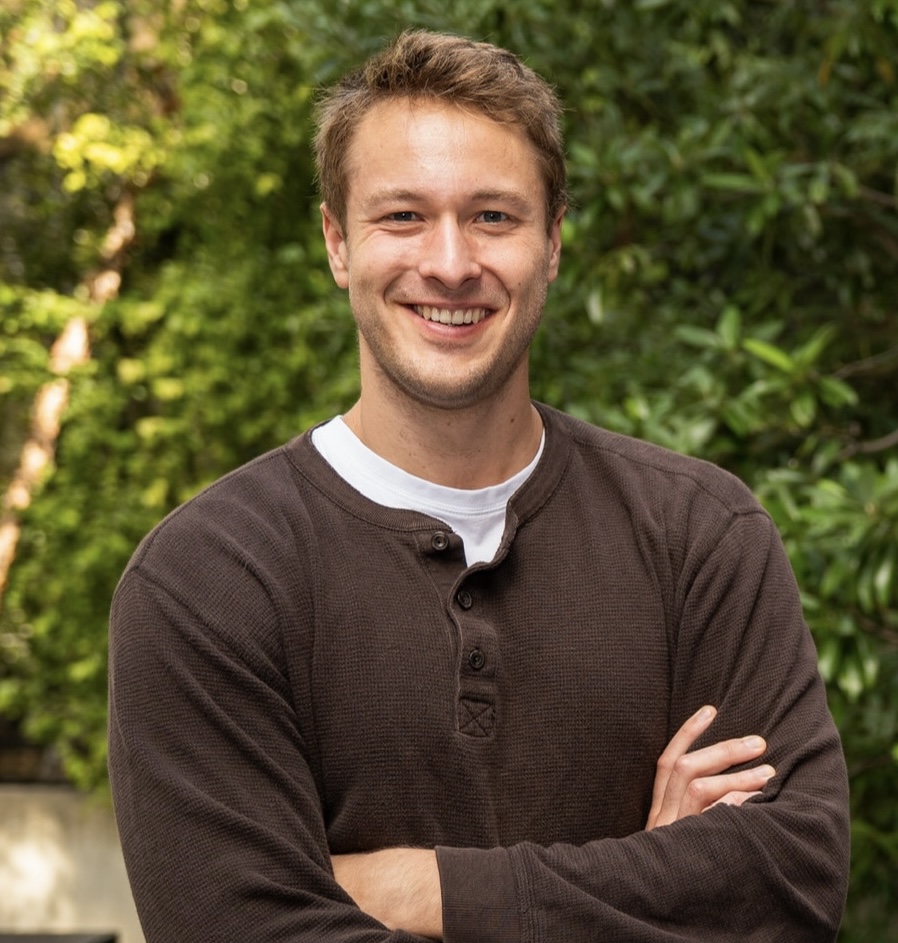
 Bruce D Lee
· 4 previous affiliations
- ETH ZurichSince 2025
- Postdoc · Since 2025
- ETH AI CenterCurrent
- Current
- University of Pennsylvania2020–2025
- PhD student · 2020–2025
- University of Minnesota2016–2020
- Undergrad student · 2016–2020
Research Overview
Bruce D Lee focuses on developing reliable autonomous decision-making agents that interact with the physical world, drawing on tools from robust control, reinforcement learning, and generative modeling. His trajectory spans theoretical guarantees for representation learning in dynamical systems to practical methods for uncertainty-aware robotic control. Most recently, his work investigates out-of-distribution discovery and zero-shot language grounding for robotics.
Research Trajectory
Lee's early work addresses the challenge of deploying learning-based control policies in physical environments. With collaborators, he investigated methods to calibrate uncertainty estimates for pre-trained robotic policies in Uncertainty Aware Deployment of Pre-trained Task Conditioned Imitation Learning Policies (2023). By using these calibrated estimates for uncertainty-aware action selection, this approach improved task completion rates for generalist imitation learning agents.
In 2024, his research expanded into the theoretical foundations of multi-task learning and system dynamics. He contributed to Multi-task imitation learning for linear dynamical systems, which proposed leveraging data from related source tasks to learn a shared, low-dimensional representation of system dynamics. This approach significantly improved sample efficiency when target task data was scarce, advancing the broader research area of Statistical Learning Theory for Dependent Dynamical Systems. Building on these themes, he co-authored Guarantees for Nonlinear Representation Learning: Non-identical Covariates, Dependent Data, Fewer Samples. This work established theoretical guarantees for learning nonlinear representations under challenging data conditions, contributing to several fundamental research directions including Feature Learning Dynamics Beyond the Linear Regime, The Statistical Computational Gap in Learning, and Shared Representations for Sample Efficient Task Adaptation. The paper also addressed challenges in areas such as Task Diversity for Provable Representation Learning and Mitigating Dataset Imbalance in Multi-Task Learning.
Moving toward more complex modalities and generative frameworks, Lee's subsequent research explored natural language interfaces for robotics. In DEMONSTRATE: Zero-shot Language to Robotic Control via Multi-task Demonstration Learning (2025), he and his collaborators introduced a method that bypasses the need for complex, hand-crafted prompts for large language models. Instead, the system learns directly from robot demonstrations using multi-task learning to make zero-shot language-to-robotic control more robust and accessible.
Expanding his focus to generative modeling and scientific discovery, Lee contributed to Active Flow Expansion for Out-of-Distribution Discovery: from Theory to Molecules (2026). This research introduced ACTFLOW, a framework designed to push generative models—such as flow and diffusion models—beyond their training distributions. By shifting the objective from merely matching a known distribution to iteratively expanding the model's "generable set" through verifier feedback, the method successfully mapped out previously inaccessible regions of valid design spaces for discovering new-to-nature molecules and proteins.
Current Directions
The most recent work in the evidence indicates a dual focus on advanced interfaces for robotic control and the application of generative models to out-of-distribution scientific discovery. In the robotics domain, Lee is investigating how multi-task demonstration learning can facilitate zero-shot execution of natural language commands, removing the reliance on rigid, hand-crafted prompting. Concurrently, his research in generative modeling explores active expansion techniques that allow flow and diffusion models to discover novel, valid structures—such as new molecules and proteins—that lie outside their original training distributions. Together, these directions reflect a broader interest in building reliable, adaptable AI systems capable of operating in complex, open-ended physical and scientific environments.
Profile updated
Loading new papers…
Other researchers whose papers cluster into the same research directions — a proxy for overlapping technical interests and shared intellectual neighborhoods.
See something wrong? Report a mistake